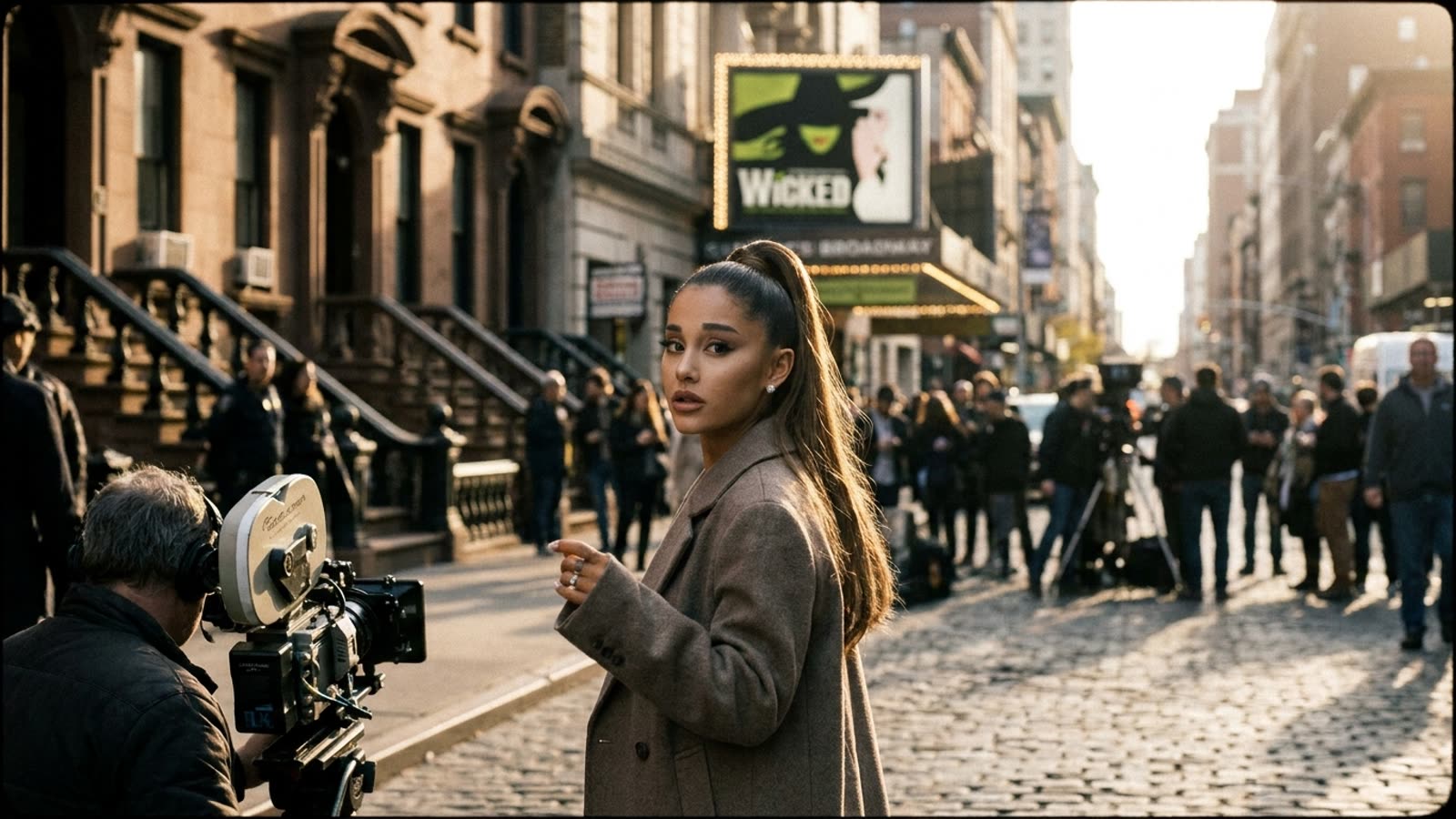
The photographs of Ariana Grande and Ethan Slater emerging from a Manhattan restaurant this week carried none of the furtive energy that defined their early public sightings. They looked, for lack of a more interesting word, comfortable—the kind of couple who argue about whose turn it is to book the dinner reservation rather than one navigating the wreckage of overlapping marriages and a $200 million film production.
This is the new phase of Grande-Slater, and it is aggressively, almost performatively normal.
The long game of reputation management
When news broke in mid-2023 that Grande and Slater had begun a relationship on the London set of Jon M. Chu's Wicked adaptation, the timing could not have been worse. Grande was freshly separated from Dalton Gomez; Slater was still married to his high school sweetheart, with whom he shared an infant son. The internet's reaction was swift and unforgiving, particularly toward Grande, who found herself cast as the villain in a narrative she could not control.
The couple's response was to disappear. They gave no interviews about the relationship, posted no couple content, and let the Wicked promotional machine do the talking. By the time the film dominated the 2025 awards season—Grande earning a Golden Globe nomination, Slater receiving widespread praise for his Boq—the conversation had shifted from their personal lives to their professional accomplishments. It was a masterclass in waiting out the news cycle.
Domestic architecture as PR strategy
Recent reports place the couple in a Tribeca apartment, a neighborhood whose appeal to celebrities lies precisely in its residents' cultivated indifference to fame. Grande, who once documented her life with the granular enthusiasm of a lifestyle influencer, has become notably private. Slater, a relative unknown before Wicked, has avoided the usual traps of sudden celebrity—no podcast appearances dissecting his journey, no men's magazine profiles exploring his fitness routine.
The restraint is strategic. Broadway's ecosystem operates differently from Hollywood's; it rewards craft and longevity over tabloid heat. If Slater intends to build a stage career—and his recent casting discussions suggest he does—the quieter his personal life, the better. Grande, meanwhile, has nothing left to prove in pop music and everything to gain from being taken seriously as an actress. A messy public romance would undermine both ambitions.
Our take
The Grande-Slater relationship is interesting not because of how it started but because of how deliberately it has been managed since. In an era when celebrity couples monetize their partnerships through joint ventures, coordinated Instagram posts, and documentary series about their love stories, these two have chosen opacity. Whether this reflects genuine privacy preferences or calculated image repair is unknowable and, frankly, irrelevant. The result is the same: a couple that has successfully bored the public into acceptance. That is not romantic, but it is effective.