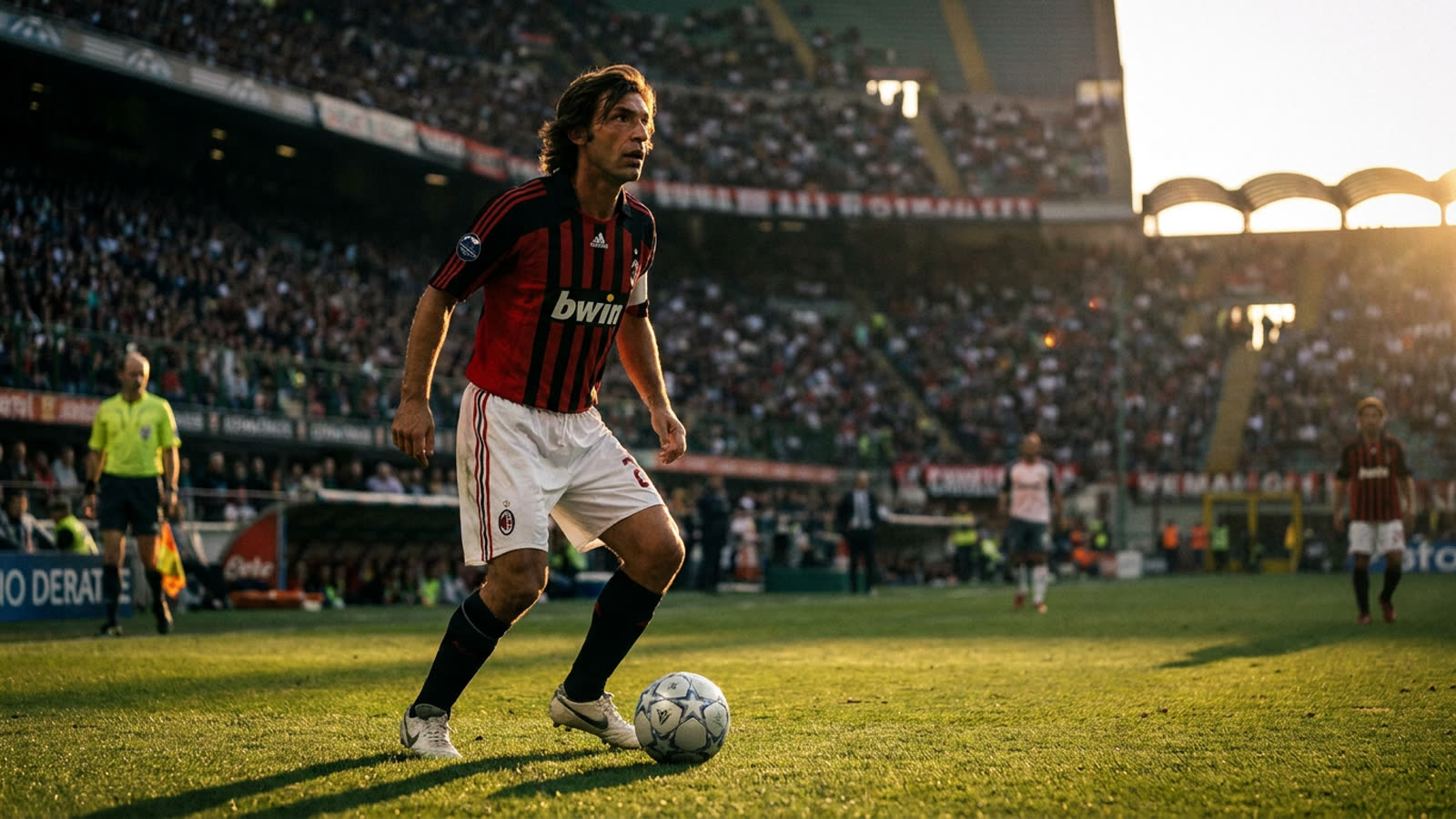
For most of football history, the deep-lying midfielder existed to destroy. He won the ball, moved it forward, and let more creative players do the thinking. Andrea Pirlo inverted this logic entirely. Stationed in front of the back four, he became the most creative player on the pitch precisely because he refused to leave that position.
The regista role wasn't Pirlo's invention — Italians had long valued the deep playmaker — but he perfected it so thoroughly that an entire generation of coaches had to reconsider their pressing systems. You couldn't ignore him, but you couldn't reach him either. He sat in the pocket of space that aggressive midfield pressing necessarily creates, and from there he dismantled defences with forty-yard diagonal passes that seemed to arrive from a different sport entirely.
The paradox of stillness
Pirlo's career statistics reveal something counterintuitive about elite football. He covered less ground per match than almost any other starting midfielder in top European leagues during his peak years. Managers who valued work rate should have discarded him. Instead, AC Milan and Juventus built dynasties around his apparent laziness.
The secret was positional intelligence so refined it bordered on precognition. Pirlo didn't chase the ball because he knew where it would arrive before it was played. His movement off the ball was minimal but devastatingly precise — two steps to create a passing lane, a subtle drift that pulled a marker out of position. Opponents described marking him as maddening: he was always available, never moving, somehow impossible to dispossess.
The free kick as signature
Direct free kicks became Pirlo's calling card, but they also illustrated his broader philosophy. Where other specialists relied on power or dramatic swerve, Pirlo's technique was almost academic. He struck the ball with the inside of his foot, imparting a gentle curve that goalkeepers consistently misjudged. The placement was always the same — inside the near post, just beneath the crossbar — because he had calculated that this was the mathematically optimal location. Goalkeepers knew where it was going and still couldn't stop it.
This approach extended to his entire game. Pirlo didn't beat opponents with athleticism or surprise. He beat them with inevitability. His passes weren't unexpected; they were simply better than any available defensive response.
Our take
Pirlo's legacy isn't just tactical — it's philosophical. He proved that football rewards intelligence over industry when that intelligence is sufficiently developed. The modern game has moved toward pressing intensity and physical dominance, making his style increasingly rare. But every time a deep-lying midfielder receives the ball with his back to goal and casually sprays a sixty-yard pass to an unmarked winger, that's Pirlo's ghost haunting the pitch. He didn't change how the position is played; he revealed what it could be when played by someone who refused to run.