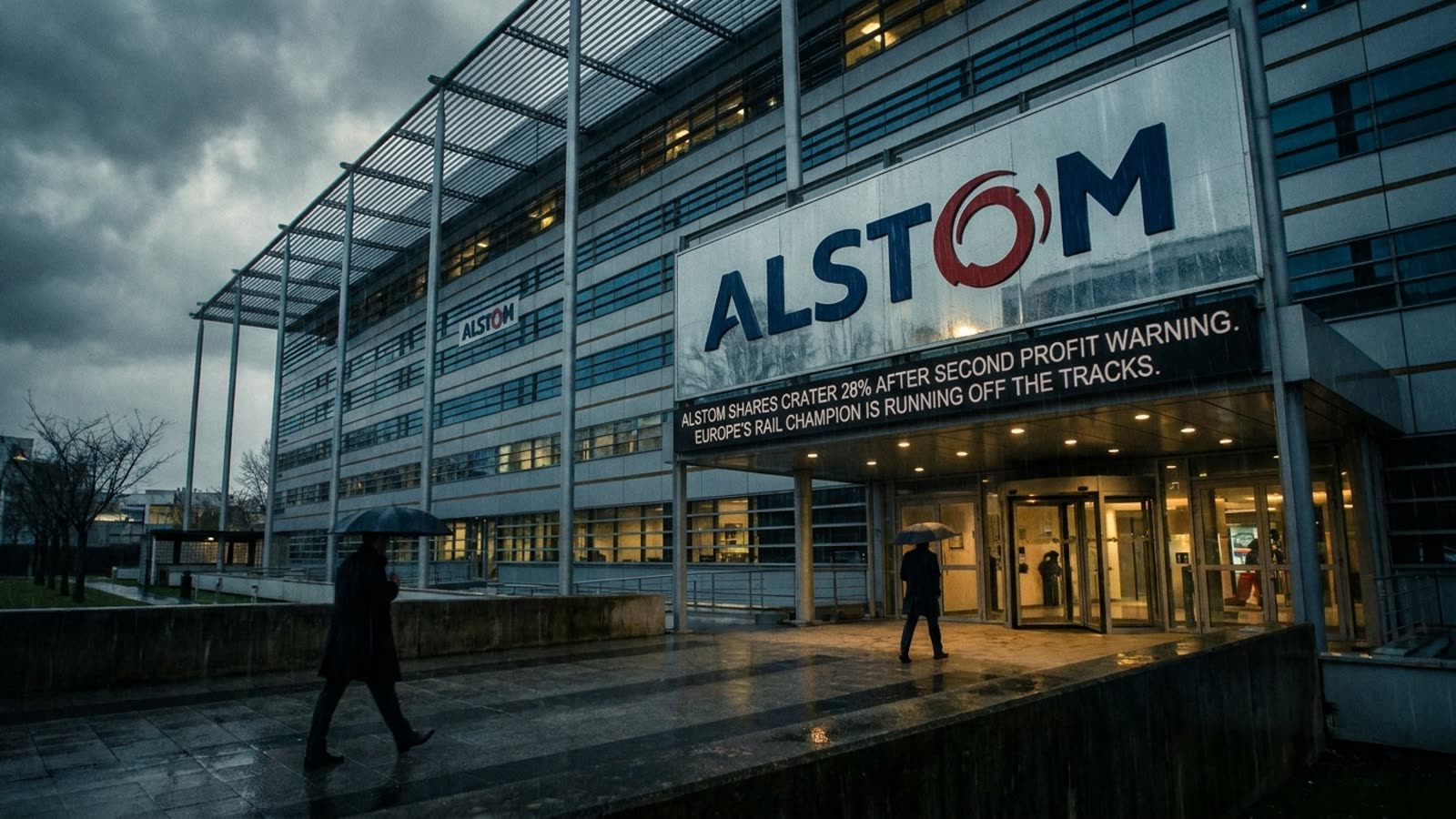
Martin Sion has been Alstom's chief executive for barely a year, and he has already delivered the kind of news that ends careers. On Monday, the French train manufacturer slashed its profit forecast and unveiled a €2 billion debt-reduction plan, sending shares into freefall and raising uncomfortable questions about whether Europe's largest rail equipment maker can survive its own ambitions.
The 28% single-day collapse is not a market overreaction. It is a vote of no confidence in a company that was supposed to be the industrial backbone of Europe's green transport future. Alstom builds the high-speed trains, metros, and signalling systems that policymakers love to cite when they talk about decarbonising mobility. Yet the company's financial engineering has proven considerably less elegant than its engineering engineering.
The Bombardier hangover
Alstom's troubles trace directly to its 2021 acquisition of Bombardier Transportation, a deal that was supposed to create a European champion capable of challenging China's CRRC. Instead, it saddled the company with integration headaches, legacy contracts signed at unfavourable terms, and a balance sheet that now groans under the weight of obligations it cannot easily service. The debt-reduction plan announced Monday—asset sales, working capital improvements, the usual restructuring playbook—reads like an admission that the Bombardier bet was mispriced.
This is the second major profit warning under Sion's watch, which means either the problems are deeper than management understood or the disclosure has been selectively timed. Neither interpretation inspires confidence. Institutional investors who bought the green-rail thesis are now staring at a stock that has lost more than half its value since the Bombardier deal closed.
The subsidy paradox
Here is the peculiar position Alstom occupies: it is simultaneously indispensable and fragile. European governments are pouring billions into rail infrastructure as part of their climate commitments. France alone has earmarked tens of billions for high-speed rail expansion. Germany, Spain, and Italy are all ordering new rolling stock. The demand is there. The problem is that Alstom's contracts often come with fixed prices negotiated before inflation spiked and supply chains seized up. The company is building trains that politicians want at prices that no longer make economic sense.
This is the hidden cost of the green transition's political economy. Governments want to announce splashy rail projects; they are less enthusiastic about renegotiating contracts when input costs rise. Alstom has absorbed margin compression that would have triggered force majeure clauses in less politically sensitive industries.
Our take
Alstom is too strategically important to fail and too financially weak to thrive without either a capital raise or government intervention. The most likely outcome is a slow-motion restructuring that preserves French industrial pride while diluting existing shareholders into irrelevance. Sion's debt plan is a start, but €2 billion barely covers the interest-rate environment's bite on a company this leveraged. If you believe in European rail, you should probably wait for the equity raise before buying the stock. If you believe in European industrial policy, you should ask why the continent's rail champion is trading like a distressed asset.