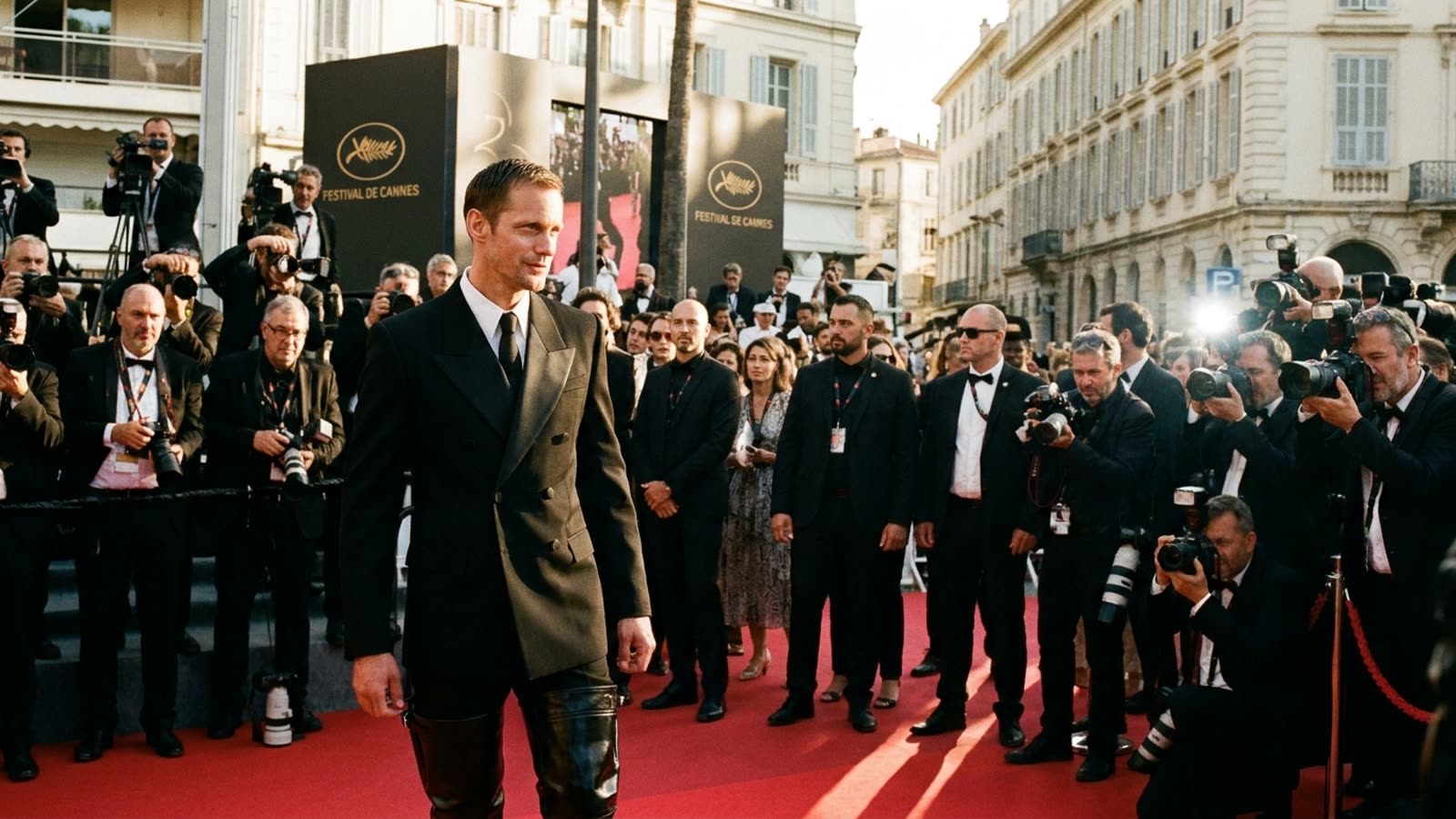
In an awards season already drowning in safe navy suits and borrowed Cartier, Alexander Skarsgård has chosen violence. The 50-year-old Swede has spent the past three weeks promoting Wicker, his new fantasy romance opposite Olivia Colman, in a series of outfits that seem designed to short-circuit fashion commentary entirely: transparent shoes, a floor-length multicolored skirt, and most recently, a grey wig he claims was "inspired by" his co-star. The effect is less red carpet and more performance art—and it's working.
The film itself is a modest thing, a moody period piece about forbidden love in a reimagined 18th-century Scotland, the kind of mid-budget adult drama that typically dies quietly between superhero installments. It has no franchise potential, no IP recognition, no built-in fanbase. What it has, instead, is Skarsgård in clear plastic heels, and that has proven more valuable than any marketing budget.
The economics of chaos
Hollywood's promotional machinery has grown stale. The standard playbook—late-night appearances, coordinated Instagram posts, carefully managed "candid" moments—produces diminishing returns in an attention economy that rewards the unexpected. Skarsgård appears to understand this intuitively. Each outfit generates its own news cycle: the skirt was dissected by fashion critics, the wig spawned memes, the shoes became a minor TikTok phenomenon. None of this costs the studio a cent beyond whatever his stylist is charging.
The strategy has precedent. Timothée Chalamet's backless Haider Ackermann look for Bones and All in 2022 generated more coverage than the film's actual reviews. But Skarsgård has escalated the approach, treating the entire press tour as a single sustained provocation rather than one memorable moment.
Method dressing, or just dressing
Skarsgård himself has been coy about whether the looks constitute some deeper artistic statement. In interviews, he's described the choices as "fun" and "collaborative," crediting his stylist while deflecting questions about meaning. The grey wig, he told Variety, was simply because he "thought Olivia looked wonderful with grey hair" and wanted to "try it out."
This studied casualness is, of course, its own form of performance. The actor has spent two decades cultivating an image of Nordic inscrutability—the kind of man who can play a Viking warlord, a tech billionaire, and Tarzan without ever quite revealing what he actually thinks about anything. The fashion chaos fits neatly into this persona: it's attention-grabbing without being confessional, memorable without being vulnerable.
Our take
What Skarsgård is doing isn't fashion so much as media strategy wearing fashion's clothes. In a landscape where studios spend tens of millions on campaigns that blur into indistinguishable noise, he's discovered that genuine unpredictability—the kind that makes people screenshot and share and argue—is the scarcest commodity of all. Whether Wicker is any good remains to be seen; whether anyone will forget its promotional tour is already answered.