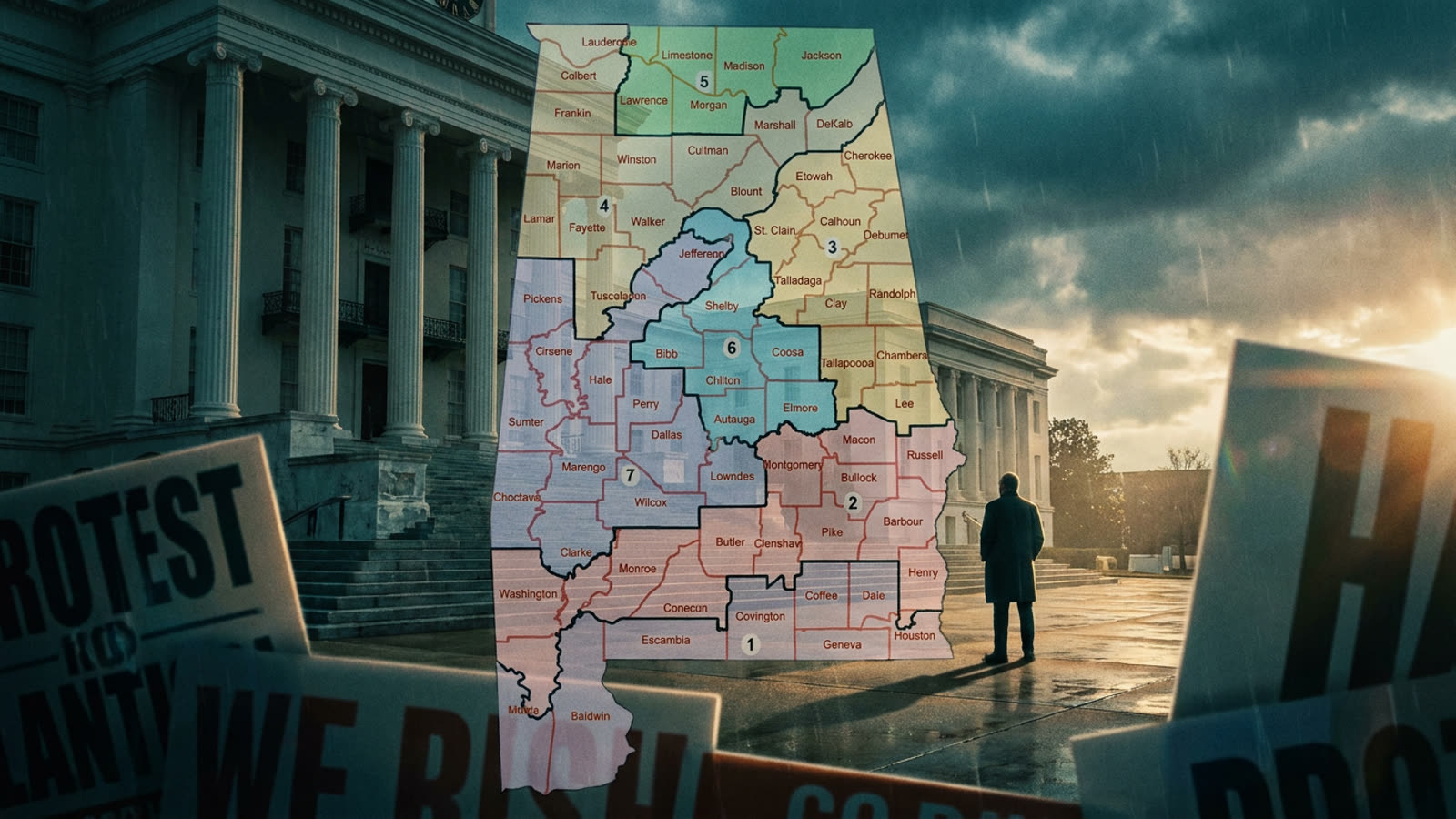
Alabama's Republican legislature has spent the better part of this decade attempting to draw a congressional map that minimizes Black voting power while technically complying with court orders. On Monday, a three-judge federal panel told them, in effect, to stop trying.
The court rejected the state's latest House map, ruling it violated Section 2 of the Voting Rights Act by diluting the votes of Black Alabamians, who comprise roughly 27 percent of the population but have been confined to meaningful influence in just one of seven congressional districts. The decision marks the second time since 2023 that federal judges have invalidated Alabama's redistricting efforts—and the language this time was notably less patient.
The long road from Milligan
The saga traces back to Allen v. Milligan, the 2023 Supreme Court decision that surprised observers by upholding a lower court's finding that Alabama's post-2020 census map likely violated the Voting Rights Act. Chief Justice John Roberts, writing for a 5-4 majority that included Justice Brett Kavanaugh, rejected Alabama's argument that any race-conscious redistricting was constitutionally suspect. The state was ordered to create a second majority-Black district or something "close to it."
Alabama's response was to pass a map that did neither. The new district increased its Black voting-age population from about 30 percent to roughly 40 percent—a figure plaintiffs argued was designed to be just diverse enough to claim compliance while remaining too white to elect a Black-preferred candidate. The court agreed, appointing a special master to draw a remedial map for the 2024 elections.
Now, with the 2026 midterms approaching, the legislature tried again. And failed again.
What the ruling means
The practical effect is that Alabama will likely head into another election cycle with a court-drawn map, unless the state appeals successfully to the Supreme Court—a path that looks increasingly steep given Roberts's apparent unwillingness to gut Section 2 entirely.
More broadly, the decision signals that the judicial guardrails on racial gerrymandering, while weakened over the past decade, have not collapsed. The Voting Rights Act, despite the Supreme Court's 2013 decision in Shelby County v. Holder eliminating its preclearance requirements, retains some teeth when plaintiffs can demonstrate discriminatory effect.
For other Southern states watching closely—Louisiana and Georgia both face ongoing redistricting litigation—the message is that there are limits to how aggressively legislatures can pack and crack minority voters, even with a conservative federal judiciary.
Our take
Alabama's strategy has been less about winning in court than about running out the clock—forcing plaintiffs to relitigate the same questions every cycle while elections proceed under maps that dilute Black political power. That this has worked as well as it has is an indictment of how slowly voting rights cases move. That it has now failed twice suggests the judiciary, or at least this panel, has grown tired of the game. The Voting Rights Act is not dead. It is, however, on life support, and its survival depends on judges willing to enforce what remains of it. Monday's ruling suggests some still are.