For most of the past century, weather forecasting has been an exercise in brute-force physics. Divide the atmosphere into millions of grid cells, apply the equations of fluid dynamics, and let supercomputers churn through the math. The approach works remarkably well, but it has a ceiling: the atmosphere is chaotic, the equations are imperfect, and beyond about ten days, forecasts dissolve into noise.
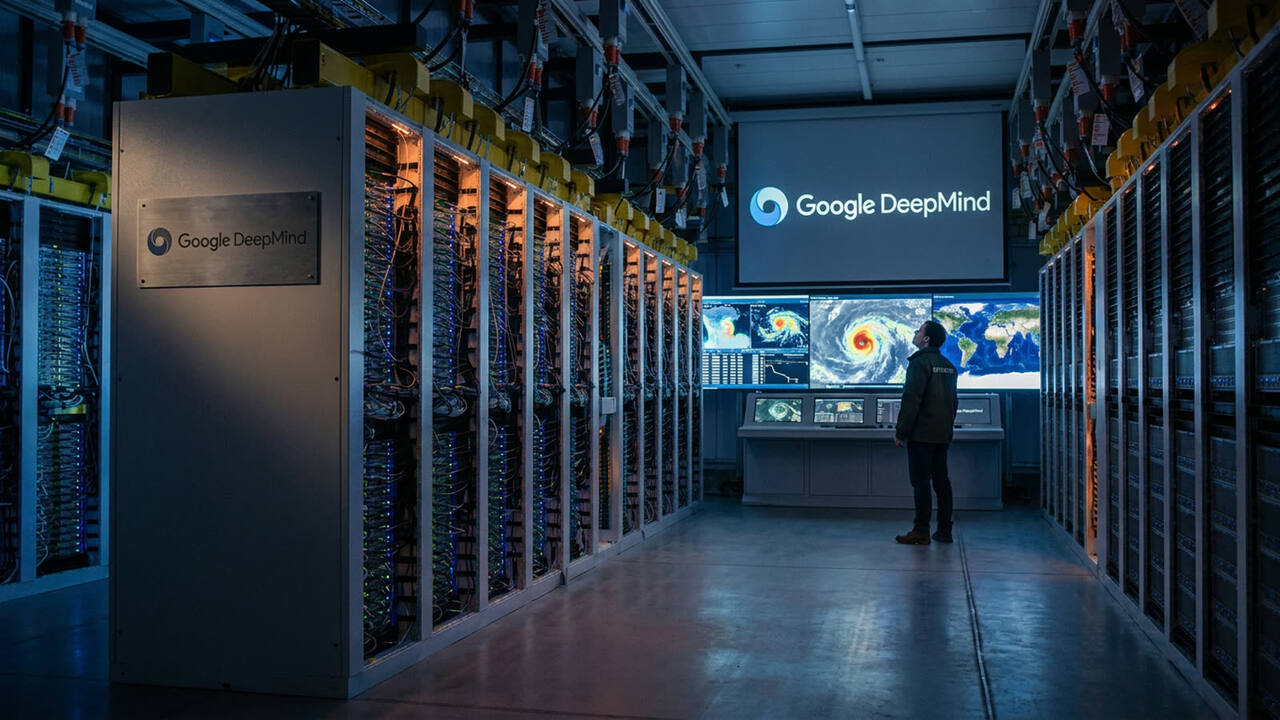
Then, quietly, something changed. In 2022, researchers at DeepMind published a paper showing that a machine learning model called GraphCast could match or exceed the European Centre for Medium-Range Weather Forecasts' gold-standard system — the ECMWF's IFS — on most metrics. The AI wasn't solving physics equations. It had learned to recognize patterns in decades of historical weather data and extrapolate forward. What took the IFS hours on a supercomputer, GraphCast accomplished in under a minute on a single machine.
The pattern-recognition pivot
Traditional numerical weather prediction is expensive. Running the IFS costs millions annually in computing power, and the models require armies of physicists to maintain and improve. Machine learning models, once trained, are cheap to run and surprisingly portable. Huawei's Pangu-Weather, Google's NeuralGCM, and NVIDIA's FourCastNet have all demonstrated competitive performance with a fraction of the operational overhead.
The implications extend beyond efficiency. AI models excel at precisely the task forecasters care most about: predicting extreme events. Hurricane track forecasts, which determine evacuation decisions affecting millions, have shown particular improvement. The models seem to capture subtle atmospheric signatures that physics-based systems miss — or at least miss at the resolution they can afford to compute.
What the machines still cannot do
The revolution has limits. AI weather models are trained on historical data, which means they struggle with unprecedented events — the kind climate change is making more common. They also lack the interpretability of physics-based systems. When a traditional model produces a bad forecast, meteorologists can diagnose why. When GraphCast errs, the reasoning is locked inside billions of parameters.
There's a deeper epistemological problem. Physics-based models encode our understanding of how the atmosphere works. AI models encode correlations in past data. The former can, in principle, handle novel situations; the latter cannot. Most operational forecasters now advocate for hybrid approaches: let AI handle the pattern-matching it excels at, but keep physics in the loop for edge cases and long-range projections.
The profession adapts
Meteorology is not being automated so much as reorganized. The grunt work of running numerical models is increasingly handled by AI, freeing human forecasters to focus on interpretation, communication, and the judgment calls that algorithms cannot make. A hurricane track forecast is only useful if people understand it and act on it. That translation remains stubbornly human work.
The field offers a template for how AI might reshape other professions: not wholesale replacement, but a redistribution of cognitive labor. The tasks that seemed most impressive — the raw computational power of numerical weather prediction — turn out to be the easiest to automate. The tasks that seemed routine — explaining uncertainty to a nervous public — turn out to be the hardest.
Our take
Weather forecasting is AI's sleeper success story. While the technology press obsesses over chatbots and image generators, machine learning has quietly achieved something more consequential: making the future more legible. The models are imperfect, the physics still matters, and the humans remain essential. But the next time a hurricane forecast saves lives, there's a reasonable chance an algorithm deserves part of the credit. That's not hype. That's just weather.