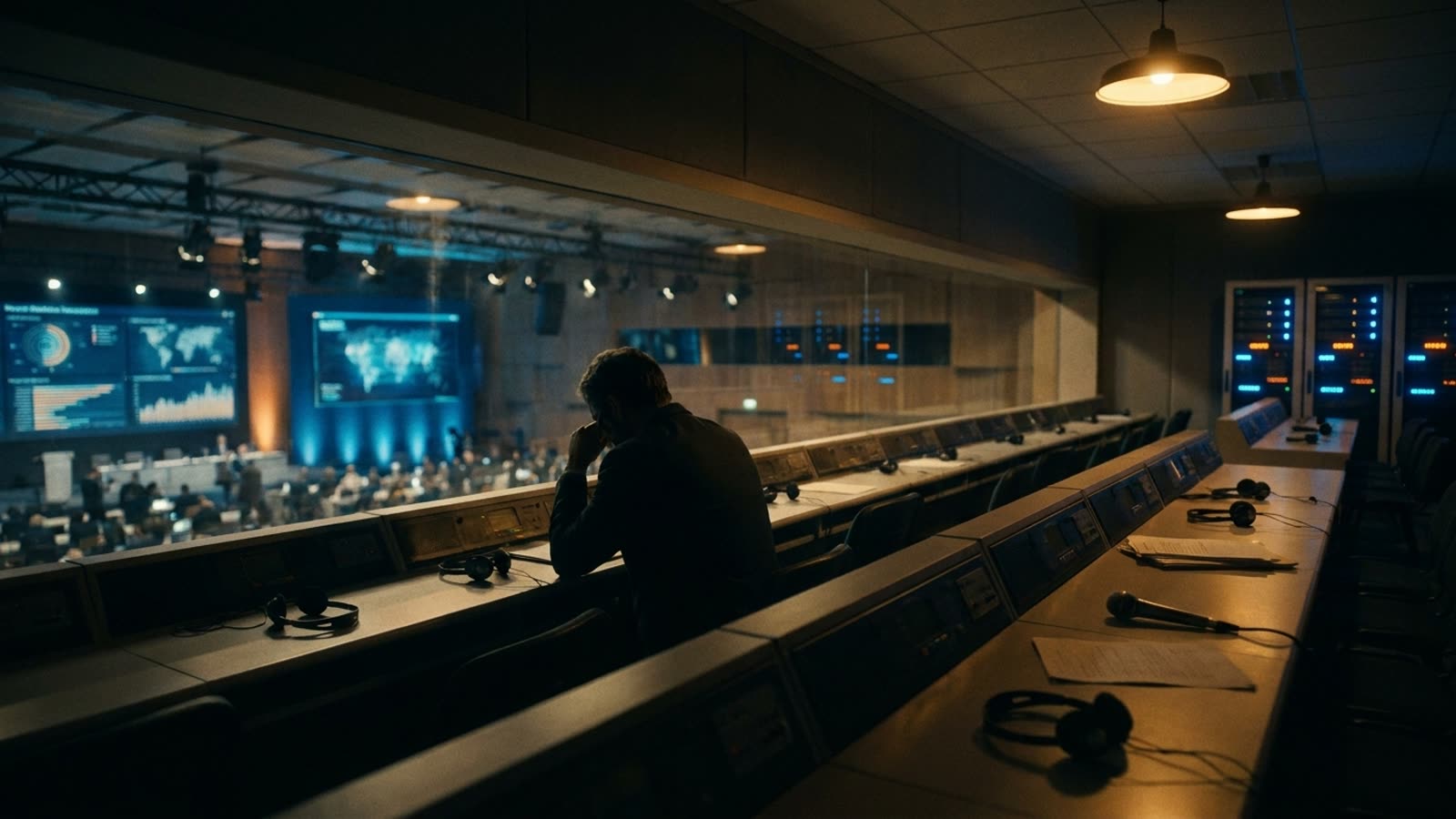
For decades, the simultaneous interpreter occupied a peculiar professional niche: invisible yet indispensable, sitting in soundproof booths at the United Nations or whispering into the ears of heads of state, converting thought between languages in real time. It was work that combined the stamina of an air-traffic controller with the linguistic dexterity of a poet. Neural machine translation hasn't eliminated these professionals. It has done something more insidious — it has compressed the market for their services while expanding the universe of people who believe they no longer need them.
The compression effect
The economics are straightforward. A conference that once required a six-person interpretation team now books three, supplementing with AI-generated captions and post-event machine translation of proceedings. Corporate clients who previously hired interpreters for routine international calls now route them through real-time translation APIs. The work that remains tends toward the high-stakes and high-complexity: diplomatic negotiations where a mistranslated nuance could spark an incident, medical consultations where liability demands human judgment, legal depositions where the record must withstand cross-examination.
This bifurcation has created two distinct interpreter economies. At the premium end, rates have actually increased — clients who specifically want human interpreters are typically those who understand exactly why they need them and will pay accordingly. But the volume of such work has shrunk. The middle market, where competent professionals once built sustainable careers handling business meetings and technical conferences, has largely evaporated into the cloud.
What machines still cannot do
The limitations of neural translation reveal themselves most clearly in contexts that require what linguists call pragmatic competence: understanding not just what words mean but what speakers intend. When a Japanese executive says something is "difficult," an experienced interpreter knows this often means "impossible, and I'm being polite." When a witness in a deposition pauses mid-sentence, a human interpreter can distinguish between searching for a word and reconsidering testimony. Machine translation renders the words; it cannot render the silence.
There is also the matter of cultural mediation. Interpreters at their best function as bridges between conceptual frameworks, not merely lexical ones. They know when a direct translation would be technically accurate but culturally incomprehensible, and they navigate these gaps in real time. Current AI systems, trained on parallel corpora of already-translated text, inherit the biases and conventions of their training data without understanding why those conventions exist.
The adaptation already underway
Smart interpreters have responded by repositioning themselves as quality controllers and editors of machine output, a role that requires all their expertise but commands lower fees. Others have moved into training — teaching AI systems the domain-specific vocabulary of medicine, law, or finance. Some have become consultants, advising organizations on when machine translation is adequate and when human interpretation remains essential.
The professional associations have been slower to adapt, still largely organized around credentialing systems designed for a world where the primary competition was other humans. The conversation about standards for human-AI hybrid interpretation workflows has barely begun.
Our take
The interpreter's predicament is a preview of what awaits many knowledge workers: not sudden obsolescence but gradual compression into a smaller, more specialized, and more precarious market. The work that remains may be more interesting and better compensated per hour, but there will be fewer hours of it. The professionals who thrive will be those who understand that their value lies not in performing a task that machines cannot do at all, but in performing it with a judgment and contextual awareness that machines cannot yet replicate — and who can articulate that distinction to clients increasingly inclined to believe that "good enough" translation is good enough.