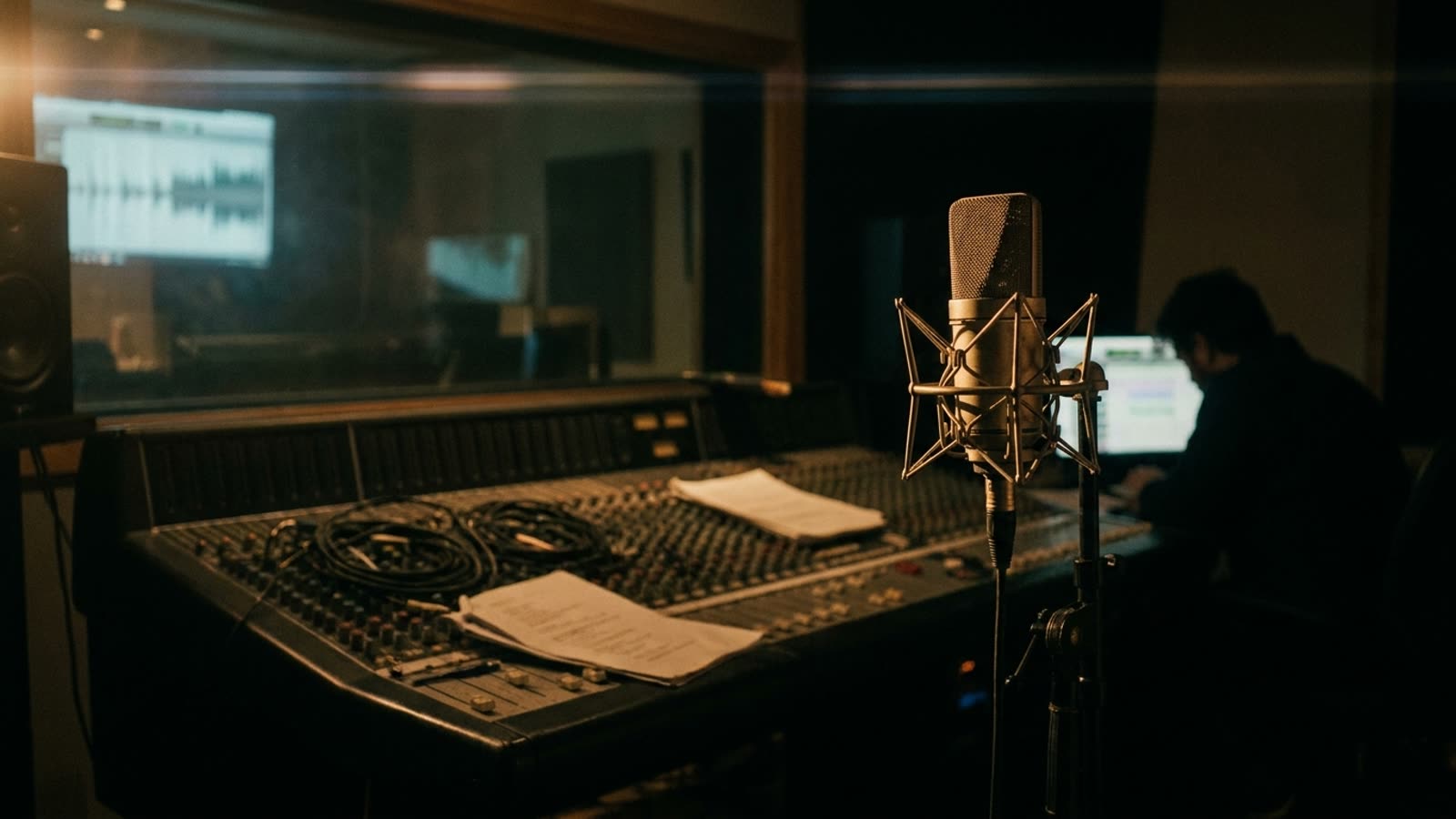
The voice acting profession has always been invisible by design. Unlike screen actors, whose faces become brands, voice performers exist as pure sound — the warm narrator of a pharmaceutical ad, the urgent announcer of a movie trailer, the friendly guide in a corporate training module. This invisibility made them uniquely vulnerable to a technology that excels at capturing and reproducing sonic patterns.
The shift began not with dramatic announcements but with quiet contract clauses. Recording sessions that once required a performer to return for revisions started including language granting studios perpetual rights to manipulate, extend, and synthesize the recorded voice. What began as efficiency — fixing a mispronunciation without rebooking a session — evolved into something more fundamental: the creation of voice models that could generate new performances without the performer present.
The economics of synthetic speech
The financial logic is straightforward and, from a studio perspective, compelling. A human voice actor for commercial work commands anywhere from a few hundred to several thousand dollars per project, with additional fees for usage, revisions, and exclusivity. A synthetic voice, once licensed or created, costs a fraction of that per generation and never needs rest, travel, or residuals.
This has bifurcated the market. Premium work — animated features, prestige video games, audiobooks by celebrity narrators — still demands human performance, where the subtle emotional textures and improvisational choices justify the expense. But the vast middle tier of voice work, the corporate explainers and app interfaces and e-learning modules that constitute the industry's bread and butter, has become contested territory.
Voice actors who built sustainable careers on this middle-tier work describe a familiar pattern: the jobs didn't disappear overnight. They simply stopped calling back. The same clients who once booked quarterly sessions now license synthetic voices or, increasingly, use AI tools to clone the voices of performers who recorded for them years ago under contracts that never anticipated such use.
The consent problem
The legal and ethical landscape remains genuinely unsettled. Some jurisdictions have begun extending personality rights to voice, recognizing that a person's vocal identity carries the same commercial value as their likeness. But enforcement lags far behind capability. A voice model trained on a performer's recordings can be deployed globally in minutes; litigation takes years.
Unions have responded with varying degrees of success. Recent labor actions in the entertainment industry have secured provisions requiring consent for AI voice replication, but these protections cover only unionized work in specific sectors. The vast non-union market, where most voice actors actually earn their living, remains largely unregulated.
Some performers have attempted to turn the technology to their advantage, licensing their voice models directly and collecting royalties on synthetic generations. This works for the established names whose voices carry brand recognition. For the working majority, it simply accelerates the commodification of their labor — why pay a premium for a licensed model when an unlicensed approximation costs nothing?
What machines still cannot do
The technology's limitations are real but narrowing. Current synthetic voices excel at consistency and clarity but struggle with what performers call "the read" — the interpretive choices that transform text into communication. The pause that signals doubt. The warmth that implies trustworthiness. The micro-variations that make a thirty-second spot feel like a conversation rather than a recitation.
These qualities matter less in some applications than others. A GPS navigation voice benefits from consistency; emotional range would be distracting. An audiobook narrator, by contrast, must inhabit dozens of characters across hundreds of pages. The technology is advancing toward this more demanding work, but it hasn't arrived.
What has arrived is a generation of voice actors who must now decide whether to compete with their own synthetic ghosts, pivot to work that still requires human presence, or leave the profession entirely. Many have chosen the latter, not because the work disappeared completely but because the uncertainty became untenable.
Our take
The voice acting profession offers a preview of a broader transformation. The question was never whether AI would replace human workers wholesale — that framing misses the point. The question is whether it would degrade the economic conditions under which human work remains viable. In voice acting, the answer is becoming clear: the microphone is still there, the scripts still need reading, but the sustainable middle-class career built on that work is eroding. The technology didn't eliminate the profession; it hollowed it out.