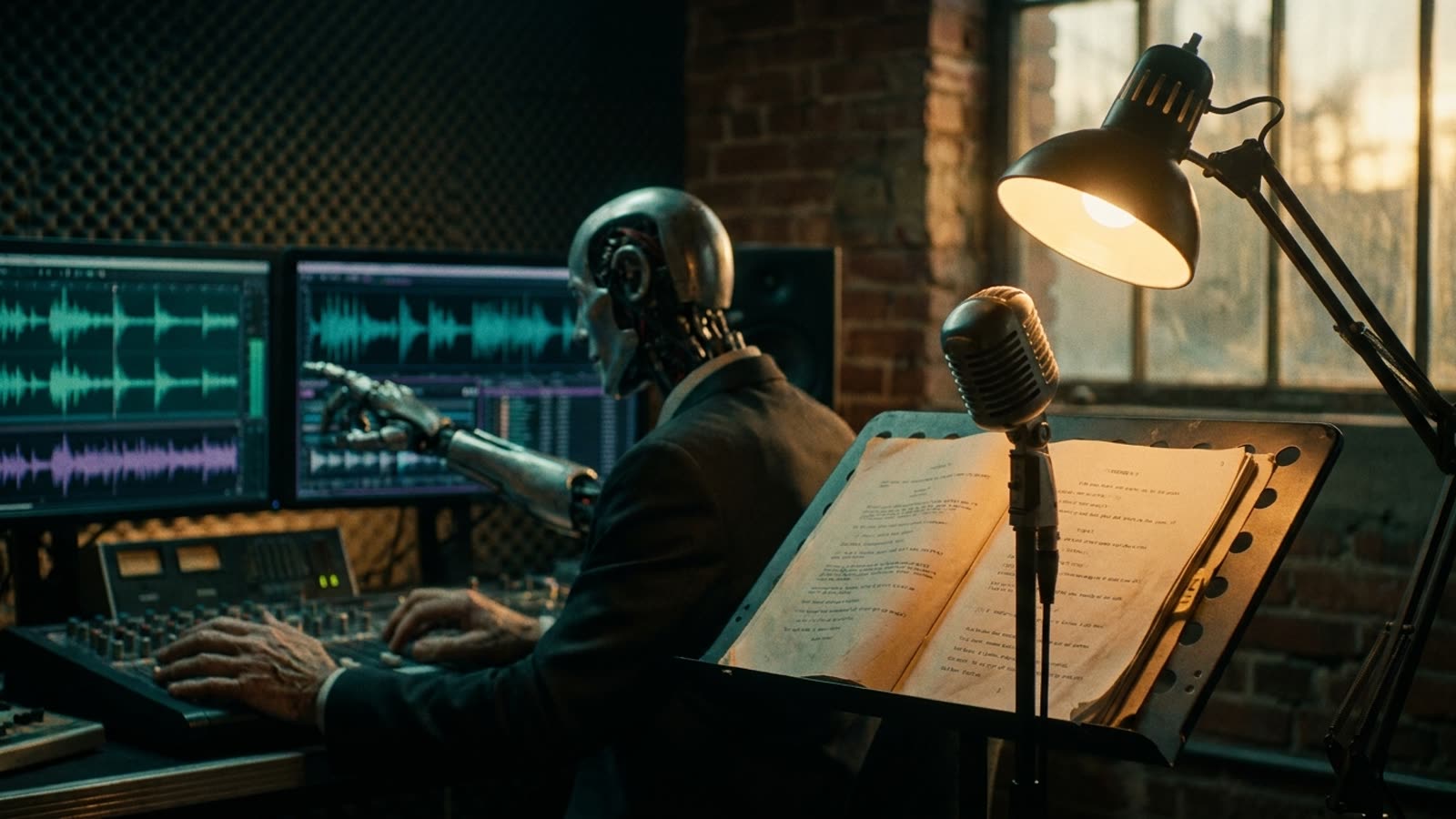
For decades, voice acting occupied a peculiar middle ground in the entertainment industry—unglamorous enough to avoid public scrutiny, lucrative enough to support a professional class of several thousand performers in the United States alone. Audiobook narrators, video game characters, corporate training modules, GPS navigation, phone trees, documentary narration: the human voice was everywhere, and someone had to provide it.
That someone is increasingly no one. Or rather, no one human.
The economics of silence
The mathematics are brutal in their simplicity. A professional voice actor charges anywhere from several hundred to several thousand dollars for a finished hour of audio, depending on the project's scope and the performer's reputation. The recording requires studio time, direction, editing, and often multiple takes. A synthetic voice, once licensed, costs a fraction of that per hour of output and requires no breaks, no retakes, no residuals.
For audiobook publishers, who have long operated on thin margins, the calculation has proved irresistible. Major platforms now offer AI-narrated editions alongside human-read versions, with the synthetic option priced lower and produced faster. The quality gap, once a chasm, has narrowed to something many listeners cannot detect or do not care about.
Corporate clients have moved even faster. The training video that once required a day of studio work now requires an afternoon of text input. The phone system that once needed a voice actor to record every conceivable menu option now generates them on demand. The documentary that once budgeted for narration now budgets for licensing.
The uncanny valley, traversed
What makes voice acting particularly vulnerable is that the uncanny valley—that zone of almost-human-but-not-quite that triggers discomfort—proves far easier to cross in audio than in video. A synthetic face still unsettles most viewers. A synthetic voice, trained on sufficient data and deployed with proper pacing, can pass unnoticed.
The technology has progressed with remarkable speed. Early text-to-speech systems were recognizable within syllables. Current models capture breath, hesitation, emphasis, and emotional register with sufficient fidelity that even industry professionals sometimes struggle to identify synthetic speech in blind tests. The voice cloning capabilities are more troubling still: with a few minutes of sample audio, a performer's voice can be replicated without their participation or, in many cases, their consent.
Some performers have attempted to adapt by licensing their voices for synthetic use, receiving upfront payments in exchange for training data. This bargain has proved Faustian for many—the one-time fee rarely compensates for the ongoing work the synthetic version displaces.
What remains human
The profession has not vanished entirely. Premium audiobooks, particularly literary fiction and memoir, still command human narration as a selling point. Video game protagonists in major releases still benefit from the improvisational collaboration between actor and director that synthetic voices cannot replicate. Animation, with its demand for character invention and emotional range, remains largely human.
But these are the peaks of a profession whose broad middle has eroded. The journeyman voice actor who once made a living from commercial work, corporate narration, and minor video game roles now competes with software that never tires, never ages, and never asks for a raise.
Our take
Voice acting offers a preview of displacement that other creative professions would do well to study. The pattern is consistent: AI first captures the commodity work at the base of the pyramid, then climbs steadily upward as the technology improves. The performers who survive will be those whose humanity is the product, not merely the production method. For everyone else, the microphone is cooling.