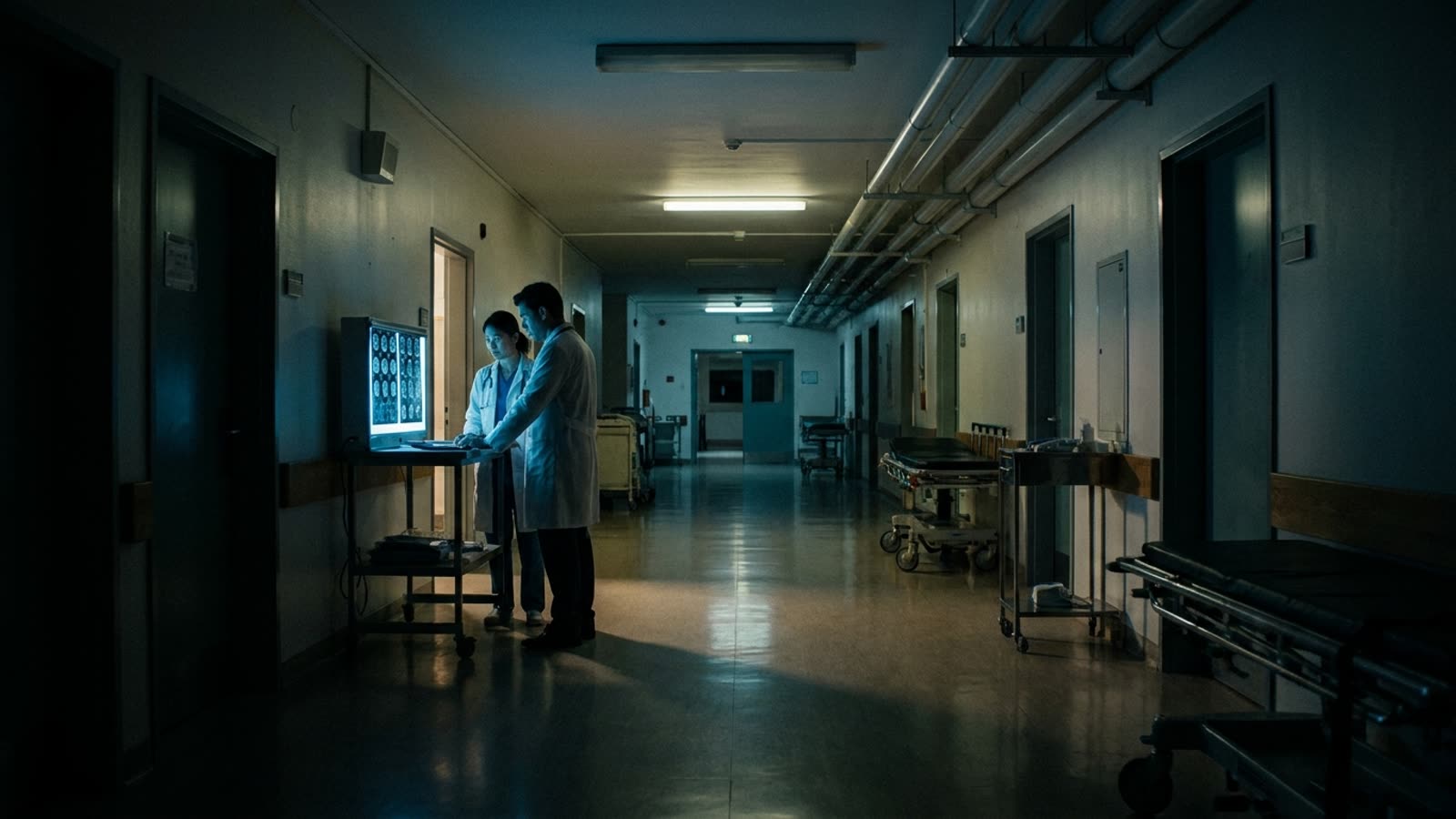
The chest X-ray arrives at 3:47 a.m., one of perhaps forty images queued for review before the morning shift begins. Within seconds, an algorithm has flagged a subtle opacity in the lower left lobe—a finding that might take a fatigued human eye another pass to catch, or might be missed entirely in the pre-dawn crush. The radiologist who reviews it an hour later sees the machine's annotation, confirms the suspicion, and orders a follow-up CT. The patient learns of a treatable early-stage malignancy two weeks sooner than they might have otherwise.
This is not a hypothetical. It is the daily reality in a growing number of hospitals worldwide, where AI-assisted radiology has moved from research curiosity to clinical workhorse. The transformation is quiet—no press conferences, no dramatic unveilings—but it may represent the most advanced integration of machine learning into a licensed medical specialty to date.
The triage layer
Radiology was always going to be AI's first serious foothold in medicine. The discipline runs on pattern recognition applied to standardized images—precisely the task at which convolutional neural networks excel. But the early fear that algorithms would replace radiologists has given way to a more nuanced reality: the technology works best as a triage layer, sorting the urgent from the routine and drawing attention to anomalies that warrant closer inspection.
Most deployed systems do not render diagnoses. They prioritize. A scan flagged as potentially showing a stroke moves to the top of the queue; one that appears unremarkable waits its turn. The radiologist remains the legal and clinical authority, but the workflow has been restructured around algorithmic pre-screening. In high-volume settings—emergency departments, breast cancer screening programs—this reordering can shave critical hours off time-sensitive findings.
The training paradox
Younger radiologists now train alongside tools their mentors never encountered. This creates an uncomfortable pedagogical question: if the machine catches what the trainee missed, has the trainee learned anything? Some residency programs have begun incorporating AI-free exercises, forcing trainees to develop pattern recognition without algorithmic assistance before reintroducing the tools. The concern is not merely academic. A generation of radiologists who rely on AI as a crutch may struggle when systems fail, networks crash, or edge cases fall outside the training distribution.
The profession is also grappling with liability. When an AI flags a finding and the radiologist dismisses it, who bears responsibility if the patient suffers harm? When the AI misses something and the radiologist, trusting the screen, moves on? Courts have not yet produced definitive answers, and hospitals are writing policies in a legal vacuum.
The economics of attention
Radiology has long been squeezed by volume. Imaging studies have multiplied faster than the radiologist workforce, and burnout rates in the specialty are among the highest in medicine. AI offers a pressure valve: not by replacing humans, but by making each human more efficient. Early adopters report that algorithms reduce the cognitive load of routine reads, freeing attention for complex cases. Whether this translates into fewer radiologists or the same number handling more studies remains an open question—one with significant implications for medical school enrollment and workforce planning.
Our take
The radiologist is not going extinct. The radiologist who ignores AI might. The profession is undergoing a subtle but irreversible shift in which the physician's role moves from first reader to final arbiter, and the machines handle the exhausting work of initial triage. This is neither the dystopia of mass unemployment nor the utopia of perfect diagnosis—it is the messy, incremental reality of technology entering a regulated profession. The chest X-ray at 3:47 a.m. still needs a human to sign off. It just gets a second opinion first.