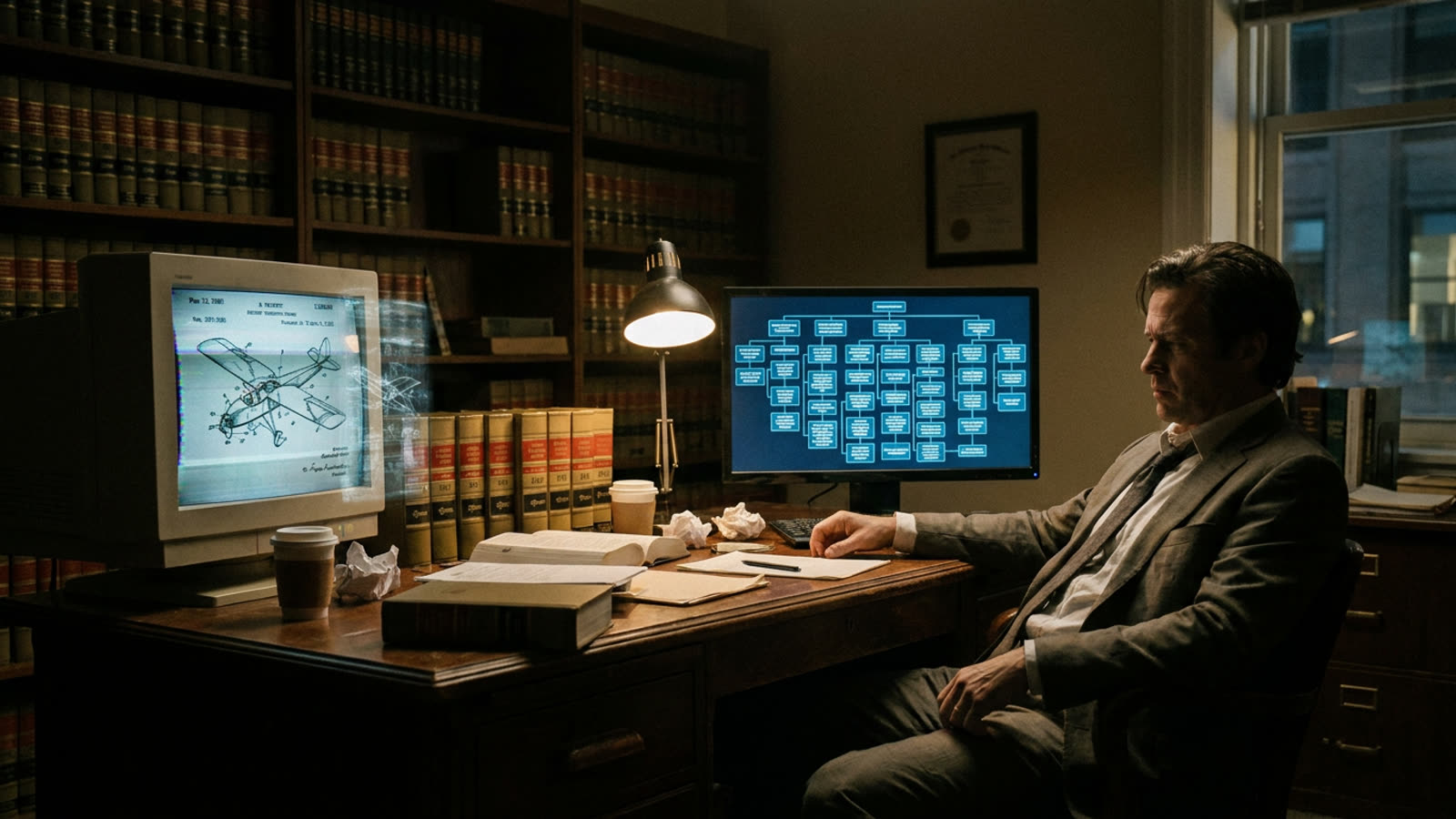
Patent attorneys occupy a peculiar position in the professional landscape: they must be fluent in both legal doctrine and technical complexity, capable of parsing semiconductor fabrication processes in the morning and pharmaceutical synthesis pathways by lunch. This combination of specialized knowledge and document-intensive labor has made them early and enthusiastic adopters of large language models — and, consequently, some of the most clear-eyed observers of what these systems can and cannot do.
The appeal is obvious. A typical patent application requires analyzing dozens of prior art references, each running to hundreds of pages of dense technical specification. A competent associate might review five or six thoroughly in a day. An LLM can surface relevant passages from hundreds in minutes. For prior art searches — the foundational work of determining whether an invention is actually novel — the productivity gains are not marginal. They are transformational.
Where the machines excel
The strongest use case turns out to be the most tedious: claim mapping. Patent claims are written in a deliberately baroque style, each word chosen to maximize legal defensibility while maintaining technical accuracy. Comparing a new application's claims against existing patents requires tracking dozens of overlapping concepts across thousands of pages. LLMs excel at this kind of structured comparison, flagging potential conflicts that a human reviewer might miss after eight hours of reading.
Drafting assistance has proven similarly valuable. Language models can generate first drafts of patent specifications that capture the essential technical disclosure, freeing attorneys to focus on the strategic choices — claim scope, prosecution history, competitive positioning — that actually require legal judgment. The junior associate's work of turning an inventor's rambling description into structured patent prose is increasingly automated.
Where they fail, reliably
The failures are instructive. Patent law depends on precise citation: specific claim numbers, exact filing dates, particular prosecution history events. Language models, trained to produce plausible text rather than verified facts, routinely invent these details. A model might cite a patent that exists but attribute to it claims it does not contain, or reference an office action from a date when none was filed. The errors are confident and grammatically perfect, which makes them dangerous.
Several firms have developed elaborate verification workflows — human review of every citation, automated cross-checking against patent databases — that add back much of the time savings. The net productivity gain, after accounting for quality control, is real but more modest than the raw speed suggests. Partners at major IP boutiques privately estimate the true efficiency improvement at perhaps thirty to forty percent, not the order-of-magnitude transformation the technology's enthusiasts promised.
The human remainder
What cannot be automated is the work that matters most: understanding what the client actually needs protected, anticipating how competitors will design around the claims, navigating the strategic relationship with patent examiners. These require judgment that emerges from experience, from understanding how the law has evolved and how examiners in specific technology centers tend to behave. No amount of training data captures this tacit knowledge.
The profession is bifurcating. Routine prosecution work — the mechanical drafting and searching that once occupied armies of junior associates — is being compressed. But complex litigation, licensing negotiations, and portfolio strategy remain stubbornly human. The attorneys who thrive are those who can leverage the machines for volume work while reserving their attention for the irreducibly judgmental tasks.
Our take
Patent law offers a useful corrective to both AI hype and AI dismissiveness. The productivity gains are genuine, the limitations are real, and the professionals closest to the technology have learned to hold both truths simultaneously. The machines are not replacing lawyers. They are replacing the parts of lawyering that lawyers always found tedious anyway — and in doing so, they are clarifying what human expertise actually consists of. That clarity may be the most valuable output of all.