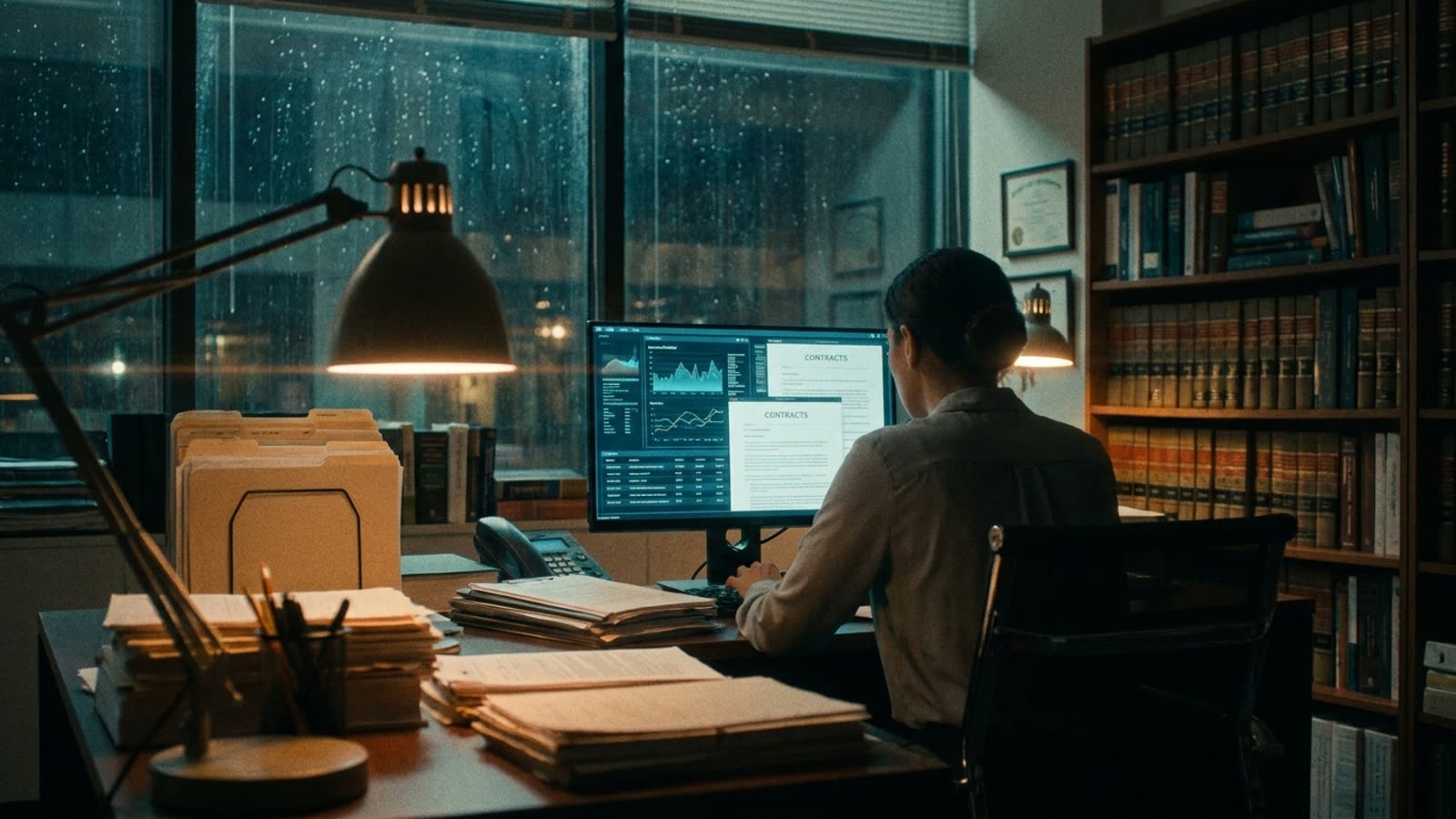
The paralegal profession has always been defined by a particular kind of endurance: the capacity to read the same boilerplate clause for the hundredth time, to spot the single anomalous indemnification provision buried in page 847 of a merger agreement, to maintain focus through document sets measured in banker's boxes and terabytes. It is work that demands intelligence, pattern recognition, and an almost monastic tolerance for tedium. It is also, not coincidentally, work that large language models do reasonably well.
This is not a story about mass displacement — at least not yet. It is a story about transformation, about how a profession is quietly reorganizing itself around a new set of tools while the technology press fixates on more dramatic narratives.
The review room, reimagined
Document review in litigation has historically operated on a simple economic premise: throw bodies at the problem. A major antitrust case might require reviewing millions of documents for relevance and privilege. Law firms and corporate legal departments would hire armies of contract attorneys and paralegals, install them in windowless rooms, and pay them by the hour to click through emails and attachments.
AI-assisted review — sometimes called technology-assisted review or predictive coding — has been changing this calculus for more than a decade, but the current generation of language models has accelerated the shift. Systems can now read documents with something approaching contextual understanding, flagging not just keyword matches but conceptual relevance. A paralegal who once spent weeks on first-pass review might now spend days refining the AI's classifications and handling the edge cases the machine cannot confidently categorize.
The work has not disappeared; it has changed shape. Senior paralegals increasingly function as quality-control specialists, training and correcting automated systems rather than doing the primary reading themselves. The skill premium has shifted from raw throughput to judgment — knowing when the AI has missed something, understanding why a particular contract clause matters in context.
The due diligence paradox
Corporate transactions present a revealing case study. When a company acquires another, paralegals traditionally comb through every material contract, lease, and employment agreement the target has ever signed. AI tools can now extract key terms, flag unusual provisions, and generate summary reports in a fraction of the time.
Yet deal timelines have not shortened proportionally. Instead, the scope of review has expanded. Tasks that were once impractical — reviewing every vendor contract rather than a sample, cross-referencing representations against actual documentation — become feasible when machines handle the initial extraction. The paralegal's role evolves from document processor to analytical reviewer, interpreting the AI's output and investigating the anomalies it surfaces.
This is the paradox of productivity tools throughout history: they rarely eliminate work so much as they raise expectations about what work should accomplish.
What the machines still miss
For all their capabilities, current AI systems struggle with precisely the situations where paralegal expertise matters most. They handle standard contracts competently but falter when documents deviate from templates in meaningful ways. They miss the significance of what is absent — the missing exhibit, the unsigned amendment, the clause that should appear but does not. They cannot call opposing counsel to clarify an ambiguity or exercise judgment about which irregularities warrant escalation to the supervising attorney.
The profession's future likely belongs to those who can operate fluently in both modes: leveraging AI for speed and coverage while applying human judgment to the irreducibly contextual work that remains.
Our take
The paralegal profession offers a useful corrective to both AI triumphalism and AI alarmism. The technology is genuinely transforming the work — anyone who denies this is not paying attention. But the transformation looks less like replacement than like restructuring, with the most adaptable practitioners finding that their judgment and contextual expertise have become more valuable, not less. The tedium is being automated; the thinking is not.