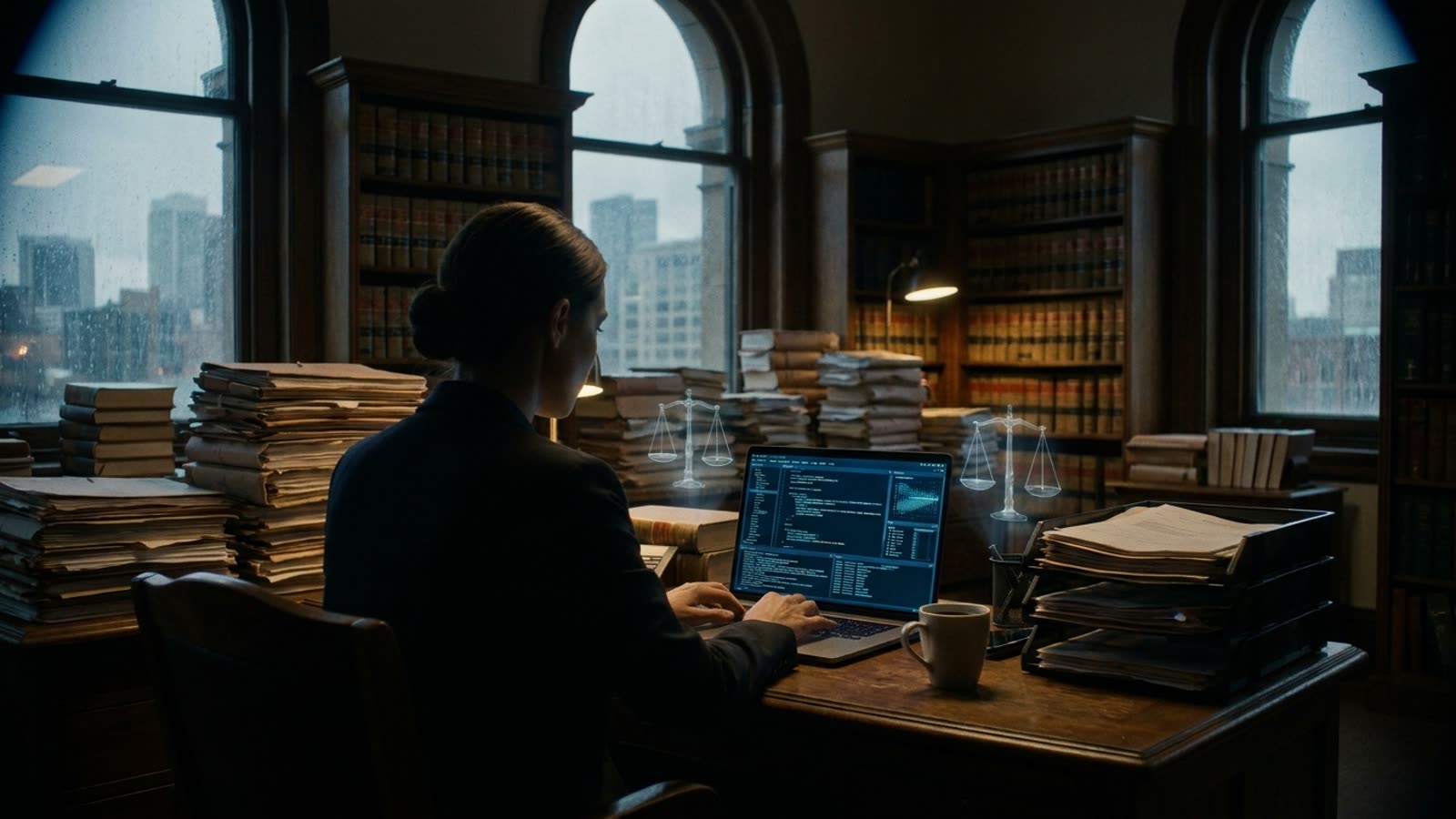
The legal industry employs roughly 350,000 paralegals in the United States alone, and most of them have spent the past two years learning an entirely new job without anyone officially telling them so.
Paralegals have always been the profession's invisible infrastructure — the people who actually read the documents, chase the deadlines, and organize the chaos that lawyers bill for. They draft discovery requests, summarize depositions, and maintain the case files that make litigation possible. It is meticulous, unglamorous work that requires genuine expertise but rarely receives public recognition. Now, large language models are rewriting the job description in real time, and the transformation reveals something important about how AI actually changes work: not by replacing humans wholesale, but by reshaping what humans do hour by hour.
The document review revolution
Document review has long been the paralegal's most time-consuming task. In complex litigation, cases can involve millions of pages of emails, contracts, and internal memoranda that must be reviewed for relevance and privilege. This work was traditionally billed at substantial hourly rates and could occupy teams of paralegals for months. AI-powered review tools now accomplish in days what once took weeks, scanning documents for patterns, flagging potentially privileged communications, and categorizing materials by issue.
The paralegals who have adapted describe their new role as supervisory rather than clerical. Instead of reading every document, they train the AI systems, validate their outputs, and handle the edge cases that machines misunderstand. The skill set has shifted from endurance reading to quality control — knowing when the algorithm is wrong and why.
The prompt as legal instrument
More striking is how paralegals now interact with generative AI for drafting work. A skilled paralegal today might spend significant time crafting prompts to generate first drafts of routine legal documents — demand letters, discovery responses, contract summaries. The craft lies not in the writing itself but in knowing precisely what to ask for and how to evaluate what comes back.
This requires a different kind of expertise: understanding both legal substance and AI behavior well enough to extract useful work while catching hallucinations and errors. Paralegals report that junior associates sometimes trust AI outputs too readily, while experienced paralegals have developed an instinct for when the machine is confidently wrong.
The bifurcation problem
Not all paralegals are thriving in this transition. The profession is splitting into two tiers: those who have mastered the new tools and become more valuable, and those whose traditional skills are rapidly depreciating. Firms vary enormously in how they have handled this shift. Some have invested in training; others have simply expected adaptation.
The economic logic is stark. A paralegal who can leverage AI effectively might handle work that previously required three people. Law firms face a choice between employing fewer, higher-paid paralegals or maintaining larger teams at lower wages. Early evidence suggests most are choosing the former, which means the profession may be shrinking even as individual practitioners become more productive.
Our take
The paralegal transformation offers a preview of how AI will reshape knowledge work more broadly — not through dramatic displacement but through quiet redefinition. The work that remains is more cognitively demanding and less repetitive, which sounds like progress until you notice that it also means fewer jobs and higher barriers to entry. The paralegals who entered the profession for its accessibility and stability are discovering that those qualities may not survive the decade. This is neither the utopia of human-AI collaboration nor the dystopia of mass unemployment. It is something more unsettling: a profession being hollowed out and rebuilt simultaneously, with individual careers rising or falling based on how quickly people can learn skills that did not exist three years ago.