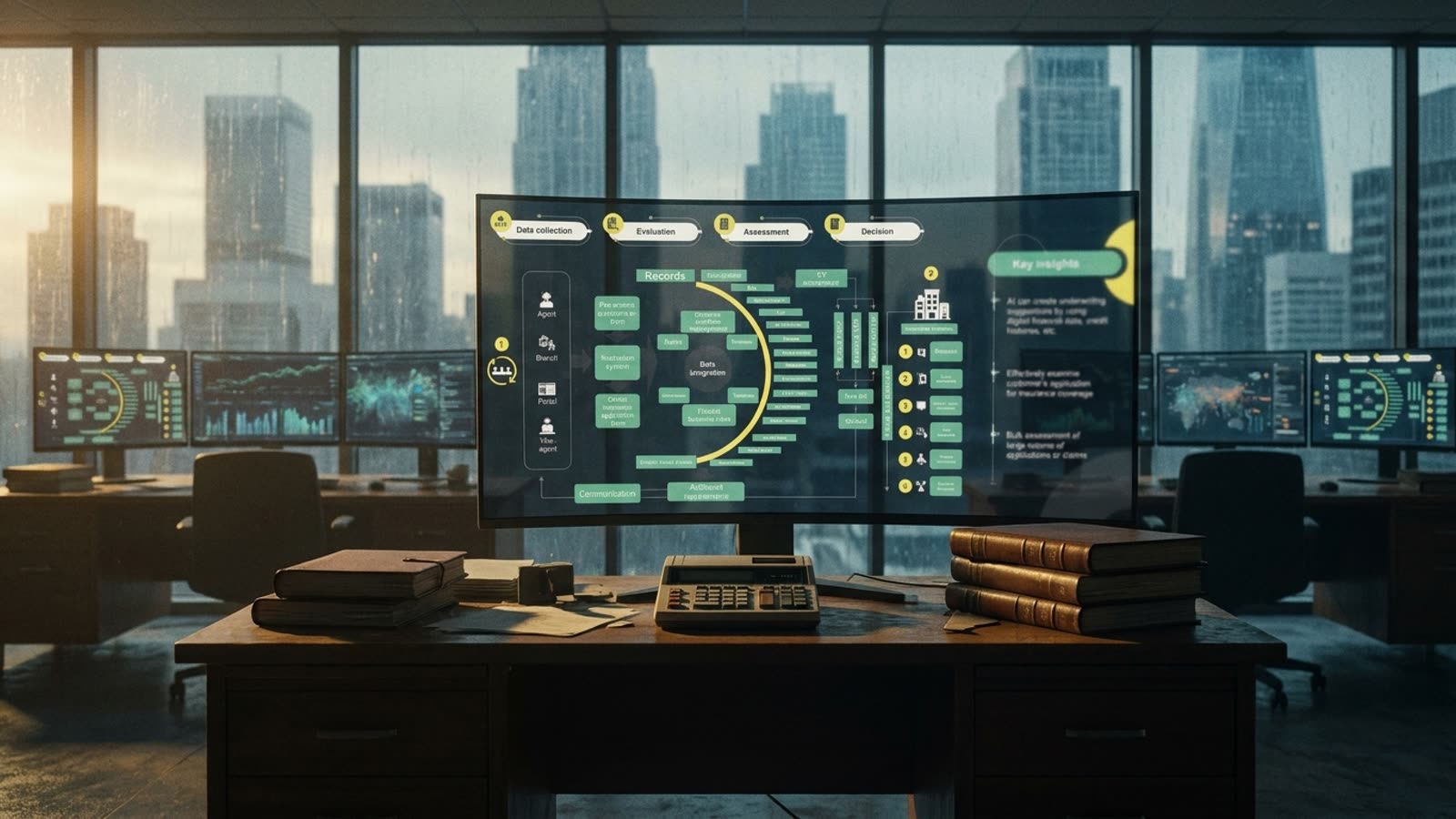
For three centuries, the underwriter has occupied a peculiar position in commercial life: part mathematician, part psychologist, part fortune-teller. They assess risk by reading applications, scrutinizing medical records, and making educated guesses about who will die young, crash their car, or burn down their house. It is a profession that has always claimed to be scientific while relying heavily on intuition. Now that intuition is being automated, and the industry is discovering that machines are often better at predicting human misfortune than humans are.
The transformation is not speculative. Major insurers across Europe, North America, and Asia have deployed machine learning systems that process applications in seconds rather than days, flagging risks that experienced underwriters miss and approving straightforward cases without human review. The technology does not replace underwriters entirely—complex commercial policies and unusual circumstances still require human judgment—but it has fundamentally altered what the job entails.
The end of the gut feeling
Traditional underwriting training took years. Junior analysts learned to read between the lines of applications, to notice when a business owner's financials seemed too clean or when a life insurance applicant's hobbies suggested undisclosed risk-taking. This expertise was hard to articulate and harder to teach. Veteran underwriters spoke of developing a feel for applications, an instinct honed over thousands of decisions.
Machine learning systems have no instincts, but they have something arguably more valuable: the ability to find patterns across millions of data points that no human could process. They notice that applicants who fill out forms at certain times of day default more frequently, or that businesses in specific postal codes with particular combinations of characteristics represent elevated fire risks. These correlations often lack obvious causal explanations, which makes them simultaneously powerful and troubling.
The humans who remain in underwriting increasingly serve as exception handlers and explainability specialists. When the algorithm flags an application or when a customer demands to know why they were denied coverage, someone must translate the machine's reasoning into language that satisfies regulators and plaintiffs' attorneys. This is skilled work, but it is not the work underwriters trained for.
The fairness problem no one has solved
Insurance has always involved discrimination in the technical sense—distinguishing between risks and pricing accordingly. The industry's entire business model depends on charging higher premiums to people more likely to file claims. But societies have drawn lines around which factors insurers may consider. Using race to price auto insurance is illegal in most jurisdictions. Using gender to price life insurance is prohibited in parts of Europe.
Machine learning complicates these boundaries. An algorithm trained on historical data will inevitably encode historical patterns of discrimination, even if protected characteristics are excluded from its inputs. If certain postal codes correlate with race, and the algorithm uses postal codes, the effect may be indistinguishable from explicit racial discrimination. Insurers and regulators are engaged in an ongoing, unresolved debate about how to audit these systems and what fairness even means when applied to probabilistic predictions.
The technical solutions proposed—adversarial debiasing, counterfactual fairness testing—are sophisticated but incomplete. They can reduce measurable disparities without eliminating them, and they often involve tradeoffs between different definitions of fairness that cannot be simultaneously satisfied. The underwriter's gut feeling was biased too, of course, but its biases were at least comprehensible.
What expertise becomes
The underwriters who have adapted most successfully to this new landscape describe their role in terms that would have puzzled their predecessors. They speak of training data curation, model governance, and regulatory translation. They spend less time reading applications and more time reading technical documentation. The deep knowledge of specific industries or risk categories that once defined senior underwriters matters less than the ability to understand what the models can and cannot do.
This shift mirrors transformations in other knowledge professions. Radiologists increasingly review AI-flagged images rather than conducting primary reads. Lawyers use document review software that finds relevant passages faster than associates can. The pattern is consistent: automation handles volume while humans handle exceptions, oversight, and accountability.
Our take
The insurance industry's AI transformation reveals something uncomfortable about professional expertise. Much of what underwriters called judgment was pattern recognition operating on limited data, and machines are simply better at pattern recognition when data is abundant. The human role that remains—explaining decisions, handling edge cases, satisfying the social need for accountability—is important but fundamentally different from the expertise that underwriters spent careers developing. This is not a story about AI replacing humans. It is a story about AI revealing that some human work was always more algorithmic than we wanted to admit.