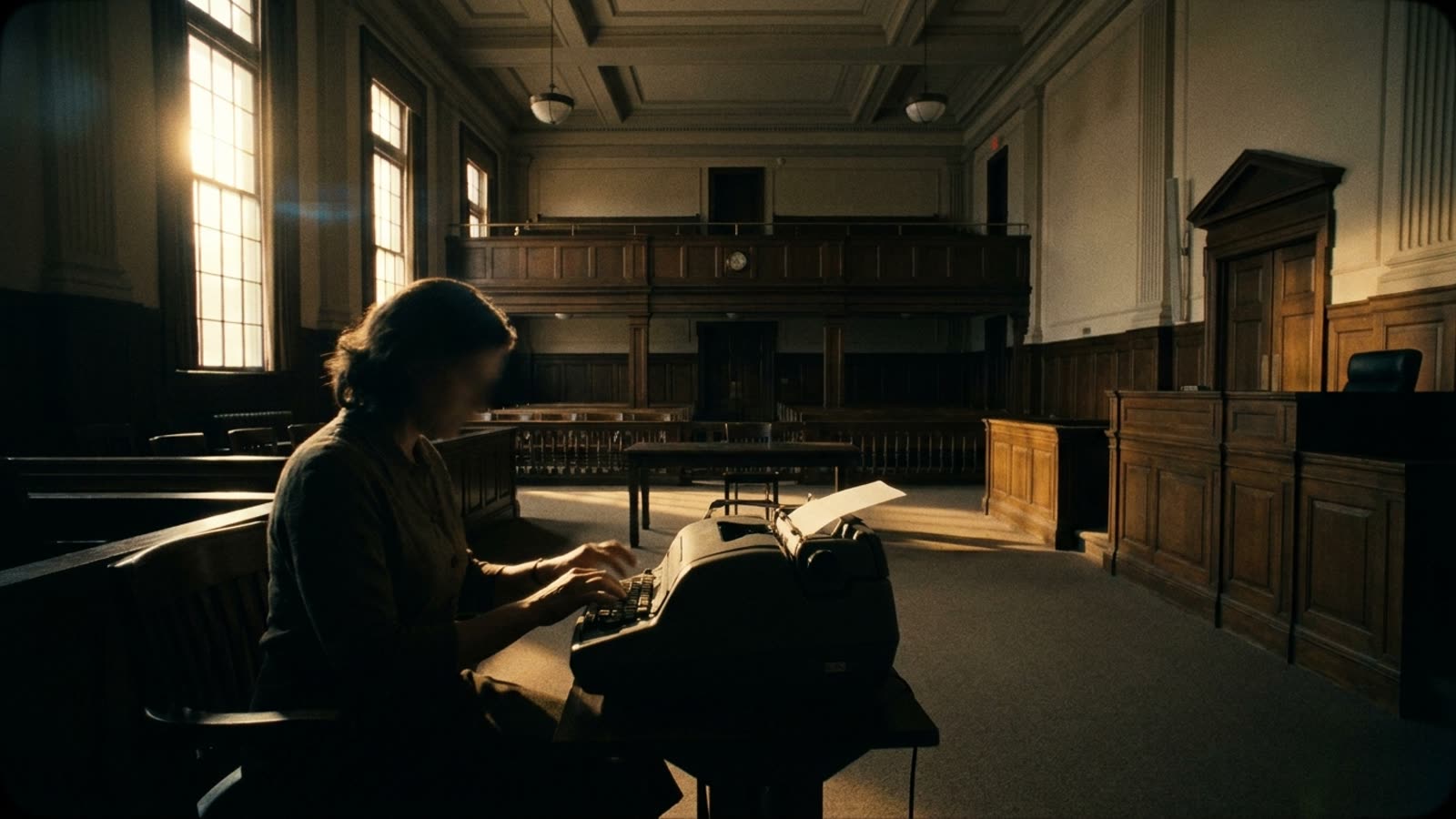
The American courtroom has always been a theater of competing voices—attorneys, witnesses, judges—but only one person has been trusted to capture every syllable with legal precision. The court reporter, hunched over a stenotype machine, has served as the silent guarantor of the judicial record since the early twentieth century. That role is now being eroded by AI transcription systems that work faster, cost less, and never ask for a bathroom break.
This is not a story about a technology that might someday disrupt an industry. The disruption is already underway, proceeding with the bureaucratic quietude that characterizes most genuine transformations.
The economics of the spoken word
Court reporting has long been a bottleneck. The profession requires years of specialized training to master stenography—a phonetic shorthand system that allows reporters to type at speeds exceeding 200 words per minute. The supply of qualified reporters has been shrinking for decades, even as demand for legal transcription has grown. Many jurisdictions face chronic shortages, with trials delayed simply because no reporter is available.
AI transcription services have entered this gap with aggressive pricing. Where a human reporter might charge several dollars per page of transcript, automated systems can deliver drafts at a fraction of that cost. More importantly, they can work continuously across multiple proceedings simultaneously. A single software deployment can monitor every courtroom in a county.
The accuracy question, once the profession's strongest defense, has weakened considerably. Modern speech-to-text systems trained on legal terminology now achieve accuracy rates that approach human performance under favorable acoustic conditions. They still struggle with overlapping speakers, heavy accents, and the courtroom's inevitable moments of chaos—but so do humans.
What gets lost in translation
The stenographer's defenders argue that transcription is only part of the job. A skilled court reporter serves as a real-time quality control mechanism, able to interrupt proceedings when testimony becomes inaudible or when speakers need to be identified for the record. They catch the mumbled aside, the witness who trails off, the attorney who speaks over the judge. They are, in essence, the courtroom's institutional memory operating in the present tense.
AI systems, by contrast, are fundamentally passive. They record what they hear without the judgment to know when something important has been missed. A transcript full of "[inaudible]" notations may be technically accurate but functionally useless for appeal purposes. The legal system's tolerance for such gaps remains untested at scale.
There is also the question of certification. Court reporters are licensed professionals who can be called to testify about the accuracy of their transcripts. An algorithm cannot be cross-examined, which creates novel questions about evidentiary reliability that courts are only beginning to confront.
The hybrid interregnum
For now, most jurisdictions are pursuing a middle path. AI transcription generates a first draft, which a human editor reviews and certifies. This preserves the legal formalities while capturing much of the cost savings. The human in the loop is no longer a stenographer but a proofreader—a less specialized role that commands lower wages.
This arrangement is unstable. Once the technology demonstrates sufficient reliability, the economic pressure to eliminate the human checkpoint entirely will become irresistible. The question is not whether but when, and the answer likely varies by proceeding type. Routine hearings may go fully automated within years; capital trials may retain human reporters for decades.
Our take
The court reporter represents a particular kind of professional: highly skilled, modestly compensated, essential but invisible. These are precisely the roles that AI tends to consume first, because their value is difficult to articulate until it disappears. The stenographer's obsolescence will not make headlines, but it will quietly reshape how the legal system produces truth. Whether that reshaping improves justice or merely reduces its cost is a question the courts themselves will eventually have to answer—assuming someone is still there to write it down.