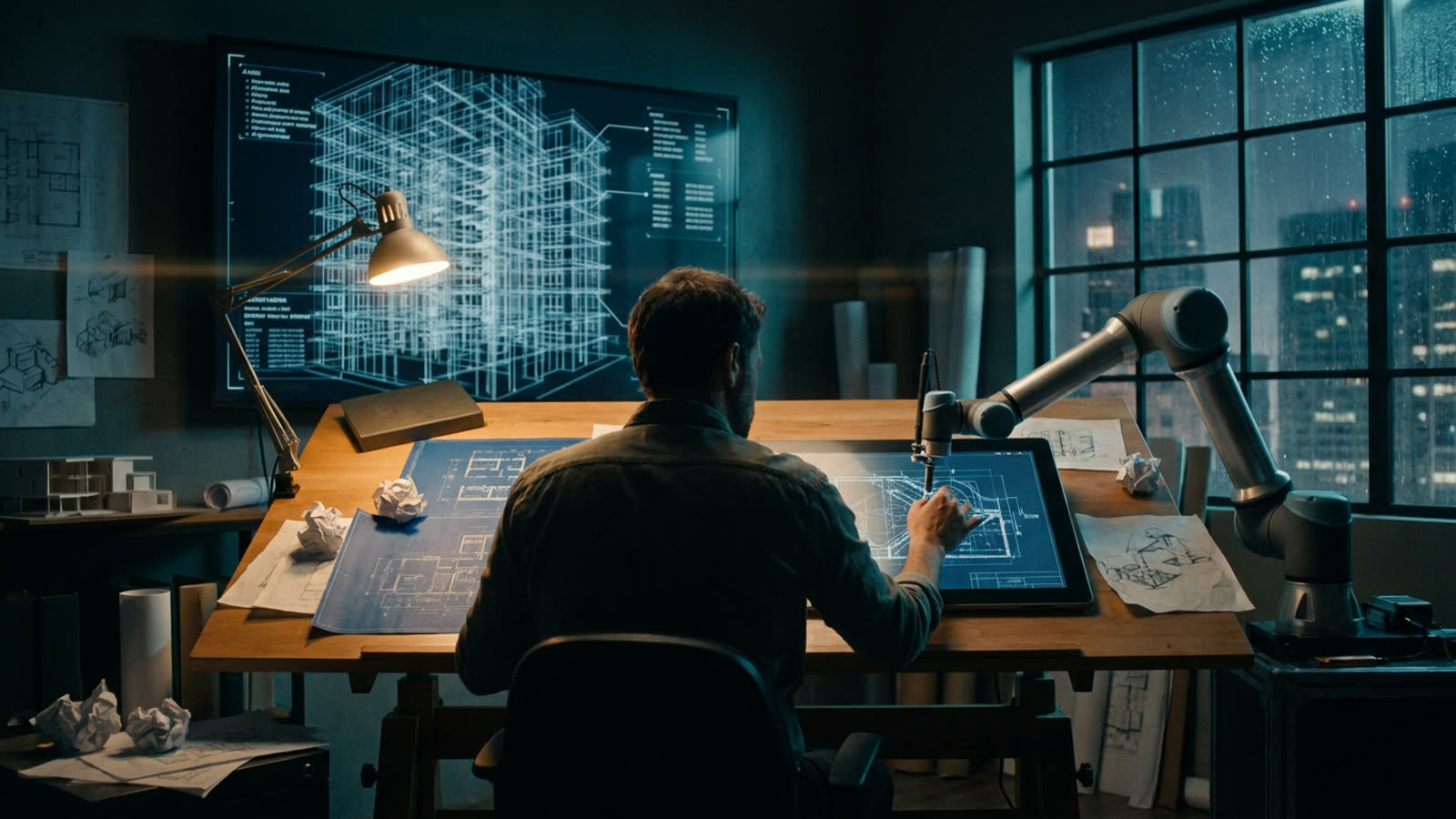
For most of the twentieth century, the architect's workflow followed a recognizable pattern: sketch, draft, model, revise, present. The tools evolved from T-squares to CAD software, but the fundamental cognitive labor remained human. The architect imagined; the tools recorded. That division is dissolving.
Generative AI systems can now produce hundreds of building variations in the time it once took to sketch a single floor plan. Feed the software a site's dimensions, local building codes, solar orientation data, and budget constraints, and it returns not one solution but a constellation of possibilities—each structurally sound, each code-compliant, each representing a path the human designer might never have considered. The architect's role shifts from creator to curator, from author to editor of machine-generated options.
The productivity paradox
Firms adopting these tools report dramatic efficiency gains in the schematic design phase. What once required weeks of exploratory sketching can compress into days. Yet this acceleration creates its own tensions. Architecture has long justified its fees through the mystique of creative labor—the idea that good design emerges slowly, through iteration and intuition. When a machine can iterate faster than any human, what exactly is the client paying for?
The answer, increasingly, is judgment. The AI generates; the architect discerns. This sounds elegant in theory, but it demands a different kind of expertise. Young architects trained to develop their design voice through years of drawing must now develop a critical eye for evaluating options they did not originate. The skill set shifts from generative to evaluative, from making to choosing.
What machines still cannot see
For all their speed, current AI systems struggle with what architects call the intangibles—the emotional resonance of a space, the cultural memory embedded in a neighborhood, the way light falls through a window at a particular hour. These systems optimize for measurable parameters: square footage, energy efficiency, structural load. They cannot yet optimize for awe.
This limitation reveals something important about architecture itself. The discipline has always balanced engineering and art, the quantifiable and the ineffable. AI excels at the former and remains largely blind to the latter. A system can calculate the most efficient egress routes for a concert hall, but it cannot understand why a particular curve in the ceiling makes the music feel different.
The democratization question
Some observers predict AI will democratize design, allowing smaller firms to compete with global practices. Others worry it will concentrate power further, as large firms with resources to develop proprietary tools pull ahead. Both outcomes seem plausible, and both may occur simultaneously in different market segments.
What seems certain is that the profession's boundaries are blurring. Developers who once hired architects for their vision can now generate passable designs internally. The architect's value proposition must evolve beyond form-giving toward something harder to automate: the integration of technical, social, and aesthetic considerations into coherent human environments.
Our take
Architecture has survived the transition from hand-drafting to computers before, and it will survive this one. But survival is not the same as unchanged continuation. The profession that emerges will likely be smaller, more specialized, and more focused on the irreducibly human elements of placemaking. The architects who thrive will be those who understand that their job was never really about drawing buildings—it was about understanding why certain spaces make us feel at home and others make us want to leave. No algorithm has cracked that yet.