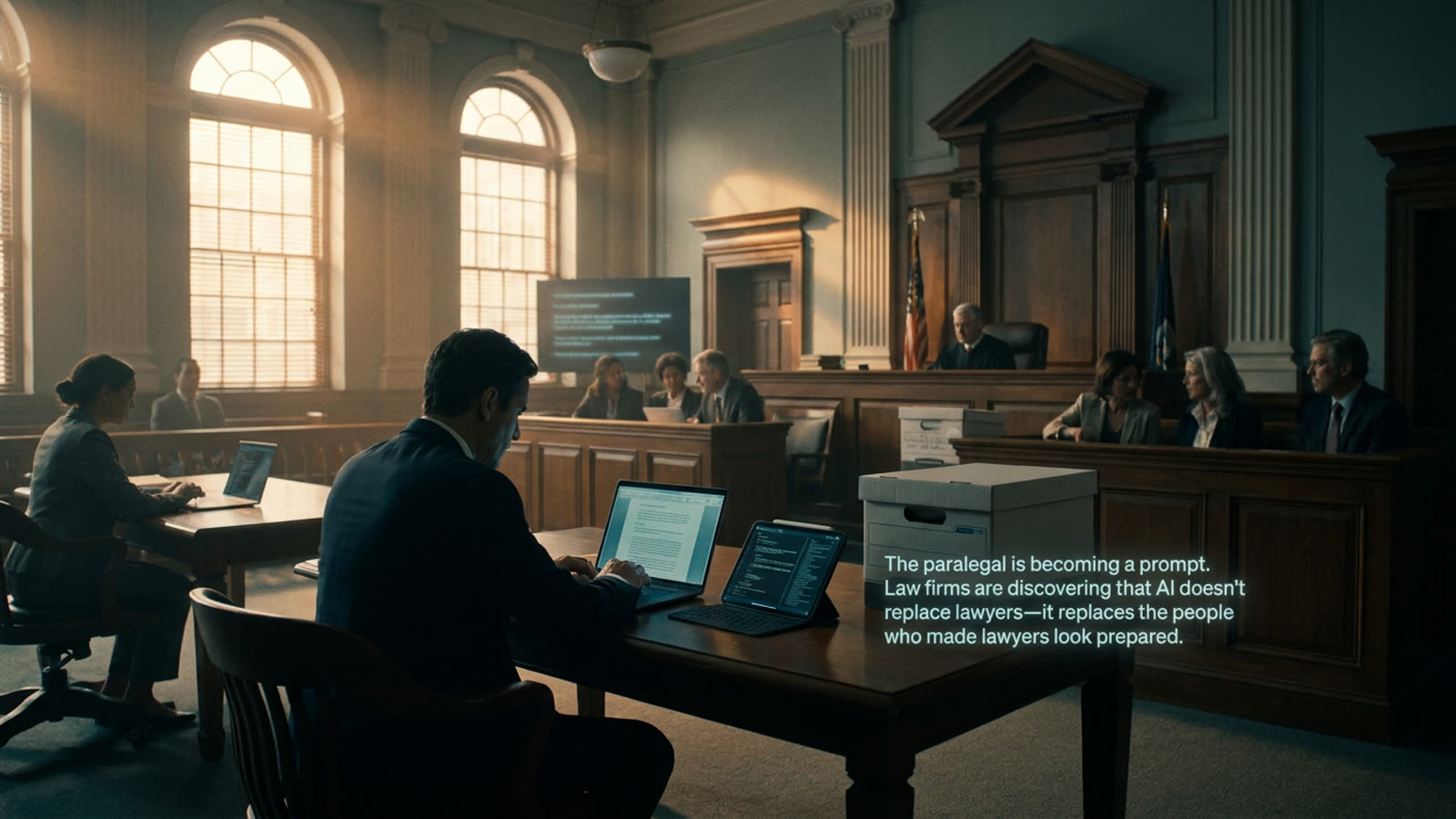
The legal profession has always run on a hidden labor force. Behind every polished brief and every confident courtroom performance stands an army of paralegals, legal secretaries, and first-year associates who spent their nights doing the work that partners would later sign. Now that work is being automated, and the transformation is happening with remarkably little fanfare.
Law firms were early adopters of AI tools for a simple reason: legal work generates enormous volumes of text, and text is precisely what large language models excel at processing. Document review during discovery—once a rite of passage for junior lawyers billing hundreds of hours to read through boxes of contracts—can now be accomplished in a fraction of the time. Citation checking, the tedious verification that every case reference actually says what the brief claims it says, has become a task that AI handles with fewer errors than exhausted associates working at midnight.
The economics of invisible labor
The paralegal profession in the United States employs roughly 350,000 people, according to the Bureau of Labor Statistics. These workers have long occupied an awkward position: essential to the functioning of law firms but rarely visible to clients, compensated modestly while generating substantial revenue for their employers. A paralegal billing at $150 per hour while earning $25 might represent the most profitable employee in the building.
This economic structure made paralegals simultaneously indispensable and vulnerable. When AI tools can perform document summarization, contract analysis, and legal research at a marginal cost approaching zero, the math changes dramatically. Some firms are reducing paralegal headcount. Others are repositioning their paralegals as AI supervisors, humans who review machine output rather than producing the initial work themselves.
The shift is not uniform. Litigation-heavy practices have embraced AI most aggressively, while transactional work involving client relationships and negotiation remains more human-dependent. Small firms that never had large support staffs are finding that AI lets them punch above their weight, taking on complex cases they would previously have declined.
What the machines still cannot do
The limits of current AI in legal work are instructive. Large language models can summarize a deposition transcript with impressive accuracy, but they cannot tell you which moment in that deposition will resonate with a jury. They can identify relevant precedents, but they cannot craft the narrative that makes those precedents feel inevitable rather than cherry-picked. They can draft a contract clause, but they cannot sense when the opposing counsel is bluffing about a deal-breaker.
Legal work, it turns out, divides fairly cleanly into tasks that require judgment about human behavior and tasks that require processing large volumes of information. AI excels at the latter and remains largely useless at the former. The partner who can read a room, anticipate a judge's concerns, or know when to settle is not threatened. The associate whose value proposition was simply working harder and longer than anyone else very much is.
Our take
The legal industry's AI adoption offers a preview of how automation will ripple through white-collar professions more broadly. The work being displaced is not unskilled—paralegals require training, certification, and genuine expertise. But it is work that can be specified clearly enough for a machine to attempt it. The humans who remain essential are those whose contributions resist specification: the intuition, the persuasion, the judgment calls that cannot be reduced to a prompt. Law firms are learning what every industry will eventually discover. The question is not whether AI can do your job. The question is whether your job can be described precisely enough that AI can try.