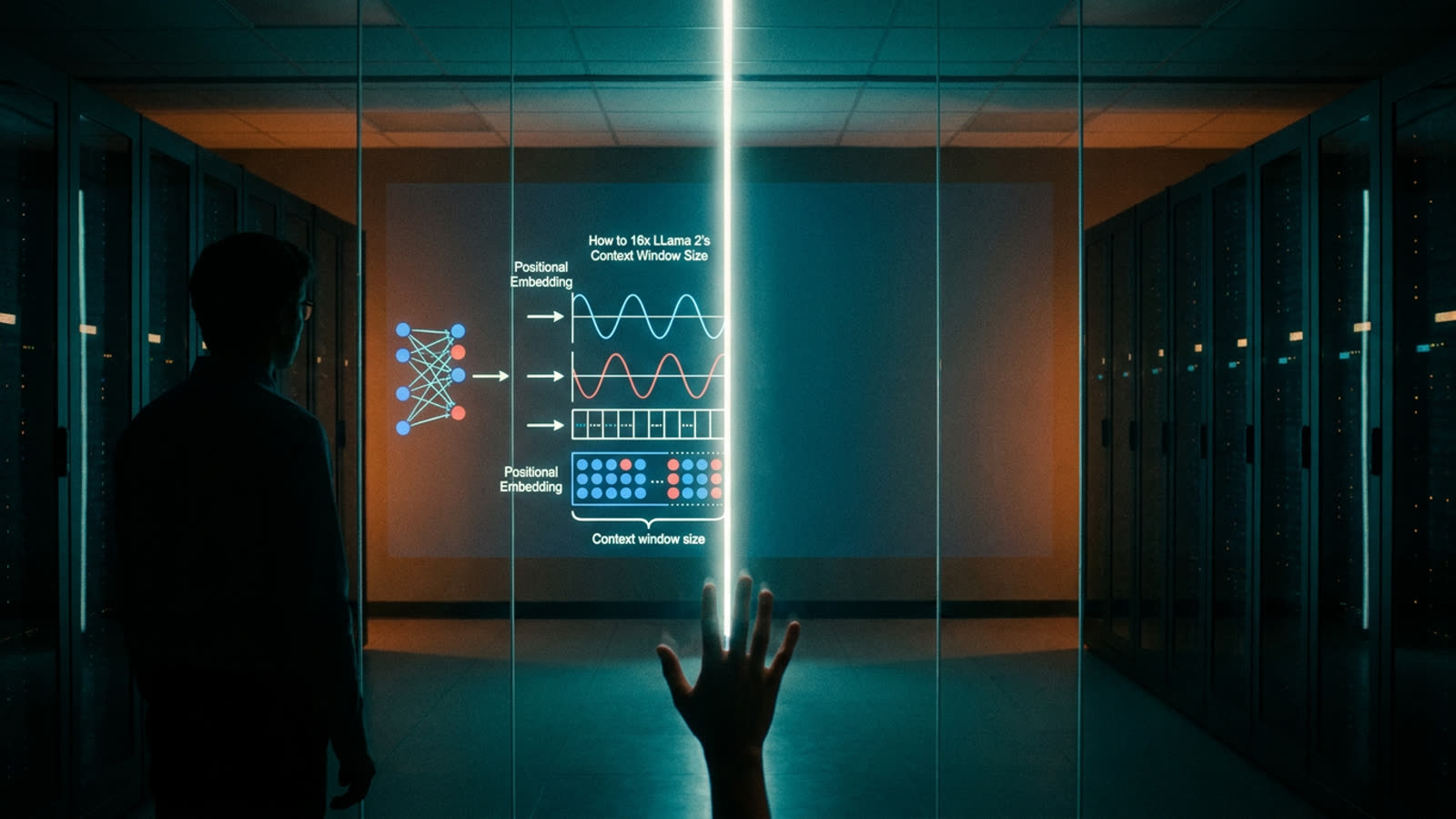
Every large language model carries a secret boundary, an invisible wall beyond which it cannot see. This constraint, called the context window, determines how much text the model can consider at once — and it shapes every AI interaction in ways most users never notice until something goes wrong.
The context window is measured in tokens, those subword fragments that models use to parse language. When OpenAI's GPT-4 launched, its context window held roughly 8,000 tokens, enough for perhaps fifteen pages of text. Anthropic's Claude and subsequent GPT iterations have pushed this to 100,000 tokens and beyond. Yet even these expanded windows represent a fraction of what humans routinely hold in working memory across days of conversation.
Why the wall exists
The architectural reason is computational. Transformer models, the neural network design underlying modern AI, process relationships between every token and every other token in the context. This creates what mathematicians call quadratic scaling: double the context length, and you quadruple the computation required. Triple it, and you need nine times the processing power. The elegant attention mechanism that makes transformers so capable also makes them expensive to scale.
Researchers have proposed various workarounds. Some models now use sliding windows that summarize older content. Others employ retrieval systems that fetch relevant passages from external databases. Still others experiment with sparse attention patterns that skip over presumably irrelevant token pairs. Each approach trades something — accuracy, coherence, or the ability to make unexpected connections across distant parts of a conversation.
What users actually experience
The practical effects are subtle but pervasive. Ask an AI to revise a document it helped you draft yesterday, and it will have no memory of the original. Request consistency across a long creative project, and watch the model contradict itself as earlier context falls away. Upload a lengthy research paper and find the model confidently discussing the introduction while misremembering conclusions from later sections.
Professional users develop workarounds: chunking documents into digestible segments, maintaining external notes to re-inject context, or simply accepting that each session begins fresh. These adaptations work, but they represent a tax on productivity that the AI's impressive capabilities initially seemed to promise eliminating.
The research frontier
The quest for longer context windows has become a quiet arms race. Companies trumpet ever-larger numbers, though benchmarks suggest that models often struggle to use their full stated capacity effectively. A model might technically accept 200,000 tokens while functionally attending to only a fraction of that information, particularly content in the middle of long inputs — a phenomenon researchers have termed the "lost in the middle" problem.
More promising may be architectural innovations that move beyond the transformer paradigm entirely. State-space models and other emerging designs offer linear rather than quadratic scaling, potentially enabling context windows measured in millions of tokens. Whether these approaches can match transformer quality while gaining efficiency remains an open research question.
Our take
The context window is not a bug to be patched but a fundamental design constraint, like the refresh rate of a screen or the sample rate of audio. Understanding it transforms how one works with AI: not as an omniscient oracle but as a capable collaborator with a specific, bounded form of attention. The most sophisticated AI users are those who have internalized this limit and learned to work within it, structuring their requests and maintaining their own context in ways that complement rather than fight the architecture. The wall is real, and pretending otherwise only leads to frustration.