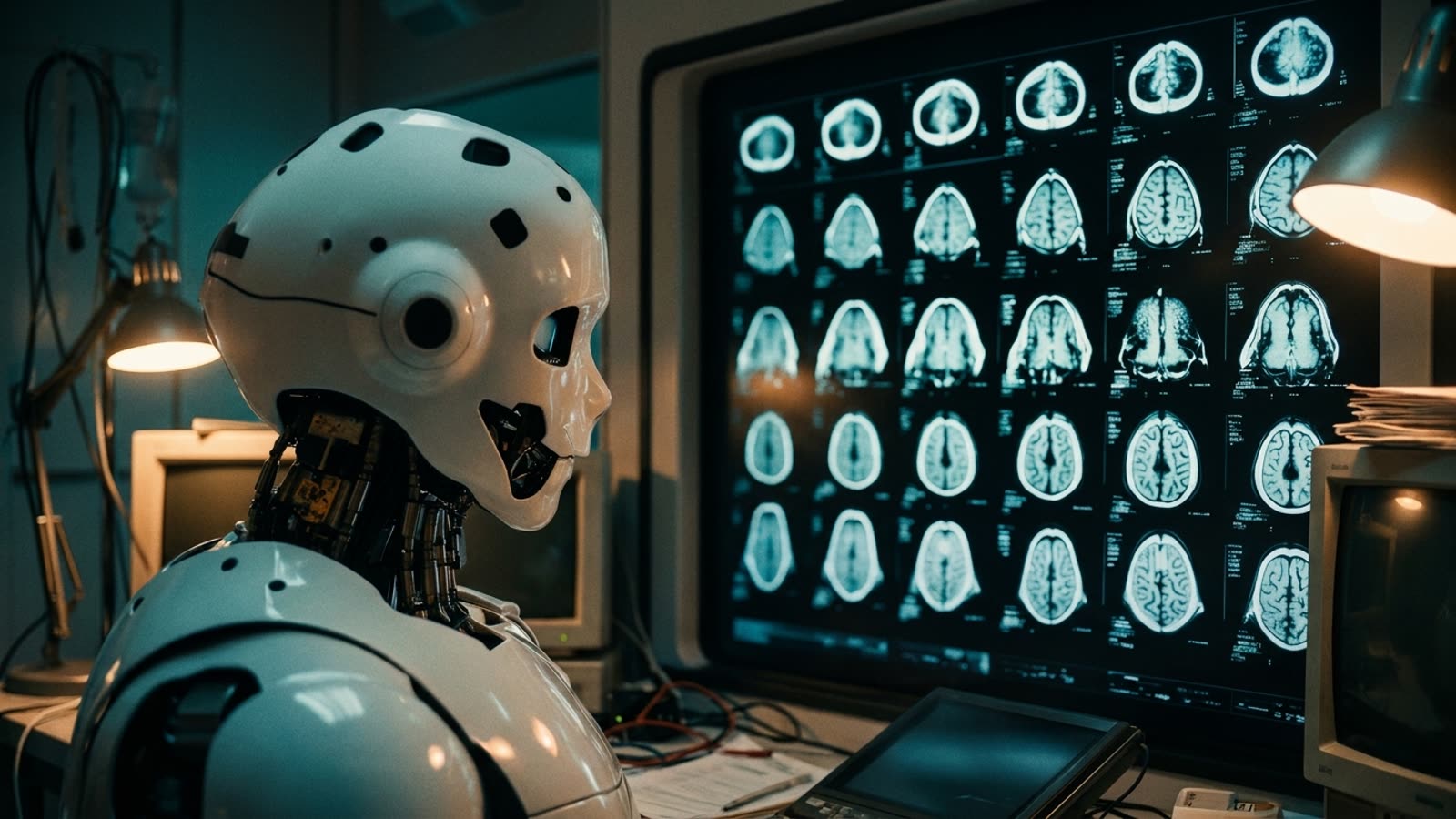
There is a particular kind of confidence that emerges from knowing nothing about what you do not know. It is the confidence of the undergraduate who has just discovered Nietzsche, the confidence of the first-time founder who has never met payroll, and it is the confidence of every large language model ever built. The systems that now draft legal briefs, diagnose skin lesions, and tutor children in calculus share a common trait: they cannot distinguish between what they know and what they are fabricating. This is not a bug to be patched. It is a structural feature of how these systems work.
The architecture of false certainty
When a human expert encounters a question at the edge of their knowledge, something remarkable happens. A cardiologist reviewing an ambiguous ECG feels uncertainty—a phenomenological signal that triggers caution, consultation, additional testing. This capacity for calibrated self-doubt is not incidental to expertise; it is constitutive of it. Large language models possess no equivalent mechanism. They are trained to predict the next plausible token in a sequence, which means they are optimized for fluency, not accuracy, and certainly not epistemic humility. The model that confidently explains quantum chromodynamics and the model that confidently invents a fictional Supreme Court case are running the same process. From the inside, there is no difference.
Researchers have attempted various interventions. Some prompt models to express uncertainty. Others train them on datasets annotated with confidence levels. A few have experimented with ensemble methods that measure disagreement between multiple model runs. None of these approaches solve the fundamental problem: the model has no ground-truth access to its own knowledge state. It can learn to say "I'm not sure" in contexts where humans typically say "I'm not sure," but this is mimicry, not metacognition.
Why this matters more than hallucination
The AI industry has focused intensely on "hallucination"—the tendency of models to generate false information. But hallucination is a symptom; the disease is the absence of epistemic self-awareness. A system that hallucinates but knows it might be hallucinating is manageable. A system that hallucinates and presents every output with identical confidence is dangerous in proportion to how much we trust it. The radiologist using AI as a second opinion can catch errors. The patient using AI as a first opinion cannot.
This limitation explains why the most successful AI deployments tend to be those with robust human oversight or narrow, verifiable domains. Code completion works because the compiler provides immediate feedback. Chess engines work because the rules are absolute. Medical diagnosis works less well because the feedback loop is slow, noisy, and sometimes arrives only at autopsy.
Our take
The uncomfortable truth is that we have built systems that are maximally confident and minimally calibrated—the precise opposite of what good judgment requires. Until AI can genuinely model its own uncertainty, every deployment is an exercise in borrowed trust. The machine does not know what it does not know, which means the burden of knowing falls entirely on us. That burden is heavier than most users realize, and it is not getting lighter.