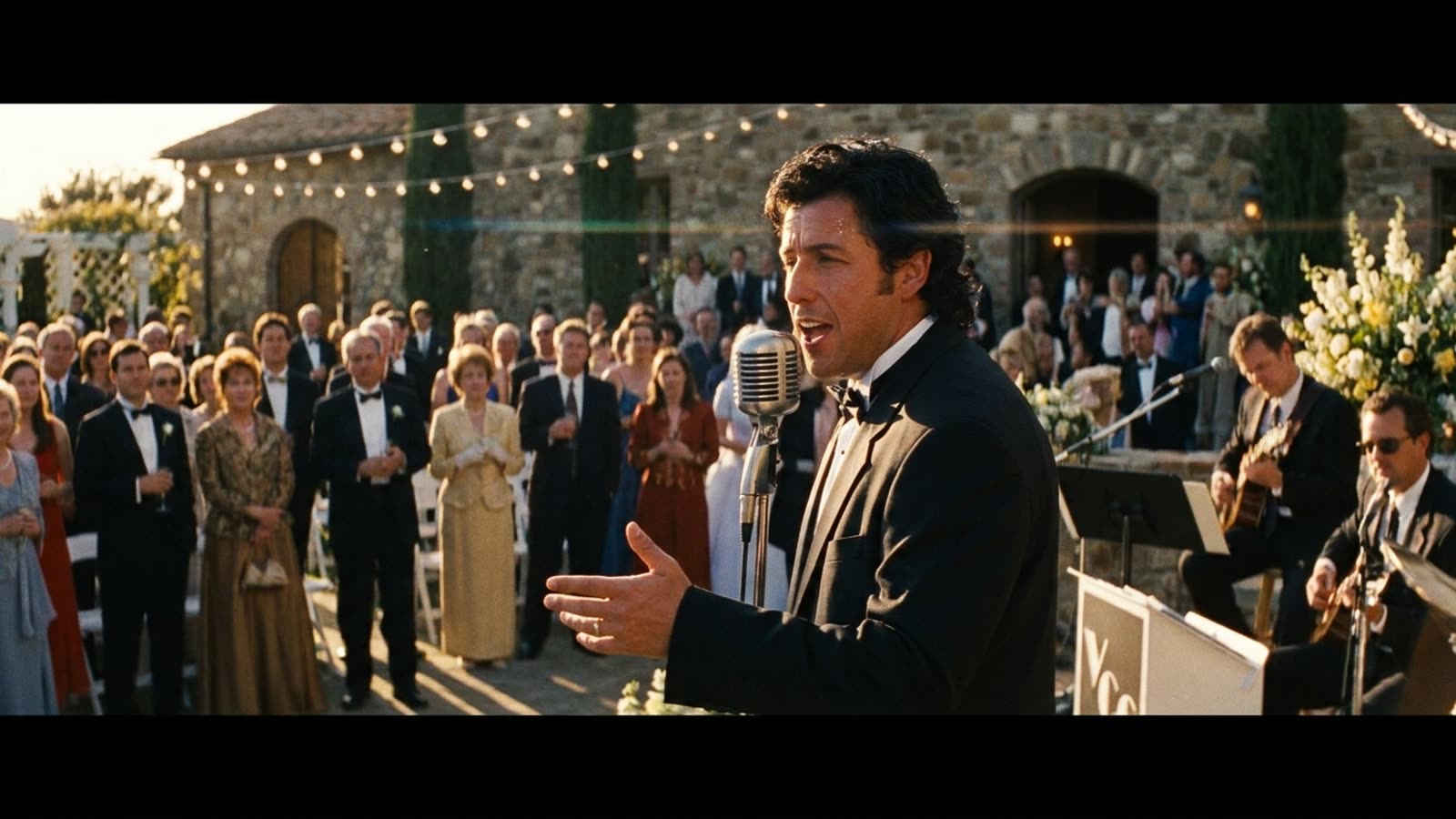
When Adam Sandler picked up a guitar at Taylor Swift and Travis Kelce's Fourth of July wedding, he was not simply entertaining guests—he was completing a joke three decades in the making.
The 1998 film The Wedding Singer cast Sandler as a lovelorn performer crooning at other people's receptions, forever the hired help at someone else's happiest day. Now, at what may be the most scrutinized American wedding since the Kennedys, he was doing exactly that—except this time as a billionaire friend of the bride, not a struggling musician in a rented tux. The internet, predictably, fractured into camps: those who found the meta-commentary delicious, and those who found it unbearably on-the-nose.
The performance that launched a thousand takes
Details remain fragmentary, filtered through guests' social media and tabloid sources with varying degrees of access. What is confirmed: Sandler performed at the reception, the song selection reportedly included at least one original composition, and the reaction inside the venue was reportedly rapturous. Outside, the discourse was less unified. "This is either the most self-aware wedding moment in celebrity history or the most insufferable," read one post that accumulated millions of views within hours.
The ambiguity is the point. Swift has built a career on Easter eggs and layered references; Sandler has built one on commitment to bits that outlast their welcome until they become beloved again. Together, they created a moment engineered for exactly the conversation it generated.
Why celebrity weddings still matter
The Kelce-Swift ceremony arrived at a peculiar moment for celebrity culture. The parasocial economy has never been more sophisticated—fans track private jets, decode jewelry choices, construct elaborate relationship timelines—yet the actual access has never been more controlled. There were no official photographs released as of this writing, no sanctioned livestream, no Vogue spread locked in before the vows. The wedding existed primarily as rumor, secondhand accounts, and carefully leaked fragments.
This scarcity is itself a strategy. In an attention economy flooded with content, the thing you cannot see becomes the thing most worth discussing. Swift, who has spent two decades mastering the architecture of anticipation, understands this better than perhaps any living entertainer.
Our take
Adam Sandler singing at Taylor Swift's wedding is, objectively, extremely funny—whether you find it funny-ha-ha or funny-strange depends entirely on your tolerance for celebrity self-mythology. The moment works because both parties are in on the joke and because the joke has enough layers to sustain interpretation. It is a wedding performance designed for people who will never attend the wedding, which is either a generous gift to fans or a slightly exhausting extension of the content machine into what should be a private ritual. Probably both. The best celebrity spectacles usually are.