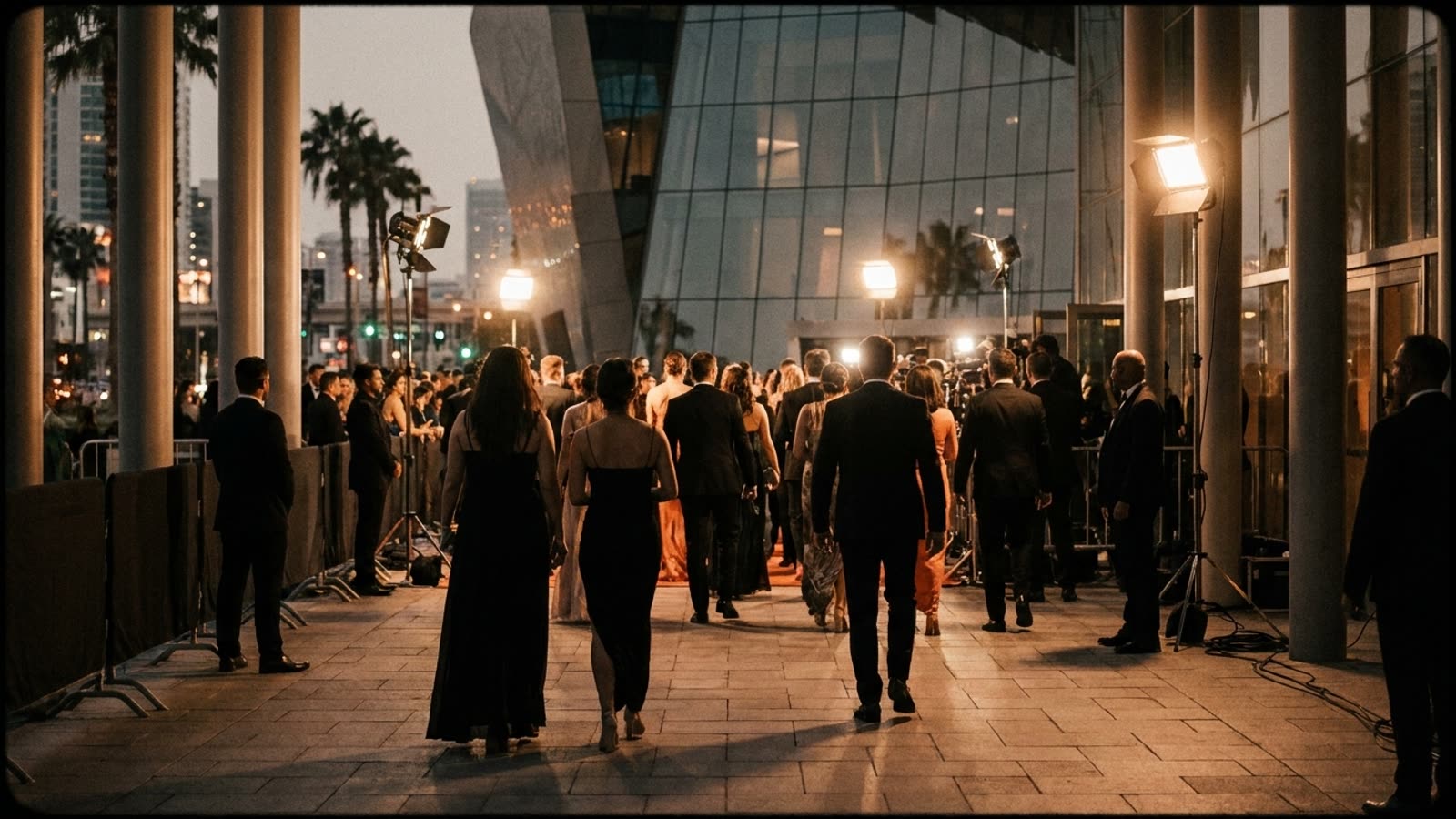
The Academy Museum Gala has become something rare in contemporary Hollywood: an event where showing up actually matters. Saturday night's sixth edition, held at the Renzo Piano-designed museum on Wilshire Boulevard, delivered the kind of concentrated star power that used to define the industry's self-image—before streaming fractured audiences and awards season became a year-round endurance test.
The guest list read like a deliberate rebuke to anyone who'd written off theatrical glamour. Sabrina Carpenter arrived in sculptural Schiaparelli. Jennifer Hudson chose architectural Valentino. Colman Domingo, fresh off another awards-season victory lap, wore custom Louis Vuitton with the easy confidence of someone who's figured out that menswear can be a statement. Charlize Theron, Jamie Lee Curtis, and Pamela Anderson represented three distinct eras of screen presence, each proving that Hollywood's relationship with aging remains more complicated—and more interesting—than the Botox discourse suggests.
The Emma Chamberlain factor
Perhaps the most telling presence was Emma Chamberlain, the 25-year-old content creator who's become fashion's favorite bridge between old media and new. Her look—a deliberate nod to classic Hollywood, styled with Chateau Marmont after-party energy—captured the gala's essential tension. "This is LA, baby," she told Vogue beforehand, and the statement landed as both celebration and slight irony. The gala needs Chamberlain's 20 million followers as much as she needs its institutional credibility.
Beauty as statement
Hailey Bieber's jet-black manicure became its own micro-story, a reminder that in 2026, nail art generates as much coverage as couture. Her longtime nail artist Zola Ganzorigt executed what might be called anti-glazed-donut nails—matte, severe, deliberate. The choice felt pointed: after years of the dewy, approachable aesthetic Bieber helped popularize, a pivot toward something harder-edged suggests the cultural mood is shifting.
The industry's mirror
The Academy Museum itself remains a fascinating institutional experiment—part archive, part theme park, part argument about what movies mean in an era when most people watch them on phones. The gala functions as its annual fundraising engine, but also as a kind of proof-of-concept: can Hollywood still generate the gravitational pull that once made it the world's dream factory?
Saturday's evidence suggests yes, conditionally. The red carpet produced genuinely memorable fashion moments. The mix of generations and fame-types felt curated rather than desperate. And the event's continued ability to attract designers, publicists, and photographers willing to treat it as a major moment indicates the industry hasn't entirely lost its sense of occasion.
Our take
The Academy Museum Gala works because it asks nothing of its attendees except presence and effort. No acceptance speeches, no competitive anxiety, no discourse about whether the wrong film won. Just beautiful clothes, strategic positioning, and the implicit argument that cinema deserves its own temple. In an industry that's spent the past five years in existential crisis, that's not nothing. It might even be the point.