Great athletes usually end their careers with a whimper or a triumph. Zinedine Zidane chose neither. He chose Marco Materazzi's chest.
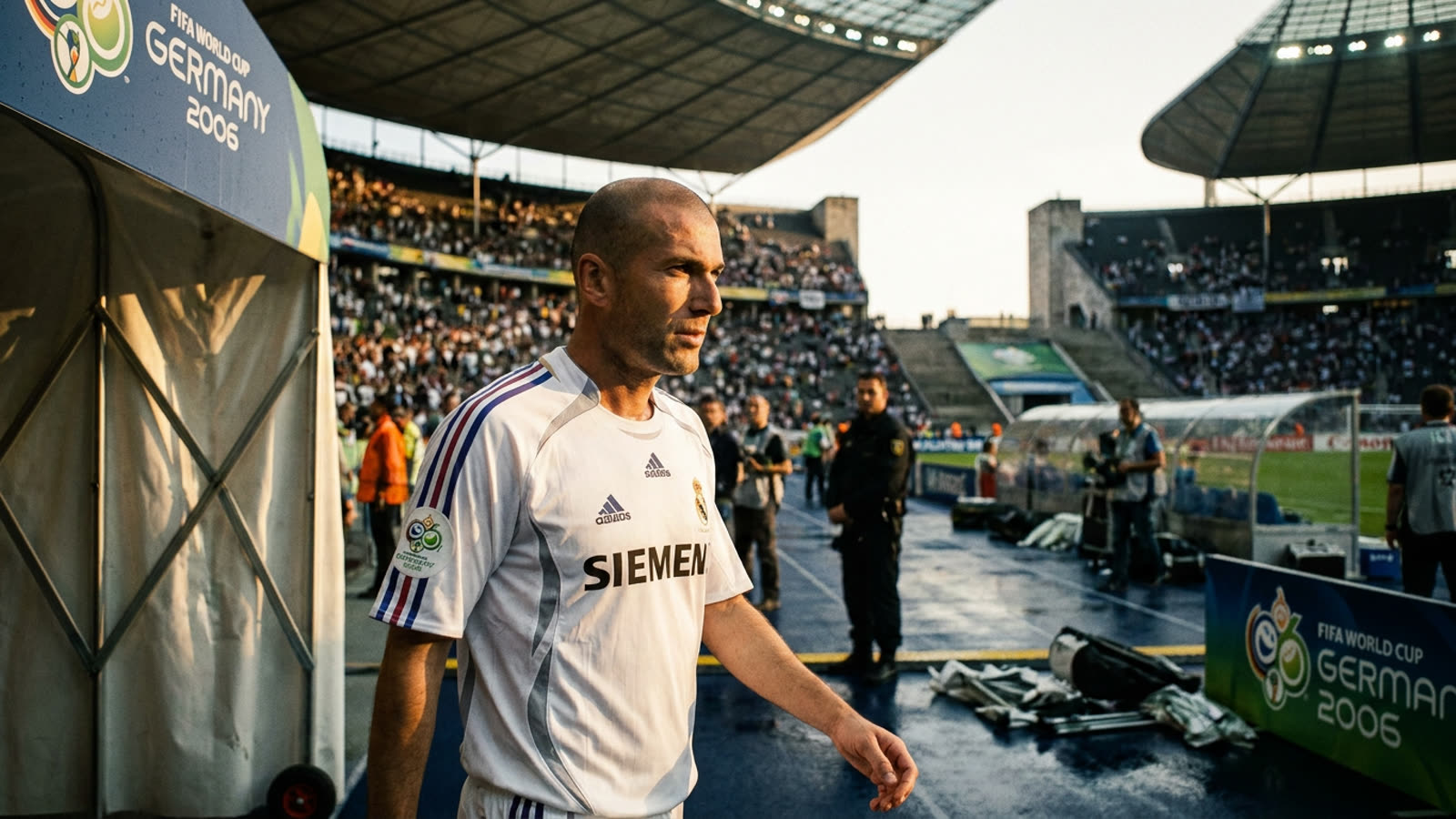
The 2006 World Cup final in Berlin was supposed to be Zidane's coronation, the perfect coda to a career that had already secured him status among football's elect. France led Italy 1-0 on his audacious Panenka penalty. Extra time beckoned. And then, in the 110th minute, Zidane walked calmly toward Materazzi, lowered his bald head, and drove it into the Italian defender's sternum. Red card. Exit. Silence. France lost on penalties. Zidane never played professionally again.
The moment was so strange, so complete in its self-destruction, that it transcended sport entirely. It became philosophy.
The act itself
What Materazzi said remains disputed — something about Zidane's sister, perhaps his mother, delivered in Italian across several exchanges as the players walked upfield. Zidane has never fully detailed it, offering only that the words were "very personal" and "about my mother and sister." Materazzi has given varying accounts. The precise insult matters less than Zidane's response to it: not a shove, not a verbal retort, but a deliberate, almost ceremonial act of violence.
Watch the footage again and notice how unhurried Zidane appears. He does not snap. He turns, walks several paces, and executes the headbutt with the same economy of motion he brought to a through ball. This was not rage but something closer to decision.
Why it endures
Sporting infamy usually fades or curdles into cautionary tale. Zidane's headbutt has done neither. It has become, improbably, part of his mystique — inseparable from the elegance, the two World Cup goals in 1998, the Champions League volleys. Artists have made sculptures of it. Philosophers have written essays. Algerian-French identity, colonial history, and masculine honor have all been excavated from those few seconds.
The headbutt endures because it is irreducible. It was obviously wrong and cost France a World Cup. It was also, in some register, an assertion of dignity — a refusal to let slurs pass even at the highest possible cost. Zidane himself has said he does not regret it, only the timing. This is not contrition. It is something stranger: a man at peace with having chosen honor over glory.
The Zidane paradox
As a player, Zidane was defined by control — the velvet first touch, the pirouette that made defenders look like they were moving through syrup. The headbutt was the opposite of control, yet it somehow confirmed his singularity. Lesser players lose their tempers and are forgotten. Zidane lost his temper and became myth.
His post-playing career has only deepened the paradox. As Real Madrid manager, he won three consecutive Champions League titles with a serene, almost passive demeanor that suggested the Berlin fury had been exorcised. Or perhaps it was always there, just beneath the surface, the same coiled intensity that made him great.
Our take
The headbutt was a catastrophe and a revelation. It showed that even the most controlled genius contains something ungovernable — and that this ungovernable thing might be the source of the genius itself. Football wants its heroes tidy: the humble winner, the gracious loser. Zidane gave us something more honest. He gave us a man who, at the summit of his profession, chose an insult over a trophy. Whether that was folly or integrity depends on what you believe sport is for. The fact that we are still asking is Zidane's final, and perhaps greatest, assist.