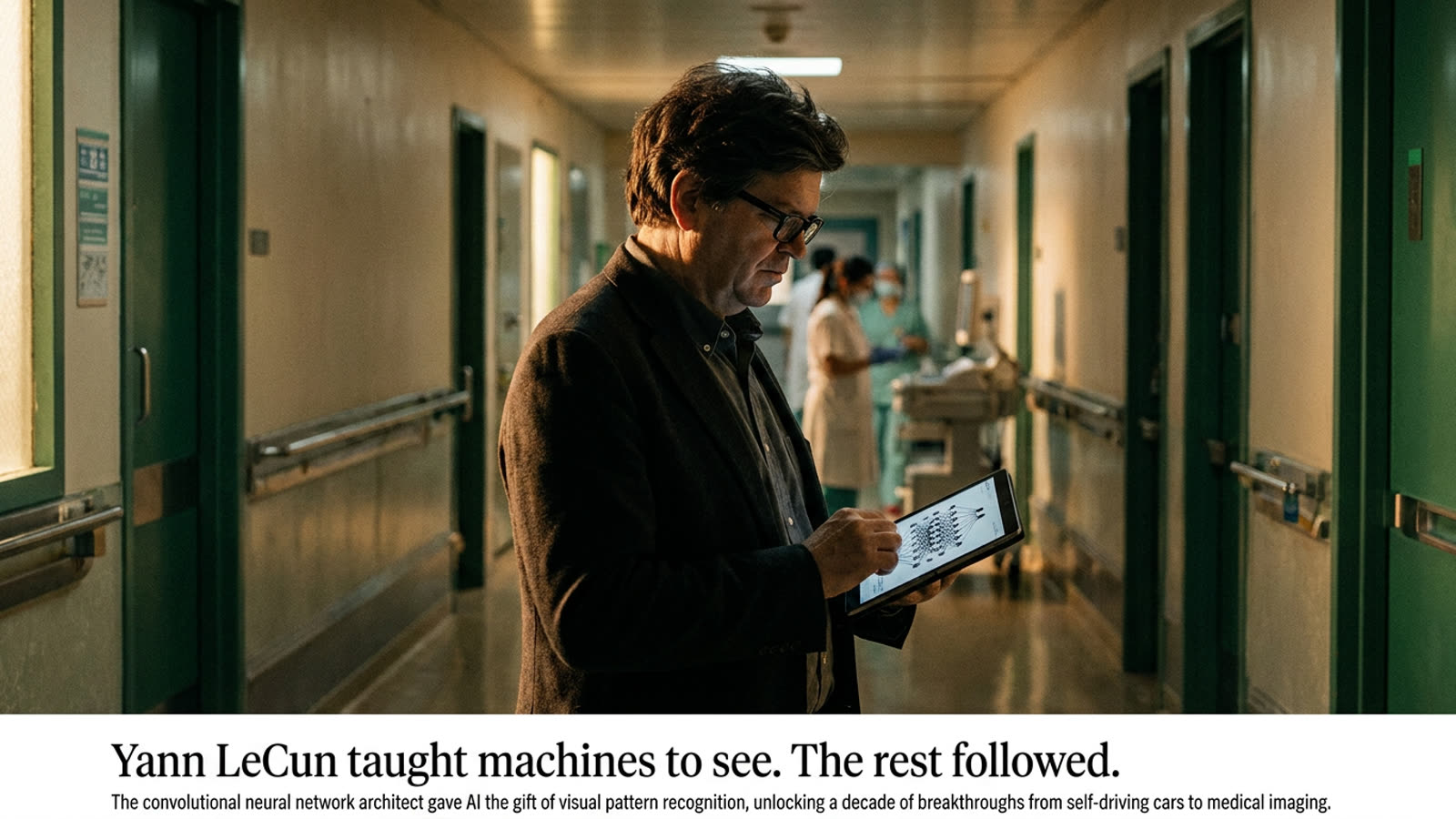
Before Yann LeCun, computers were functionally blind. They could process pixels, but they could not understand them. The French computer scientist's invention of convolutional neural networks in the late 1980s changed that, giving machines a structured way to recognize patterns in images by mimicking the hierarchical processing of the human visual cortex. His architecture, refined through the 1990s at Bell Labs and famously deployed to read handwritten digits on bank checks, laid dormant through the AI winter. Then ImageNet arrived, GPUs became cheap, and suddenly every breakthrough in computer vision traced back to the same blueprint LeCun had sketched decades earlier.
The insight was architectural. Traditional neural networks treated every pixel as an independent input, creating an explosion of parameters that made learning impossible. LeCun's convolutional layers instead scanned images with small filters, detecting edges and textures locally before pooling them into higher-order features. The approach was biologically inspired but computationally elegant: it preserved spatial relationships, reduced parameters exponentially, and made training feasible. By the time AlexNet won ImageNet in 2012 using a deep convolutional network, the design was nearly unchanged from LeCun's original papers.
The quiet decade
Between 1998 and 2012, convolutional networks were a niche tool. LeCun's LeNet-5 worked beautifully for digit recognition, processing millions of checks daily, but the hardware could not scale to natural images. Support vector machines and hand-crafted features dominated computer vision research. LeCun moved to New York University, continued publishing, and watched his architecture gather dust. The AI community had moved on to other problems. What changed was not the algorithm but the substrate: graphics processors designed for video games turned out to be perfect for the parallel matrix operations CNNs required, and ImageNet provided a dataset large enough to train them.
When Alex Krizhevsky, Ilya Sutskever, and Geoffrey Hinton trained an eight-layer convolutional network on two GPUs in 2012, they did not invent a new approach. They proved LeCun's design could scale. The error rate on ImageNet dropped by more than ten percentage points overnight. Within two years, every competitive vision system was a convolutional network. Within five, they were reading medical scans, driving cars, recognizing faces, and generating images. LeCun had been right all along; the world had simply needed to catch up.
The inheritance
Today, convolutional networks are infrastructure. They power facial recognition on smartphones, quality control in manufacturing, tumor detection in radiology, and content moderation on social platforms. The architecture has been refined—residual connections, batch normalization, attention mechanisms—but the core logic remains LeCun's. Even transformer models, which have displaced CNNs in some domains, borrow the idea of local processing and hierarchical feature extraction. The vision transformer is a convolutional network in different clothing.
LeCun now leads AI research at Meta and remains one of the field's most vocal figures, advocating for self-supervised learning and criticizing hype around large language models. He shares a Turing Award with Hinton and Yoshua Bengio, the trio often called the godfathers of deep learning. But his singular contribution is the convolutional network: the architecture that taught machines to see, and in doing so, made modern AI possible.
Our take
LeCun's career is a reminder that timing matters as much as insight. He built the right tool two decades before the world had the hardware to use it, and he kept building while others moved on. The convolutional network is now so fundamental that it is easy to forget it was once a contrarian bet. Every autonomous vehicle, every medical AI, every image generator stands on that foundation. LeCun did not just solve a problem; he created the vocabulary for an entire generation of solutions.