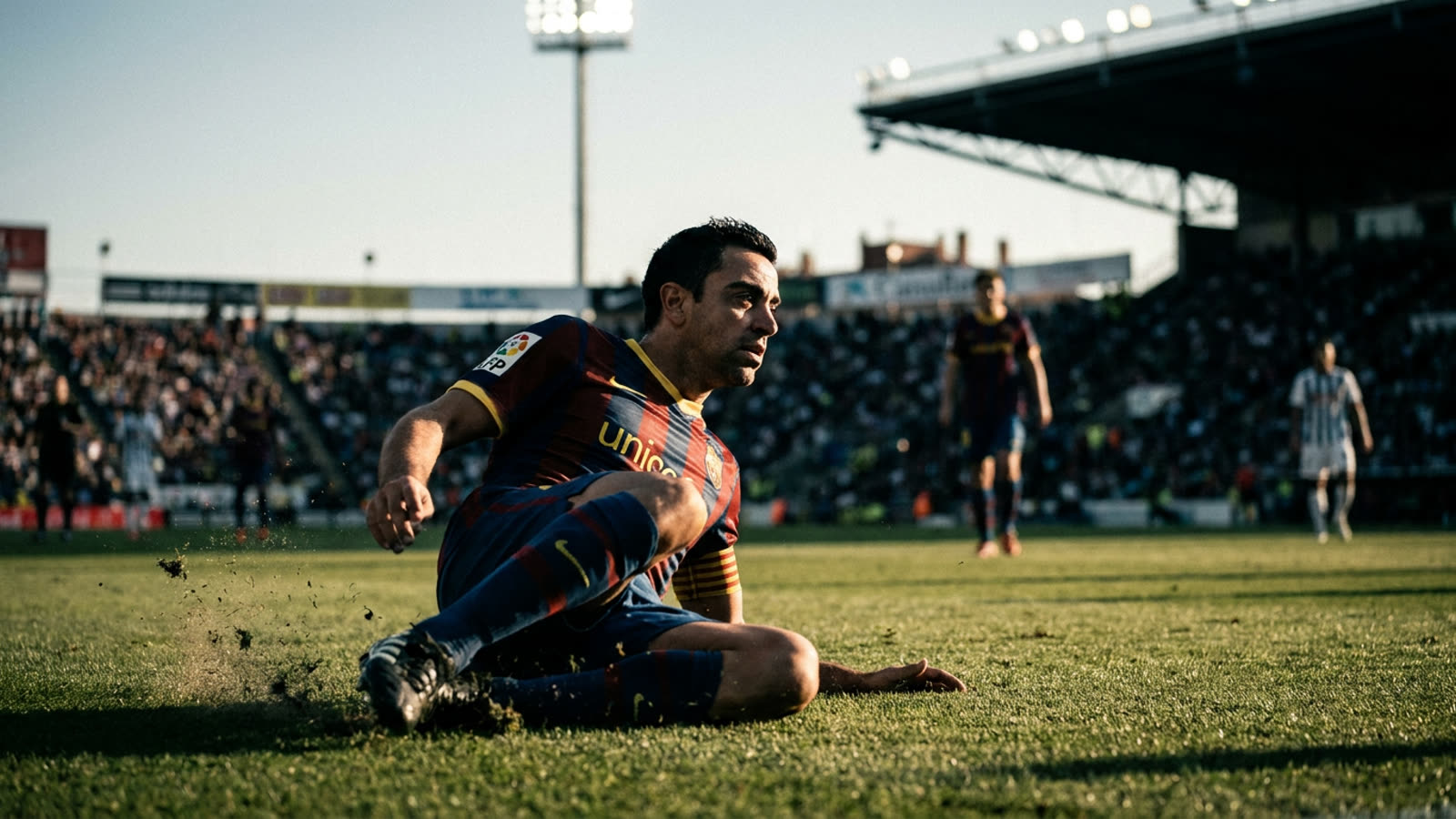
There is a clip from the 2010 World Cup semifinal against Germany that coaches still use in training sessions. Spain has possession in their own half, under no particular pressure. Xavi Hernández receives the ball, takes two touches, and plays a simple pass to Sergio Busquets. Nothing happens. Except everything happens: in those two touches, Xavi has shifted his body angle twice, drawing three German players toward him, opening a corridor on the right flank that Spain will exploit ninety seconds later for Carles Puyol's winning header from a corner. The goal will be credited to Puyol. The corner to the winger who won it. But the architecture was Xavi's.
This was his genius, and it remains difficult to categorize. He was not fast. He was not physical. His shot was adequate, not fearsome. What Xavi possessed was an almost supernatural understanding of space—where it existed, where it would exist, and how to manipulate opponents into creating more of it.
The anti-athlete who dominated athletics
Xavi came through La Masia, Barcelona's academy, at a time when English football still worshipped the box-to-box midfielder who could tackle, run, and shoot. He was none of those things. In a different era, or at a different club, he might have been discarded as too slight, too slow, too cerebral. Instead, he became the metronome of the most dominant club and international sides of the early twenty-first century.
His partnership with Andrés Iniesta—another diminutive technician—was the engine of Spain's unprecedented run: Euro 2008, the 2010 World Cup, Euro 2012. Three consecutive major tournament victories, a feat no nation had achieved before. At Barcelona, the numbers were similarly absurd: multiple Champions League titles, La Liga championships that blurred together, a style of play so distinctive it earned its own suffix (tiki-taka, though Xavi himself disliked the term, finding it reductive).
Possession as philosophy
What made Xavi singular was not just his passing accuracy—though it routinely exceeded ninety percent—but his understanding of what possession meant. For him, having the ball was not merely a prerequisite for scoring; it was a form of defensive control. The opponent cannot hurt you if they cannot touch the ball. This sounds obvious. Executing it for ninety minutes, against elite opposition, requires a kind of cognitive endurance that cannot be taught.
He played, by his own description, with his head constantly swiveling, taking mental snapshots of the pitch before the ball arrived. By the time it reached his foot, he already knew his next three options. This is why he so rarely lost possession, and why watching him could feel, paradoxically, both mesmerizing and undramatic. There were no desperate lunges, no last-ditch recoveries. Just an endless, patient circulation, until the defense made a mistake.
Our take
Xavi's legacy is complicated by what came after: his managerial tenure at Barcelona was uneven, the tiki-taka style fell somewhat out of fashion as pressing football grew more aggressive, and younger fans may know him primarily through highlight reels rather than full matches. But his influence persists in every midfielder who is told that vision matters more than velocity, that the best pass is often the simplest one, and that controlling a game is not about dominating your opponent physically but about making them run where you want them to run. Football is a geometry problem. Xavi solved it with a compass and a metronome, and the sport is still catching up.