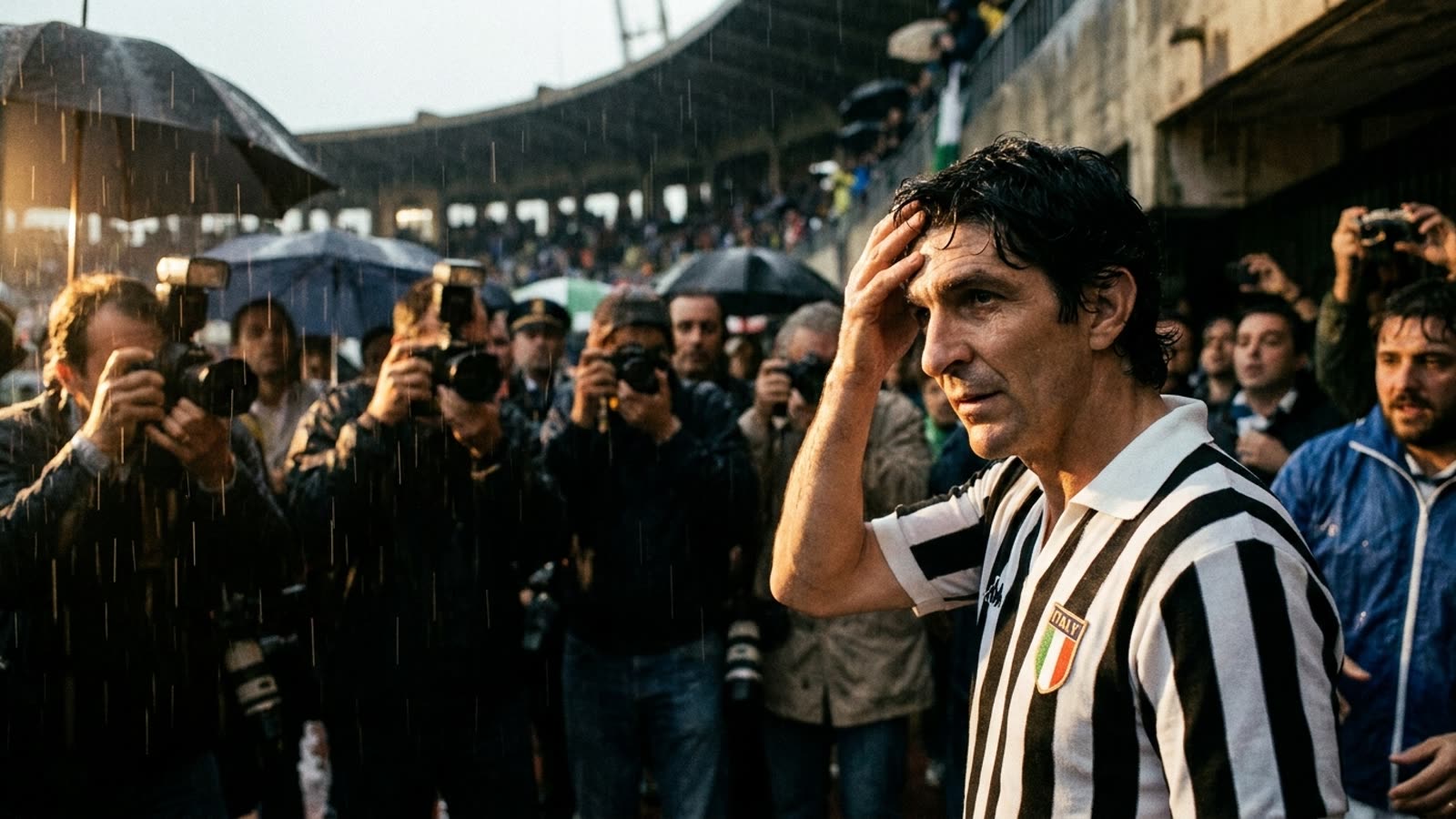
The most remarkable thing about Paolo Rossi's 1982 World Cup is not that he won the Golden Boot, the Golden Ball, and the trophy in a single tournament. It is that three weeks before kickoff, the Italian public wanted him nowhere near the squad.
Rossi had just completed a two-year ban for his involvement in the Totonero match-fixing scandal, a sentence reduced on appeal from three years. He had played only three club matches since his suspension ended. His fitness was questionable, his form nonexistent, and his reputation—at least in the newspapers—irreparably damaged. When manager Enzo Bearzot selected him anyway, the Italian press corps declared a boycott of the national team. For the duration of the tournament, Bearzot and his players refused to speak to journalists. The siege mentality was complete.
What followed is well documented but still defies rational explanation. Rossi was invisible through the group stage, failing to score in draws against Poland, Peru, and Cameroon. Italy squeaked through on goal difference. Then came the second group phase and a match against Brazil that many still consider the greatest World Cup game ever played. Rossi scored a hat-trick. Three days later, against Poland in the semifinal, he scored both goals. In the final against West Germany, he opened the scoring. Six goals in three matches, all of them decisive, all of them from a player who had looked finished.
The mechanics of resurrection
Rossi's physical gifts were never extraordinary. He was slight, not particularly fast, and possessed no signature skill that coaches could diagram. What he had was an almost supernatural sense of where the ball would arrive a half-second before anyone else realized it. His movement was constant and subtle, a series of small adjustments that created space invisible to defenders until it was too late. In 1982, this instinct had not atrophied during his ban—it had, if anything, sharpened through deprivation.
Bearzot understood something the critics did not: Rossi's game required no conditioning peak. He was not a player who beat opponents through acceleration or endurance. He was a player who beat opponents through anticipation, and anticipation does not fade with match fitness. The manager's gamble was not on Rossi's legs but on his mind, and the mind remembered everything.
The convenient forgetting
What makes the Rossi narrative uncomfortable is how quickly the match-fixing taint evaporated. By the time the team returned to Rome, he was a national hero, the scandal reframed as a minor detour rather than a serious ethical breach. The Italian football federation, which had banned him, now celebrated him. The journalists who had demanded his exclusion wrote hagiographies. The public, which had booed him weeks earlier, named children after him.
This is the pattern with sporting redemption: victory does not absolve the sin so much as it makes the sin inconvenient to remember. Rossi served his ban, which satisfied the formal requirements of justice, but his rehabilitation was not earned through contrition or transparency. It was earned through goals. Had he failed in Spain, the match-fixing would have defined his legacy. Because he succeeded, it became a footnote.
The Bearzot question
Bearzot's role is often sentimentalized as loyalty rewarded, the wise old manager who believed when no one else would. But there is another reading: Bearzot needed Rossi more than Rossi needed redemption. Italy's attack was sterile without a true poacher, and Bearzot had no viable alternative. His faith was as much pragmatism as principle. The manager's genius was recognizing that public opinion is not a selection criterion and that newspapers do not defend corners. He picked the best available player and let the results handle the narrative.
Our take
Paolo Rossi's 1982 World Cup is taught as inspiration, proof that second chances exist and that talent will out. It is also a case study in how success launders history. The match-fixing scandal involved real corruption, real damage to the sport's integrity, and real victims in the form of bettors and clubs who played fair. Rossi paid a price, returned, and performed brilliantly—but brilliance is not the same as innocence, and our eagerness to conflate them says more about our need for clean narratives than about the man himself. He was a magnificent footballer. He was also lucky that magnificence, in sport, functions as its own absolution.