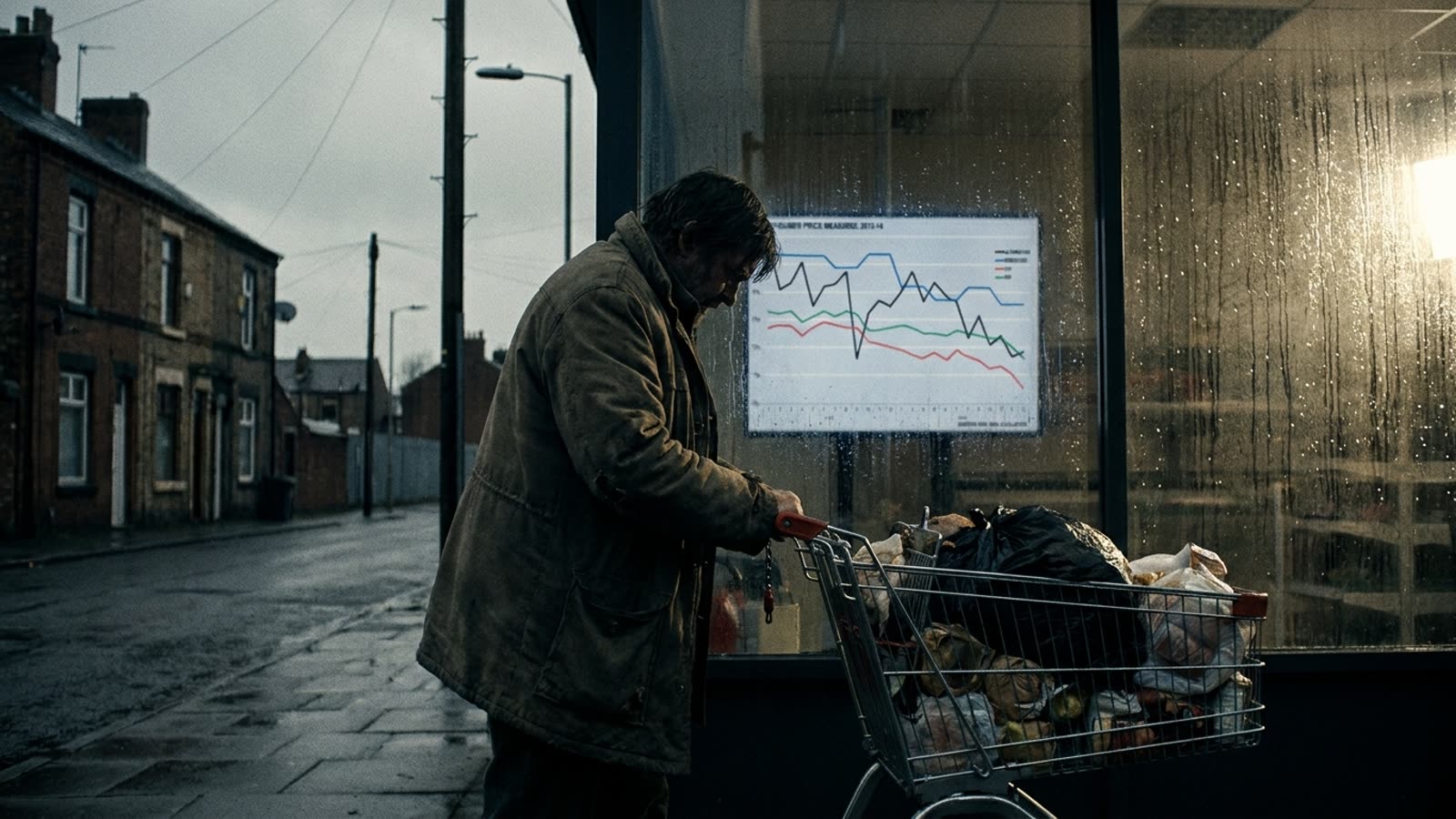
There is a persistent, uncomfortable gap between what governments report about inflation and what people feel at the checkout counter, the gas pump, and the rent office. This is not a conspiracy. It is a measurement problem baked into how we define price stability, and it has consequences that extend far beyond economic statistics into political legitimacy itself.
The divergence is real and explicable. Consumer price indices measure average price changes across a representative basket of goods, weighted by spending patterns derived from surveys conducted years earlier. But households do not experience averages. They experience the specific prices of the specific things they buy, with the specific frequency they buy them.
The frequency illusion is not an illusion
Groceries and gasoline are purchased weekly or more often. Housing, healthcare, and education are purchased rarely or through opaque mechanisms like payroll deductions and insurance premiums. When milk, eggs, and fuel spike, the psychological salience is enormous—these are prices encountered repeatedly, in cash, with full attention. When health insurance premiums rise by similar percentages, the pain is diffuse, often absorbed by employers, and encountered perhaps once annually during open enrollment.
This is not irrational. Behavioral economists have documented that frequently encountered prices anchor expectations more heavily than infrequent ones. A family that sees egg prices double notices inflation viscerally, even if their streaming subscriptions, smartphone costs, and airline tickets have declined in quality-adjusted terms.
The substitution problem
Official inflation measures assume households substitute toward cheaper alternatives when prices rise. If beef becomes expensive, the model assumes you buy chicken. If name-brand cereal spikes, you switch to store-brand. This substitution bias keeps measured inflation lower than a fixed-basket approach would show.
The logic is defensible for statistical purposes. But it misses something important about how people experience economic life. Being forced to substitute is itself a welfare loss. The family that wanted beef and now eats chicken has experienced a decline in living standards that does not appear in the inflation statistics. They are, in a meaningful sense, poorer—even if the numbers say otherwise.
Housing's long shadow
Perhaps no category generates more measurement controversy than shelter costs. In most countries, official indices use a concept called owners' equivalent rent—an estimate of what homeowners would pay to rent their own homes. This smooths out the wild swings in actual home prices and mortgage rates, which is statistically sensible but experientially absurd.
A first-time buyer facing a market where prices have risen dramatically and mortgage rates have doubled does not feel the gentle measured inflation the statistics report. They feel locked out. The index captures housing costs for a hypothetical average household; it does not capture the reality for households trying to form, move, or upsize.
Our take
The gap between measured and felt inflation is not evidence that statisticians are lying or incompetent. They are doing precisely what they were asked to do: measure average price changes in a methodologically consistent way. The problem is that this measurement was never designed to capture lived experience, and when institutions treat the two as equivalent, they invite justified skepticism. Central bankers and politicians who dismiss public inflation concerns by pointing to official figures are making a category error—confusing a useful abstraction for the thing itself. Rebuilding trust requires acknowledging that both numbers can be true: inflation can be moderate by historical standards and genuinely painful for millions of households simultaneously.