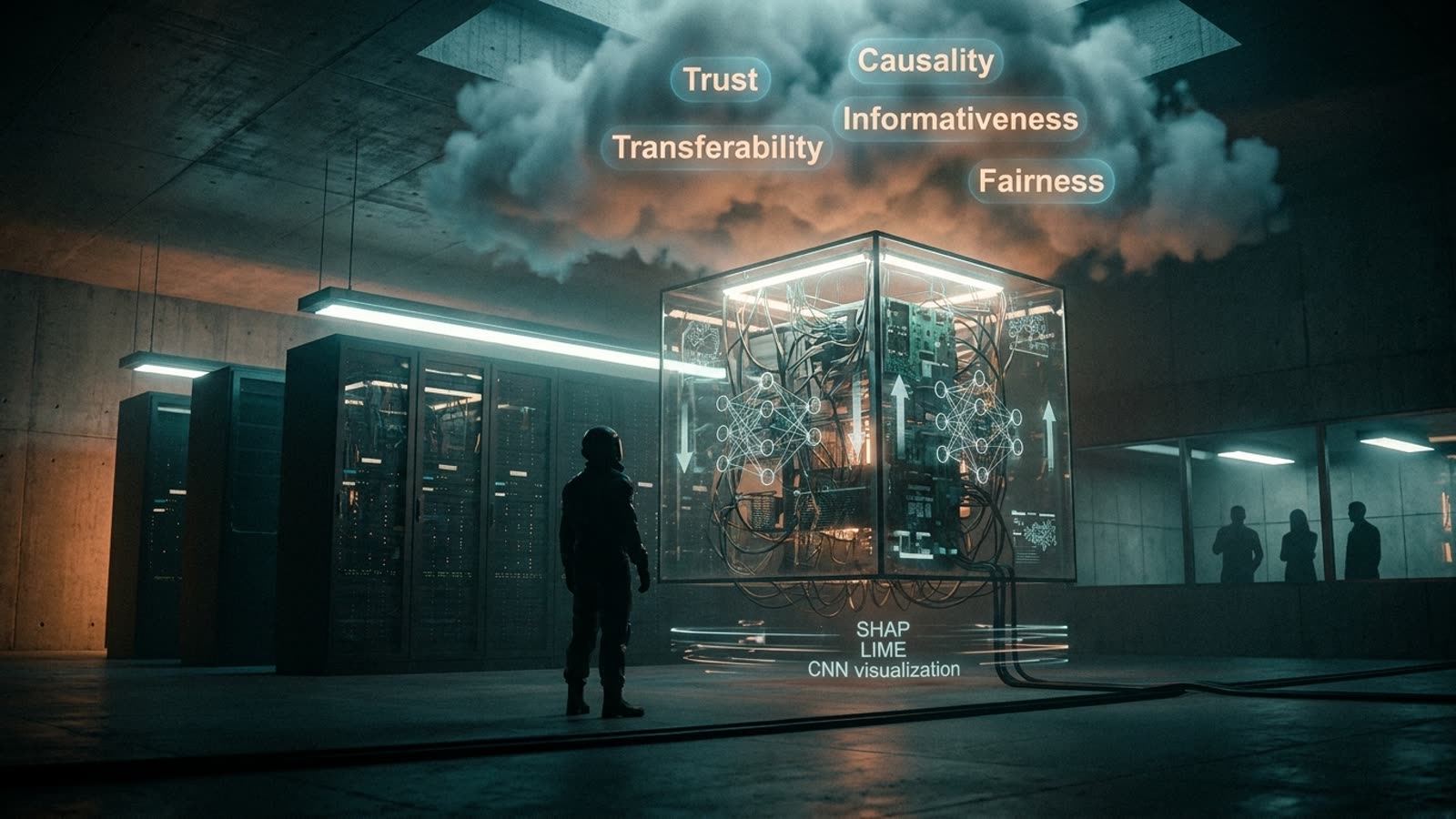
The most powerful artificial intelligence systems in the world share an uncomfortable trait with the human brain: they cannot fully explain how they reach their conclusions. This is not a temporary limitation awaiting a clever engineering fix. It is a structural feature of how neural networks learn, and it poses one of the most consequential challenges in modern technology.
When a large language model generates a response or an image classifier identifies a tumor, the system is not following a set of explicit rules that a programmer wrote down. Instead, it is activating patterns across millions or billions of numerical parameters that were adjusted during training on vast datasets. The "reasoning" — if we can call it that — is distributed across these parameters in ways that resist human interpretation. We can observe inputs and outputs, but the middle remains stubbornly opaque.
Why interpretability is so hard
The challenge begins with scale. A modern large language model contains parameters numbering in the hundreds of billions, organized into layers that transform information in cascading sequences. Each individual parameter is just a number, meaningless in isolation. Meaning emerges only from their collective interaction, much as consciousness emerges from neurons that are, individually, just electrochemical switches.
Researchers have developed techniques to probe these systems. Attention maps show which parts of an input the model focuses on. Probing classifiers test whether intermediate layers encode specific concepts. Mechanistic interpretability attempts to reverse-engineer small circuits within networks. Yet these methods offer glimpses rather than comprehension. Knowing that a model attends to certain words does not tell us why it weighted them as it did, or how that weighting interacted with everything else the model has learned.
The problem compounds because neural networks do not separate their knowledge into discrete, labeled modules. A single parameter might contribute to the model's understanding of grammar, its knowledge of history, and its sense of appropriate tone — all simultaneously. This distributed representation is precisely what makes neural networks so powerful and so resistant to explanation.
The stakes keep rising
This opacity might be tolerable for systems that recommend movies or autocomplete emails. It becomes alarming when AI influences medical diagnoses, criminal sentencing, loan approvals, and military targeting. Regulators increasingly demand that consequential automated decisions be explainable, yet the most capable systems are the least explainable. This creates a troubling inverse relationship between power and accountability.
Some organizations have responded by using simpler, more interpretable models for high-stakes decisions — decision trees, logistic regression, rule-based systems whose logic can be audited. But these models often perform worse than neural networks, creating pressure to deploy the black boxes anyway and paper over the interpretability gap with post-hoc rationalizations. A cottage industry has emerged around generating explanations for neural network outputs, though critics argue these explanations often describe what the model did rather than why.
Our take
The honest position is that we have built systems we do not understand and deployed them at civilizational scale. This is not unprecedented — we have long used medicines whose mechanisms we grasped only partially — but the speed and breadth of AI deployment outpaces anything comparable. The black box problem will not be solved by a breakthrough paper or a regulatory mandate. It is baked into the mathematics of how these systems learn. The question is not whether we can make AI fully transparent, but whether we can develop sufficient trust and oversight mechanisms for systems that will remain, in some fundamental sense, mysterious even to their creators.