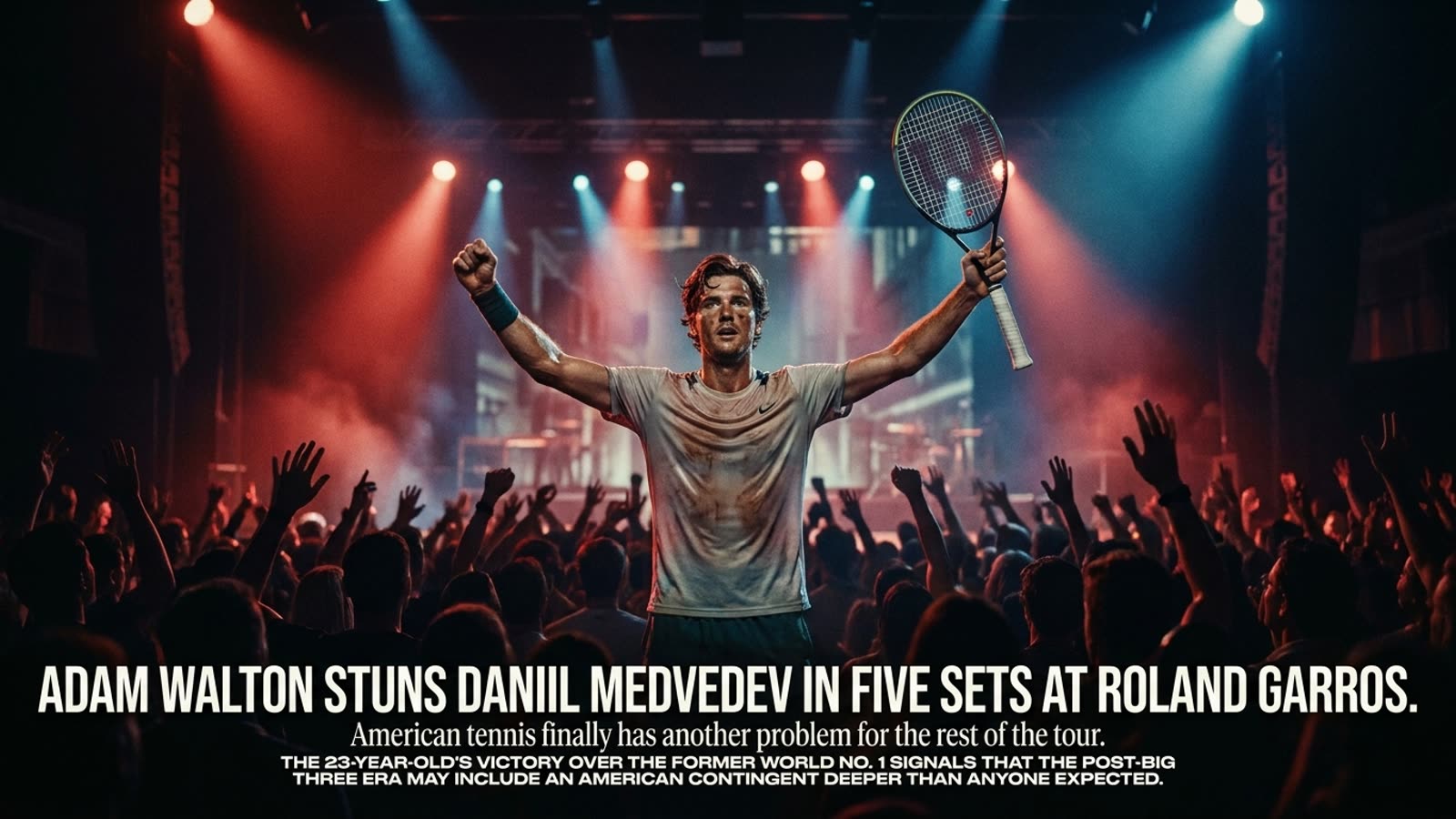
For years, the question hovering over American men's tennis was whether anyone besides Taylor Fritz and Frances Tiafoe could consistently trouble the sport's elite. Adam Walton just answered with a five-set demolition of Daniil Medvedev on the terre battue of Roland Garros, and the implications extend well beyond a single second-round result.
Walton, 23, came into Paris ranked outside the top 50 with a clay-court record that suggested competence rather than menace. Medvedev, despite his well-documented struggles on the surface, remains one of the most analytically gifted players in the game — a former US Open champion whose defensive retrieving has frustrated better movers than Walton on faster courts. That the American found a way to outlast him over five sets speaks to something more durable than a hot afternoon.
The tactical blueprint
What made Walton's victory notable was not its drama but its coherence. He refused to engage in the extended baseline rallies that Medvedev uses to suffocate opponents, instead taking the ball early and targeting the Russian's backhand with heavy topspin that kicked awkwardly on the slow Parisian clay. When Medvedev retreated to his comfort zone — eight feet behind the baseline, absorbing pace — Walton came forward, converting break points with drop shots that died in the service boxes.
This is not how Americans have traditionally won on clay. The playbook has usually involved overwhelming power from the baseline, hoping to end points before the surface's high bounce could neutralize pace. Walton played like someone who had studied the European clay-court grinders and decided to beat them at their own game while retaining American aggression.
Depth beyond the obvious names
Fritz remains the highest-ranked American man and the most likely to make deep runs at majors. Tiafoe brings athleticism and crowd energy that can carry him through volatile five-setters. But the emergence of Walton — alongside Ben Shelton's continued development and Learner Tien's junior success — suggests the pipeline is producing players with varied games rather than interchangeable baseline bombers.
The USTA's player development program has faced criticism for decades, accused of prioritizing power over tactical sophistication. Whether Walton's clay-court education came from the federation or his own initiative, the result is a player who looks comfortable on a surface that has historically eaten Americans alive. His next match will test whether the Medvedev result was an anomaly or a statement.
Our take
One upset does not make a career, and Walton will need to prove he can sustain this level against the Alcarazes and Sinners who await in later rounds. But the manner of the victory matters. He did not simply outlast Medvedev through attrition or benefit from an opponent's collapse — he imposed a tactical vision and executed it over five sets against a player who has reached multiple Grand Slam finals. American men's tennis has spent years waiting for reinforcements. They may have just arrived in Paris.