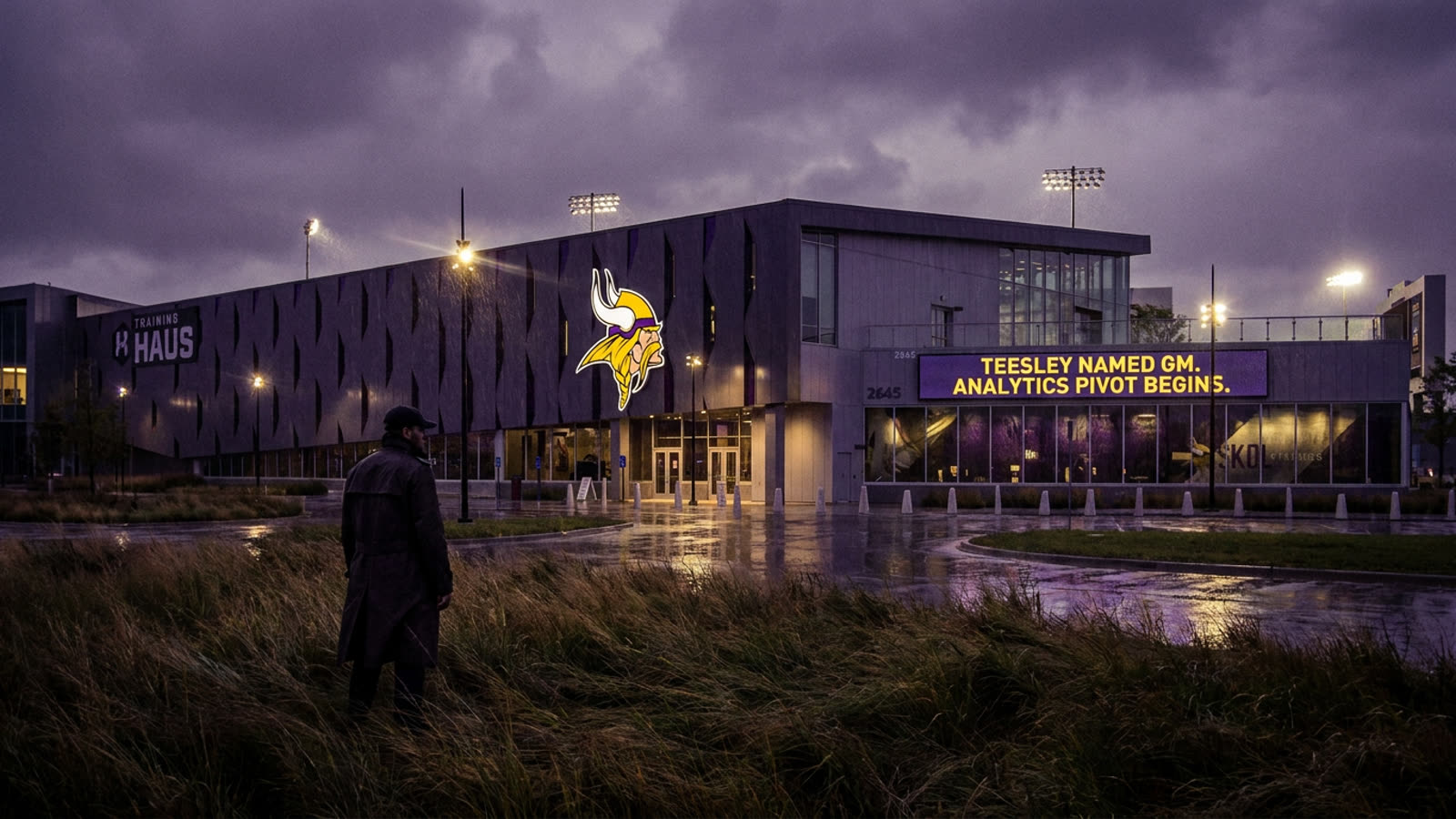
The Minnesota Vikings have spent the better part of two decades cycling through general managers the way lesser franchises cycle through punters—frequently, hopefully, and with diminishing returns. Trent Teasley, poached from the Seattle Seahawks' personnel department, represents either the next chapter of that futility or its overdue conclusion. The early evidence suggests the latter.
Teasley arrives in Minneapolis with a reputation built on two pillars: an almost obsessive devotion to positional value analytics and a knack for identifying late-round defensive talent that outperforms its draft slot. In Seattle, he was instrumental in reshaping a secondary that had grown old and expensive into one that was young and merely adequate—a lateral move on paper, but one that freed capital for other positions. Minnesota, with its own aging cornerback room and a quarterback situation that remains curiously stable, offers him a larger canvas.
The NFC North calculus
The timing matters. Green Bay is in the midst of a generational transition that has gone worse than advertised. Detroit, last year's division darling, faces a salary cap reckoning that will force difficult choices at receiver and along the defensive line. Chicago remains Chicago. The Vikings, by contrast, have draft capital, a functional offensive line, and a fan base so conditioned to heartbreak that mere competence would feel like a parade.
Teasley's first order of business will be the 2027 draft, for which Minnesota holds an extra second-round pick acquired in last year's trade-down maneuvering. His second will be deciding whether the current defensive coordinator, whose scheme has been described by players as "aggressive to the point of self-harm," fits the new regime's vision. Early indications suggest the answer is no.
Why Seattle let him go
The Seahawks' willingness to part with Teasley speaks less to his limitations than to their own organizational confusion. Seattle has cycled through three head coaches in five years and appears no closer to settling on a coherent identity. Teasley, according to people familiar with the situation, grew frustrated with the lack of long-term planning and made clear he would entertain outside opportunities. Minnesota, which had been conducting a quiet search since parting ways with its previous GM in April, moved quickly.
The hire also reflects a broader trend: the collapse of the traditional GM archetype. Teasley has never been a scout in the classic sense—he didn't spend years driving through Texas high schools or sleeping in budget motels near SEC campuses. His background is in data science, applied first to baseball before he pivoted to football. The Vikings, in choosing him, are betting that the sport's analytical revolution is no longer coming but has already arrived.
Our take
Minnesota has made worse bets. Teasley is young, hungry, and inherits a situation that is genuinely better than its reputation. The NFC North is there for the taking if anyone in Purple can summon the nerve to take it. Whether Teasley is that person remains unknowable, but the Vikings have at least hired someone with a theory of the case rather than another retread hoping to replicate past glories. In a league where most front offices are content to copy last year's Super Bowl winner, that counts as progress.