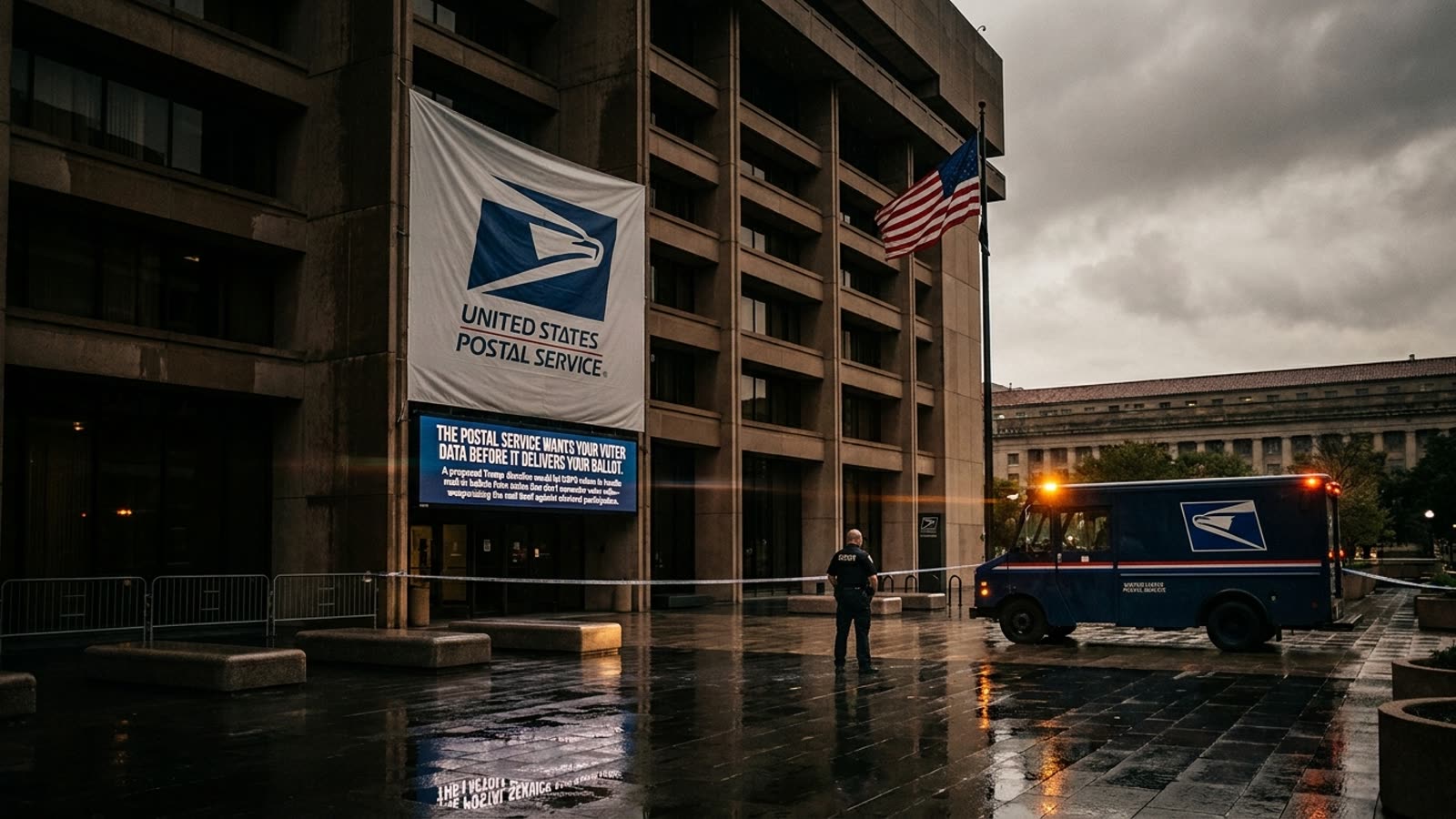
The United States Postal Service, that most banal of federal institutions, is preparing to become a gatekeeper of American democracy. Under a plan for a forthcoming Trump directive, USPS would decline to deliver mail ballots to states that refuse to hand over their voter registration lists to the federal government. The proposal represents something genuinely novel in American electoral history: the transformation of mail delivery from neutral infrastructure into a conditional service, available only to jurisdictions that comply with federal data demands.
The logic, such as it is, runs like this: the administration argues that voter list access would help USPS "verify" that ballots reach legitimate voters and reduce fraud. Never mind that mail ballot fraud remains vanishingly rare—a Heritage Foundation database, hardly a Democratic-friendly source, documents fewer than 1,500 proven cases over two decades across all fifty states. Never mind that states already maintain their own verification systems. The real innovation here is conceptual: treating the mail as leverage rather than service.
The constitutional collision course
Elections in America are administered by states, not Washington. This is not a partisan preference but a constitutional structure, one that has survived civil war, world wars, and countless attempts at federal overreach. The proposed directive would not technically federalize elections—it would simply make state-run elections logistically impossible for any jurisdiction that values voter privacy over federal compliance. The distinction is academic when the practical effect is identical.
Blue states with robust mail voting—California, Oregon, Washington, Colorado—would face an immediate choice: surrender voter data to an administration many of their residents distrust, or watch their primary mechanism for democratic participation collapse. Red states that have expanded mail voting for rural convenience would face the same dilemma, though their political calculus differs.
The privacy problem nobody is discussing
Voter registration data is already semi-public in most states, available to campaigns and researchers under various restrictions. But there is a meaningful difference between state-controlled access with audit trails and wholesale transfer to federal authorities. The directive would create, for the first time, a centralized federal database of who votes, where they live, and how they prefer to cast ballots. In an era of sophisticated data analytics, this is not neutral information—it is a targeting system.
The administration has offered no clarity on how such data would be stored, who would access it, or what would prevent its use for purposes beyond mail delivery. These are not hypothetical concerns. Federal databases have been breached before; political data has been weaponized before. The burden of proof should rest on those demanding the data, not those protecting it.
Our take
This proposal deserves to be understood for what it is: not election security, but election conditioning. The Postal Service delivers packages from foreign adversaries without demanding recipient lists from Amazon. It delivers prescription medications without demanding patient rolls from pharmacies. The sudden insistence that ballot delivery requires voter data is a solution in search of a problem, and the problem it actually solves is voter participation in states that decline to bend the knee. Whether courts will tolerate this remains to be seen. Whether Americans should is not a close question.