There is something faintly absurd about coveting a notepad. It is, after all, a stack of paper bound by glue, destined for grocery lists and phone numbers scrawled in haste. Yet for a devoted subset of travelers, the branded stationery of fine hotels—the embossed letterhead, the weighty envelopes, the pencils stamped with a crest—represents something worth preserving, even mourning. As properties quietly discontinue their paper programs in favor of tablets and QR codes, collectors are engaged in a slow-motion rescue operation, salvaging the last artifacts of an era when hotels understood that luxury lived in the details.
The anatomy of a dying art
The golden age of hotel stationery ran roughly from the late nineteenth century through the 1980s, when grand establishments competed not merely on thread count but on the quality of their correspondence materials. The Ritz Paris commissioned custom watermarks. Claridge's in London maintained its own typeface. The Beverly Hills Hotel's pink paper became so iconic that guests would write letters they didn't need to send, simply to deploy the stationery. These weren't amenities; they were invitations to inhabit a fantasy, to become temporarily the sort of person who dashes off notes on embossed cream stock.
The economics were never rational. A proper stationery program—letterhead, envelopes, notepads, postcards, luggage tags, "Do Not Disturb" hangers—required dedicated storage, regular restocking, and the services of a printer who understood that the Pantone shade of a logo was non-negotiable. Most guests never touched the stuff. But the ones who did remembered.
The collectors and their logic
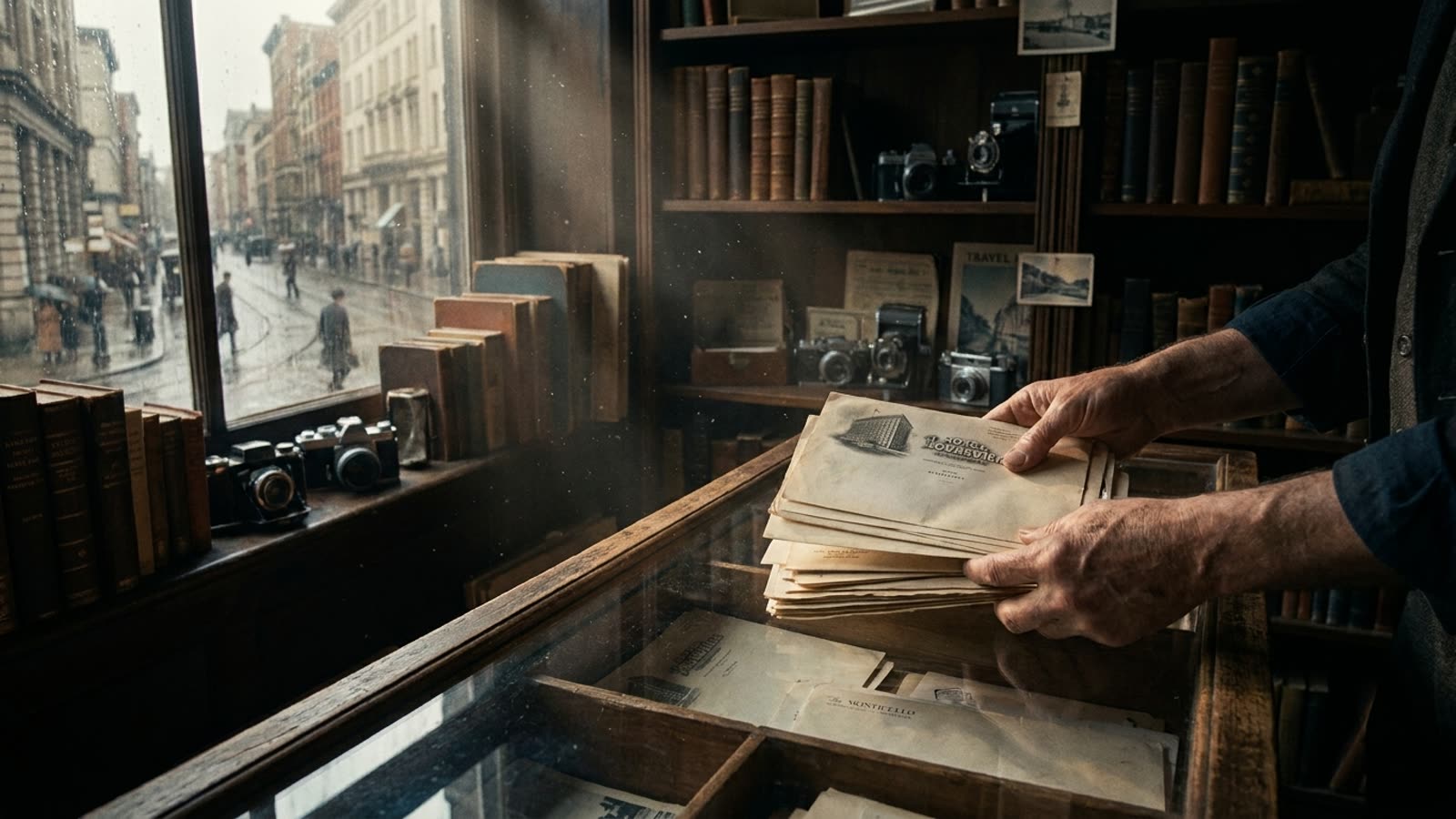
The community that trades in vintage hotel paper is small, obsessive, and surprisingly well-organized. Online forums catalog finds by decade and continent. Auction houses occasionally surface lots from estate sales—the correspondence files of mid-century executives who stayed at the same properties for decades, their letters a geographic autobiography written on hotel stock from Tokyo to Buenos Aires.
What drives the obsession? Partly nostalgia for an analog world, certainly. But collectors speak more often about specificity. A notepad from the Hotel & Cafe Royal in 1920s London is a physical artifact of a particular place at a particular moment, designed by someone who cared about kerning. It cannot be replicated by a Notes app. The paper itself carries information: the weight, the tooth, the way ink bleeds or doesn't. In an age of infinite identical pixels, that materiality feels almost radical.
What replaced it
Modern hotels haven't abandoned the impulse entirely—they've redirected it. The Four Seasons still provisions writing desks. The Aman properties maintain their minimalist notepads. But the energy has shifted toward experiences that photograph well: the welcome amenity arranged just so, the turndown ritual, the curated playlist. These are lovely. They are also ephemeral in a different way, existing primarily as content rather than keepsake.
The few properties that have doubled down on paper report that it resonates disproportionately with younger guests, the same cohort supposedly allergic to anything analog. There may be a lesson here about scarcity and intention. A hotel that still stocks proper stationery is making a statement about time—yours and theirs.
Our take
The notepad was never about the notepad. It was about a hotel saying, wordlessly, that it had anticipated your needs before you knew you had them. That kind of attention is expensive and inefficient and increasingly rare, which is precisely why a stack of embossed paper can feel, in the right light, like a small act of resistance against the frictionless and the forgettable. The collectors aren't hoarding stationery. They're hoarding evidence that someone, somewhere, once sweated the details.