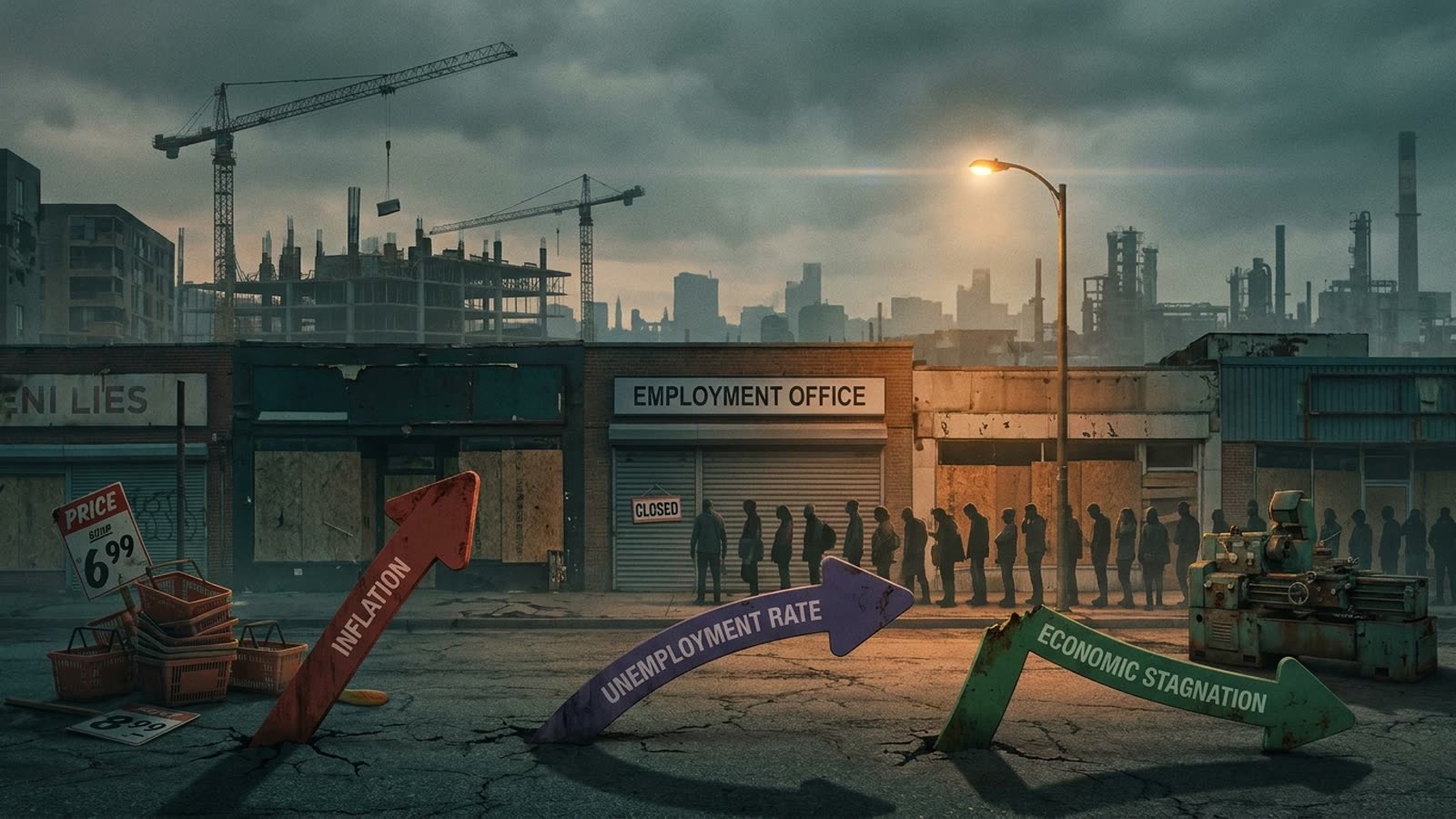
Most economic ailments come with their own cure built into the diagnosis. Recession? Cut interest rates, stimulate spending, wait for the rebound. Inflation running hot? Raise rates, cool demand, watch prices stabilize. But stagflation — the toxic combination of stagnant growth, high unemployment, and persistent inflation — offers no such comfort. It is the economic equivalent of a fever that won't break, where the medicine for one symptom worsens the others.
The term itself is a portmanteau born of desperation, coined in the British Parliament during the late 1960s when the United Kingdom found itself trapped between rising prices and rising joblessness. Within a decade, the condition had spread to the United States and much of the industrialized world, upending the economic consensus that had governed postwar prosperity.
Why it shouldn't exist (but does)
For most of the twentieth century, economists operated under the assumption that inflation and unemployment moved in opposite directions. This relationship, formalized as the Phillips Curve, suggested policymakers faced a manageable trade-off: accept slightly higher inflation to keep unemployment low, or tolerate more joblessness to keep prices stable. The 1970s shattered this framework.
The proximate cause was the oil shock of 1973, when OPEC's embargo quadrupled petroleum prices virtually overnight. But the deeper problem was that advanced economies had grown dependent on cheap energy, and the sudden price spike rippled through every sector simultaneously. Businesses faced higher input costs and passed them to consumers. Workers demanded higher wages to keep pace. Central banks, unsure whether to fight inflation or support growth, often did neither effectively.
The result was a decade of economic misery that reshaped political landscapes on both sides of the Atlantic.
The policy trap
What makes stagflation so pernicious is that it paralyzes the institutions designed to manage economic cycles. Central banks can raise interest rates to crush inflation, but doing so risks deepening the recession and throwing more people out of work. They can cut rates to stimulate growth, but that risks sending inflation spiraling further upward. Fiscal policy faces similar constraints: government spending might boost employment but also feeds inflationary pressure.
The eventual solution in the early 1980s was brutal. The U.S. Federal Reserve, under Paul Volcker, raised interest rates to punishing levels — the prime rate exceeded twenty percent — deliberately inducing a severe recession to break the inflationary psychology that had taken hold. It worked, but at enormous human cost. Unemployment peaked above ten percent, industries collapsed, and the political consequences reverberated for years.
Our take
Stagflation remains the specter that haunts every serious economic policymaker, the scenario that keeps central bankers awake at night. Its lessons are uncomfortable ones: that supply shocks can overwhelm demand management, that expectations can become self-fulfilling, and that sometimes the only way out is through considerable pain. For ordinary households, the practical implication is sobering. In a stagflationary environment, the usual hedges fail. Cash loses value to inflation while assets stagnate. Job security erodes even as the cost of living climbs. Understanding the mechanism won't make it less painful, but it might at least prevent the false comfort of expecting a quick fix.