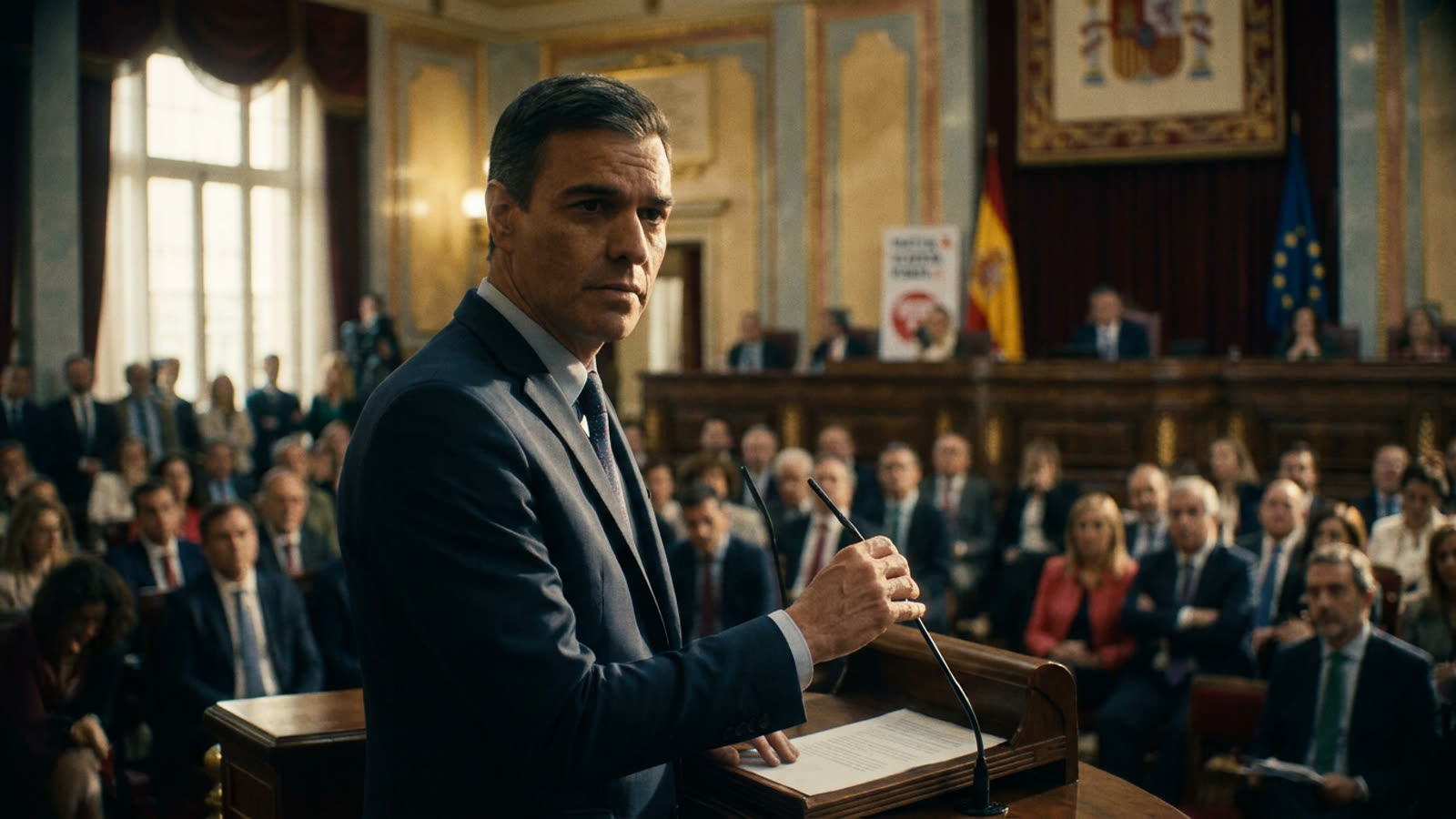
The Spanish prime minister who once theatrically offered to resign over attacks on his wife has returned to parliament to defend himself against something more corrosive: allegations that his inner circle traded on proximity to power. Pedro Sánchez's address to lawmakers this week marks the most precarious moment of his political career, and the outcome will shape whether Europe's progressive flank can hold against a continental rightward drift.
The scandal centers on accusations that figures close to Sánchez—including his wife, Begoña Gómez, and former aides—leveraged government connections for personal and business advantage. Judicial investigations remain ongoing, but the political damage compounds daily. Opposition leader Alberto Núñez Feijóo and the hard-right Vox party have seized on every drip of leaked testimony, demanding early elections that polls suggest would end socialist rule.
A coalition built on contradictions
Sánchez governs through an improbable arithmetic: his Socialist Workers' Party relies on Catalan separatists, Basque nationalists, and the far-left Sumar alliance to maintain a parliamentary majority. Each faction has its own threshold for tolerating scandal. The Catalan parties, who extracted an amnesty law for independence leaders as the price of their support, have so far remained publicly loyal. But their patience is transactional, not tribal. If Sánchez becomes an electoral liability, the calculus shifts.
The prime minister's strategy has been characteristic: defiance wrapped in victimhood. He has framed the investigations as a "lawfare" campaign orchestrated by conservative judges and media outlets. In April, he took five days of "reflection" before announcing he would remain in office, a gambit that rallied his base but struck many Spaniards as self-indulgent melodrama during a governance crisis.
The European context
Sánchez is not merely fighting for his job; he is fighting for a model of left-wing governance that has become increasingly rare on the continent. France's left is fractured and out of power. Germany's Social Democrats lead a coalition so unpopular that the far-right AfD polls first in several states. Italy is governed by Giorgia Meloni's post-fascist coalition. If Spain's Socialists fall, the European Council loses one of its few remaining progressive voices at a moment when migration policy, Ukraine support, and fiscal rules are all in flux.
The irony is that Sánchez's domestic record is defensible by most center-left metrics: unemployment has fallen, minimum wages have risen, and Spain avoided the worst of the energy crisis through early intervention. But corruption allegations have a way of erasing policy achievements from public memory. Voters rarely reward competence when they suspect venality.
Our take
Sánchez may survive this parliamentary showdown—his coalition partners have little appetite for elections they might lose—but survival is not vindication. The drip of judicial proceedings will continue through the summer, each headline a small cut. The prime minister's best hope is that investigators find nothing prosecutable and public fatigue sets in. His worst fear should be that the Spanish electorate, like so many others in Europe, decides that the left's moral authority has been exhausted. The construction project that is European social democracy cannot afford another condemned building.