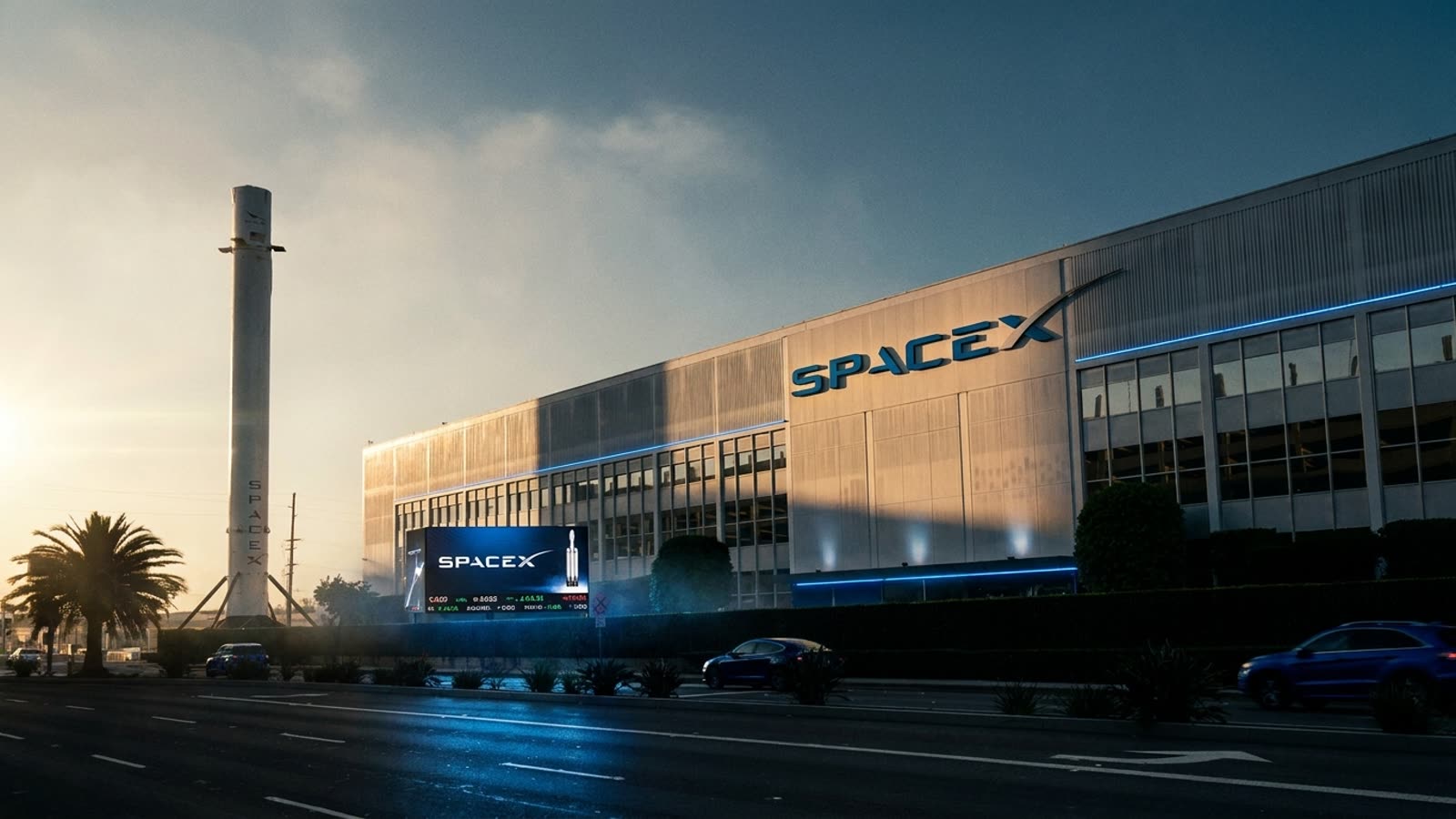
When SpaceX eventually goes public, the financial press will fixate on the obvious: Elon Musk, already the world's wealthiest person, will add tens of billions more to his net worth. His inner circle—a small cadre of early investors and loyalists—will cash out handsomely. The mechanics of wealth creation will function exactly as designed.
But the more consequential story is what the IPO reveals about the strange new topology of American capitalism, where a single individual can simultaneously run the dominant electric vehicle manufacturer, the essential satellite internet provider, the government's primary launch contractor, and a social media platform that shapes political discourse—all while serving as a senior advisor to the President of the United States.
The valuation puzzle
SpaceX's private market valuation has soared past $350 billion, making it the most valuable private company in history. That figure reflects genuine technological achievement: Starlink has become indispensable infrastructure, the Falcon 9 is the workhorse of global launch services, and Starship represents the most ambitious rocket program since Apollo. By any conventional metric, SpaceX is an extraordinary business.
Yet conventional metrics struggle with a company whose competitive moat is partly regulatory. SpaceX holds the vast majority of U.S. government launch contracts. Its Starlink service has become critical military communications infrastructure in active conflict zones. The company's relationship with federal agencies is less vendor-client than symbiotic dependency. How do you price that in a prospectus?
The governance question
Public markets impose disclosure requirements and fiduciary duties that private companies can avoid. SpaceX will need to explain, in legally binding documents, how it manages conflicts of interest when its chairman advises the administration that awards its contracts. It will need to articulate succession risk for a company whose brand is indistinguishable from its founder's persona.
Institutional investors will face their own uncomfortable questions. Index funds that must buy every large-cap stock will become de facto stakeholders in Musk's political project. ESG-focused funds will need to decide whether a company accelerating humanity's multiplanetary future outweighs concerns about its founder's public conduct. The IPO will force capital allocators to make explicit choices they've avoided while SpaceX remained private.
Our take
The SpaceX IPO is less a liquidity event than a stress test for American corporate governance. We have spent a decade watching the consequences of founder-worship—the WeWorks, the FTXs, the Theranoses—and learning nothing. Musk is not a fraud; SpaceX's rockets actually work. But the question isn't competence. It's whether public markets can function as a check on concentrated power, or whether they've become merely another mechanism for its amplification. The prospectus will be fascinating reading. The answer will take longer to arrive.