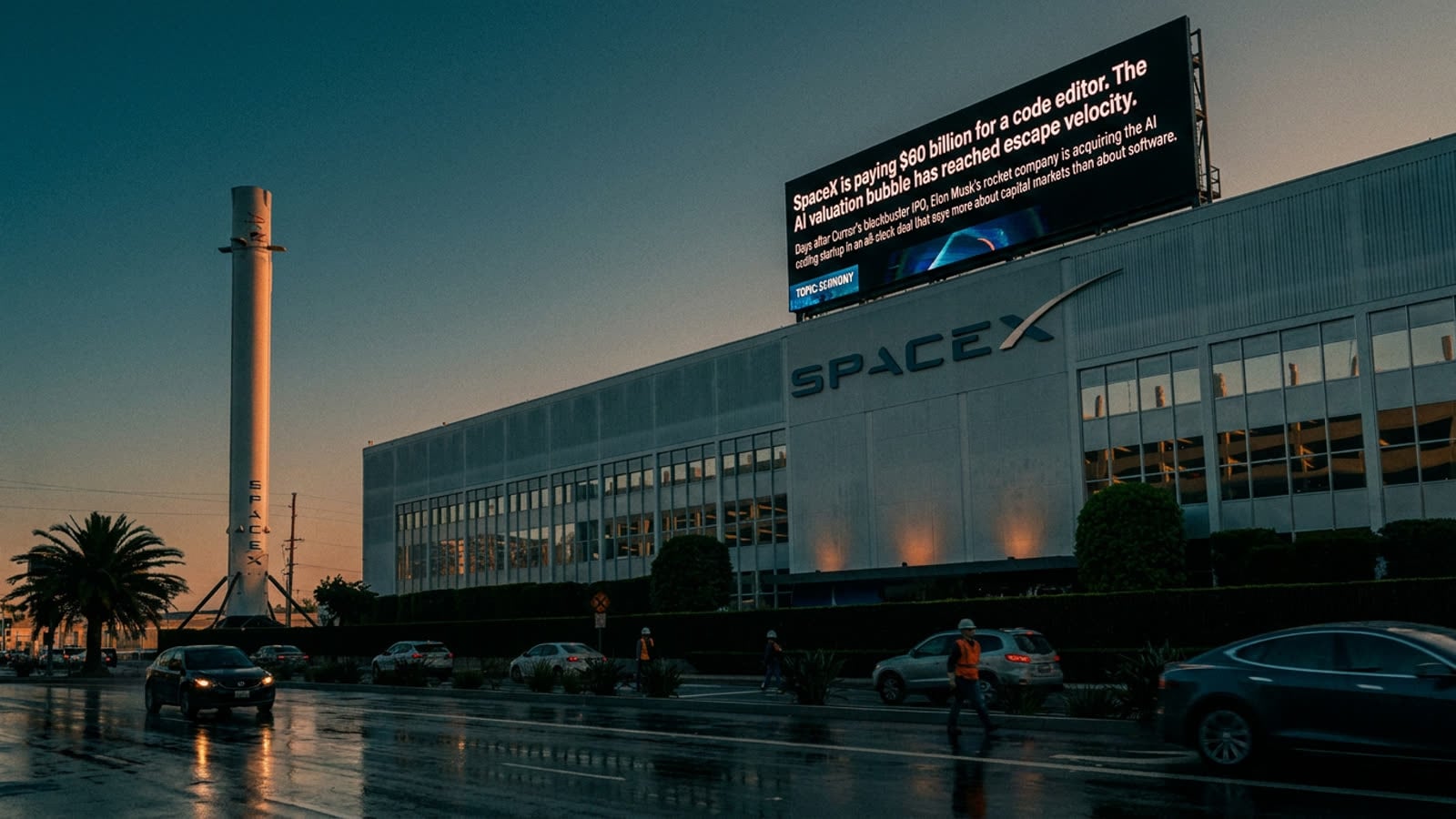
A company that makes rockets is buying a company that makes autocomplete for programmers, and the price tag has more zeros than most nations' GDP. SpaceX's agreement to acquire Cursor for $60 billion in stock, announced just days after the AI coding assistant's initial public offering, represents either a visionary bet on the future of software development or the clearest signal yet that we have lost all sense of proportion.
The deal values Cursor at roughly what Boeing was worth before its recent troubles — for a product that, however useful, remains fundamentally a sophisticated text-prediction tool layered atop large language models that Cursor itself does not own.
The strategic logic, such as it is
SpaceX's rationale centers on software velocity. The company's Starlink satellite constellation, its Starship program, and its growing defense contracts all require enormous amounts of code. Cursor's AI-assisted development environment has genuinely improved programmer productivity — most estimates suggest 20-40 percent gains for routine coding tasks. For a company shipping as much software as SpaceX, those gains compound.
But $60 billion buys a lot of programmers. At $300,000 fully loaded per senior engineer, SpaceX could hire 200,000 developers for a year. The acquisition math only works if you believe Cursor's technology will remain differentiated for decades, that competitors cannot replicate its capabilities, and that SpaceX stock — the acquisition currency — will hold its value. Each assumption is contestable.
What the deal reveals about AI valuations
Cursor's IPO priced the company at approximately $45 billion, already a staggering multiple for a firm with perhaps $500 million in annual recurring revenue. SpaceX's 33 percent premium suggests either that public markets underpriced the offering or that private acquirers are now so flush with appreciated stock that price discipline has evaporated.
The latter explanation fits the moment. SpaceX itself has seen its private valuation climb past $350 billion on the strength of Starlink's growth and government contracts. When your equity is worth that much on paper, spending $60 billion feels less like a financial decision than a strategic gesture. The deal is paid entirely in stock, meaning SpaceX parts with no cash and merely dilutes existing shareholders by roughly 17 percent.
This is how bubbles perpetuate themselves: appreciated assets purchase other appreciated assets, each transaction validating the other's valuation, until someone eventually needs to convert paper wealth into actual money.
The coding-assistant arms race
Cursor's acquisition removes an independent player from an increasingly consolidated market. Microsoft owns GitHub Copilot. Google has Gemini Code Assist. Amazon offers CodeWhisperer. Now SpaceX controls Cursor. The remaining independent AI coding tools — Replit, Codeium, Tabnine — will face pressure either to sell or to find deep-pocketed patrons of their own.
For developers, the consolidation raises uncomfortable questions. Will Cursor remain available to SpaceX competitors? Will the tool's training data, which includes patterns from millions of programmers, now serve primarily one company's interests? SpaceX says Cursor will operate independently, but corporate independence pledges have a poor survival rate.
Our take
The deal will close, the bankers will collect their fees, and the financial press will move on to the next nine-figure acquisition. But something has shifted when a rocket company pays Boeing-level money for a text editor, however intelligent. We are not witnessing the future of software development so much as the present of capital markets — a world where stock appreciation has become its own justification, where strategic logic follows valuation rather than preceding it. Cursor makes a genuinely useful product. Whether it makes a $60 billion product is a question that only a correction can answer.