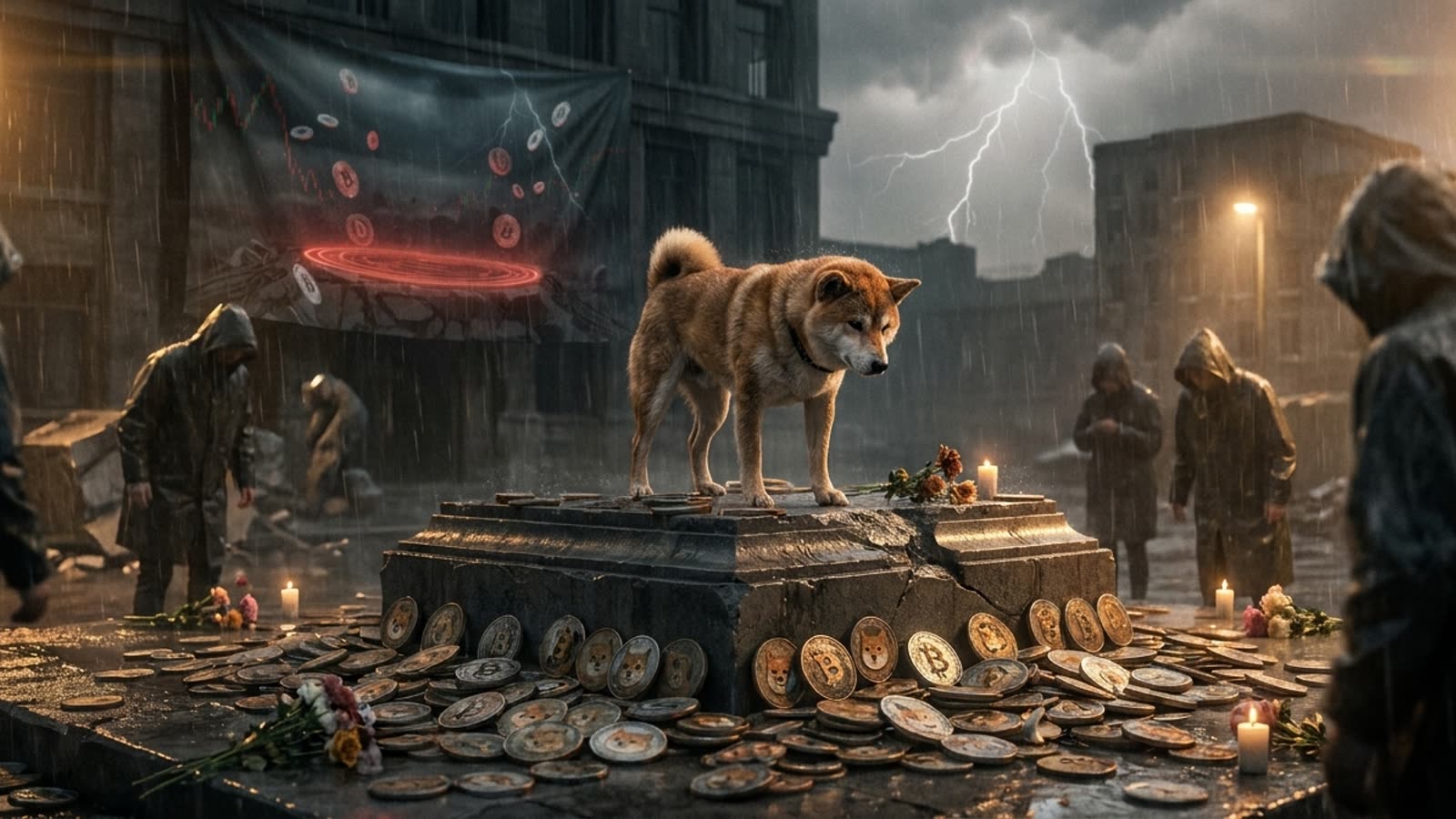
The joke stopped being funny sometime around the third zero after the decimal point. Shiba Inu, the self-described "Dogecoin killer" that once commanded a market capitalisation north of $40 billion, now trades at $0.00000425—a figure so microscopically small it requires scientific notation to discuss seriously. The token dropped another 6.7 percent in the past 24 hours, extending a year-long decline of nearly 64 percent that has quietly erased tens of billions in notional retail wealth.
This is not a crash. Crashes are dramatic, newsworthy, the stuff of congressional hearings. What SHIB is experiencing is something more instructive: a slow, grinding capitulation as the last true believers finally accept that a token created as a joke about a joke about a dog was never going to become money.
The anatomy of a meme coin death spiral
SHIB's trajectory follows a pattern now familiar to anyone who has watched the crypto markets long enough. The token launched in August 2020 as an explicit parody of Dogecoin, which was itself a parody of Bitcoin. It attracted attention through sheer audacity—a quadrillion-token supply, a "Woofpaper" instead of a whitepaper, and a community that treated ironic detachment as a virtue.
The 2021 bull market transformed this joke into a phenomenon. At its peak, SHIB briefly flipped Dogecoin by market cap, minted a handful of millionaires from four-figure investments, and attracted the attention of Coinbase, which listed the token despite its complete lack of utility. Retail investors, many of them first-time crypto buyers, poured in hoping to catch the next hundredfold return.
What they got instead was a masterclass in greater-fool economics. SHIB's tokenomics were designed for speculation, not sustainability. The project's attempts to build actual utility—a decentralised exchange called ShibaSwap, an NFT project, a layer-2 network called Shibarium—have generated minimal adoption. The community that once numbered in the millions has dwindled to a core of holders too underwater to sell.
Why this matters beyond the meme
The temptation is to dismiss SHIB's decline as irrelevant—a casino token returning to its intrinsic value of zero. But the meme coin phenomenon represented something significant about crypto's relationship with retail investors. At its peak, SHIB and its imitators accounted for a meaningful share of trading volume on major exchanges. Coinbase, Binance, and Kraken all listed these tokens, collecting fees while implicitly legitimising assets that had no business being on regulated platforms.
The hangover is now visible in the data. Meme coin trading volumes have collapsed across the board. Retail participation in crypto markets remains well below 2021 levels. The investors who bought SHIB at its peak—many of them young, many of them new to investing—learned an expensive lesson about the difference between speculation and investment. Some of them will never return to financial markets.
Our take
SHIB's decline is not a tragedy; it is a correction. The token was always a bet on collective delusion, and collective delusions eventually end. What is worth noting is how the infrastructure of legitimate finance—the exchanges, the custodians, the payment processors—enabled and profited from this delusion while it lasted. The next time a meme coin captures retail imagination, the same platforms will list it, the same influencers will promote it, and the same investors will lose money. The only thing that changes is the animal on the logo.