The familiar choreography of authoritarian survival—concede nothing, wait out the anger, let fatigue do its work—appears to be failing Aleksandar Vučić. What began as student protests after a deadly railway station collapse last November has metastasized into a broad civic uprising, and this week's clashes in Belgrade suggest the movement is intensifying rather than dissipating.
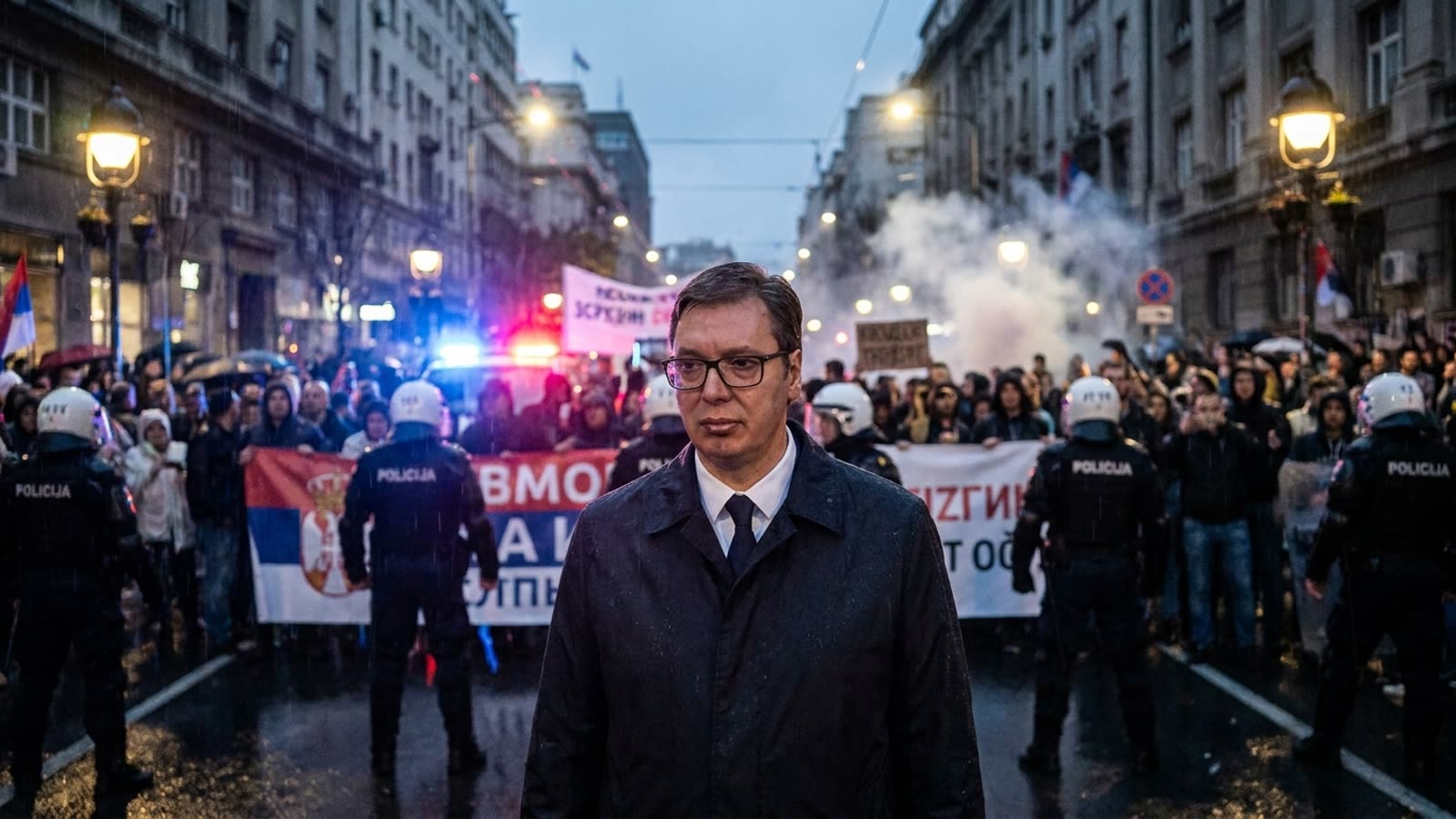
Protesters demanding snap parliamentary elections and Vučić's departure faced off against riot police in central Belgrade, with tear gas deployed and dozens detained. The images—young demonstrators bleeding, officers in full tactical gear, burning barricades near government buildings—would be unremarkable in many contexts. In Serbia, where Vučić has spent a decade consolidating control over media, courts, and electoral machinery, they represent something closer to a constitutional crisis.
The infrastructure of discontent
The proximate cause remains the November 2024 collapse of a concrete canopy at Novi Sad's railway station, which killed fifteen people. The structure had been recently renovated under a Chinese-financed infrastructure deal, and the disaster crystallized years of grievances about corruption, opaque procurement, and the government's cozy relationships with foreign contractors operating outside normal oversight. Students occupied universities. Faculty joined. Then ordinary citizens.
Vučić's initial response—expressions of sympathy, promises of investigation, hints that foreign actors were manipulating the protests—followed the autocrat's playbook. But six months later, no senior official has resigned, no criminal charges have been filed against anyone with political connections, and the president continues to dismiss demonstrators as puppets of Western intelligence services. The playbook requires a short attention span. Serbia's protesters have proven inconveniently persistent.
The Vučić method under strain
For a decade, Vučić has maintained power through a combination of genuine popularity, media dominance, and the fragmentation of opposition parties. He positioned Serbia as a bridge between East and West, extracting investment from China and the Gulf while keeping EU accession talks nominally alive. The approach delivered visible infrastructure projects and a measure of stability that many Serbians, scarred by the wars and chaos of the 1990s, found preferable to the alternatives.
That formula is now under severe stress. The economy, while not collapsing, has stagnated. Youth unemployment remains stubbornly high. And the infrastructure projects meant to showcase competent governance have become symbols of its opposite—the Novi Sad canopy being only the most lethal example. Vučić's media control, meanwhile, has been partially circumvented by social platforms where protest footage circulates freely.
The president retains significant support, particularly among older and rural voters. But the protesters are not a fringe. They include professionals, academics, and middle-class families who once accepted Vučić as a necessary strongman and now view him as an obstacle to the European future they want for their children.
Our take
Vučić is not going anywhere immediately—he controls the security services, the election commission, and enough of the legislature to survive any no-confidence motion. But the protests have exposed the brittleness beneath the surface stability. Every tear gas canister fired in central Belgrade makes EU accession more distant and the authoritarian turn more explicit. Serbia's president built his legitimacy on delivering results. The results are now on fire in the streets.