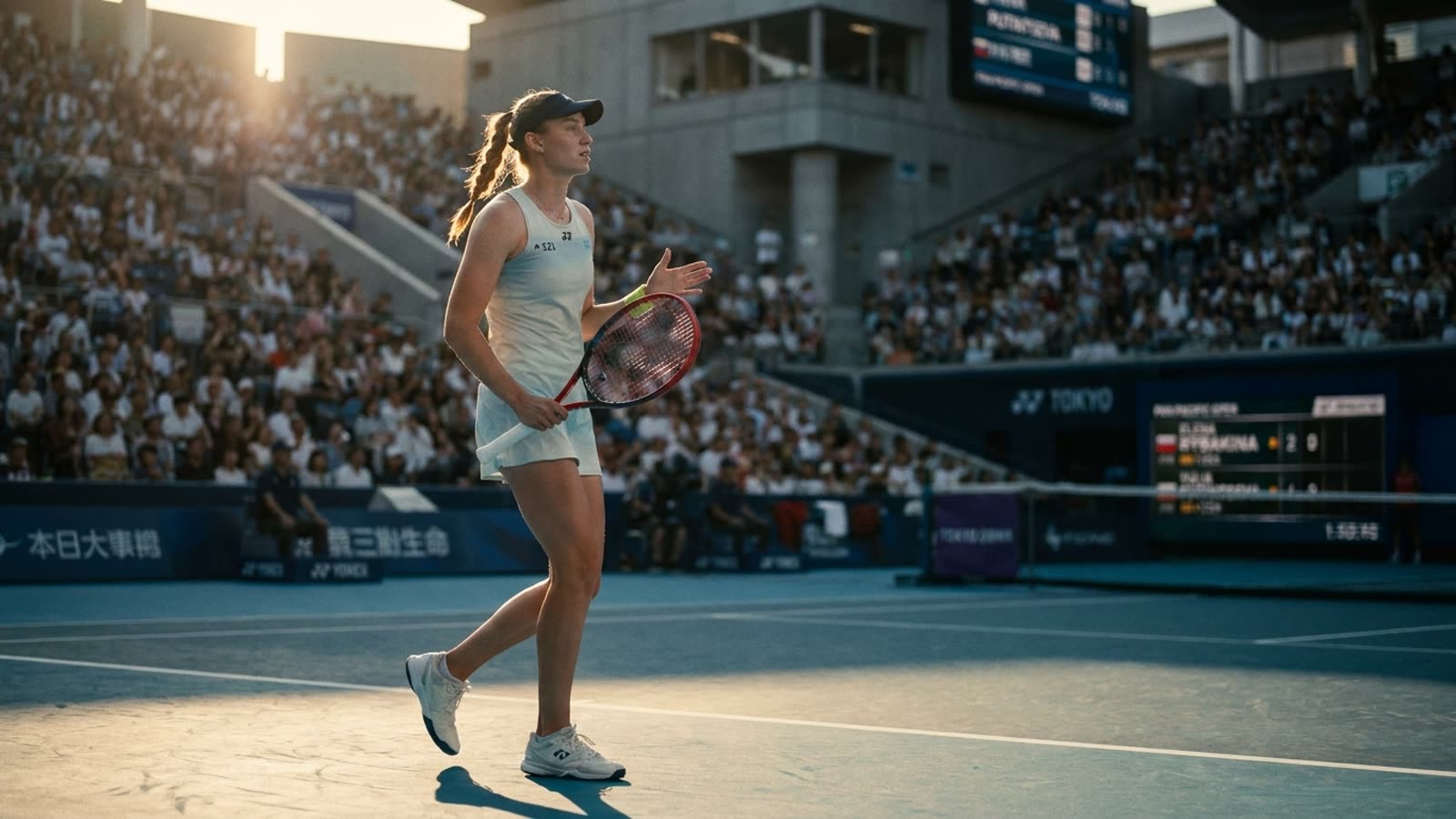
The numbers now confirm what the eye test has insisted upon for months: Elena Rybakina is the best women's tennis player in the world, and she will enter 2027 with the ranking to prove it.
By defeating fellow Kazakh Yulia Putintseva in the last sixteen of the Pan Pacific Open in Tokyo, Rybakina rendered the final weeks of the season a formality. No combination of results can dislodge her from the year-end throne. For a player whose relationship with rankings has often seemed almost indifferent—she famously shrugged off questions about the top spot after winning Wimbledon in 2022—the coronation arrives with a certain inevitability rather than drama.
A game built for dominance
Rybakina's path to the summit has been defined by her serve, arguably the most formidable weapon in the women's game. The flat, heavy delivery regularly clocks above 120 mph and has made her nearly unbreakable on her own terms. But what separated her 2026 campaign from previous seasons was the maturation of her movement and return game. Where once she could be neutralized by patient baseliners willing to absorb her power, Rybakina now dictates rallies from both ends.
Her coach, Stefano Vukov, has spoken about reducing unforced errors without sacrificing aggression—a balance that eluded her in seasons past. The results speak clearly: titles on three surfaces, a win-loss record that leads the tour, and crucially, victories over every top-ten player she faced after Roland Garros.
The Kazakh tennis question
Rybakina's nationality remains a subject of quiet complexity. Born in Moscow, she switched federations to Kazakhstan in 2018, a move that granted her funding and freedom from the crowded Russian pipeline. The arrangement has been mutually beneficial—Kazakhstan now boasts the world number one in a sport where it had no historical presence—but questions about identity and allegiance surface periodically, particularly given the geopolitical climate.
Rybakina herself has navigated these waters with characteristic brevity. She does not engage in political commentary, deflects questions about Russia, and lets her racket do the talking. Whether this is diplomatic wisdom or genuine disinterest, the approach has shielded her from controversies that have ensnared other players.
Our take
Year-end number one is a validation of consistency as much as brilliance, and Rybakina has delivered both. The women's game has lacked a sustained, dominant force since Ashleigh Barty's abrupt retirement in 2022; Iga Świątek's reign was interrupted by form dips and the occasional inexplicable loss. Rybakina offers something different: a player whose ceiling is obvious and whose floor has finally risen to match. At 27, she enters her prime with the sport's top ranking and the game to defend it. The question is no longer whether she belongs at number one, but how long she intends to stay there.