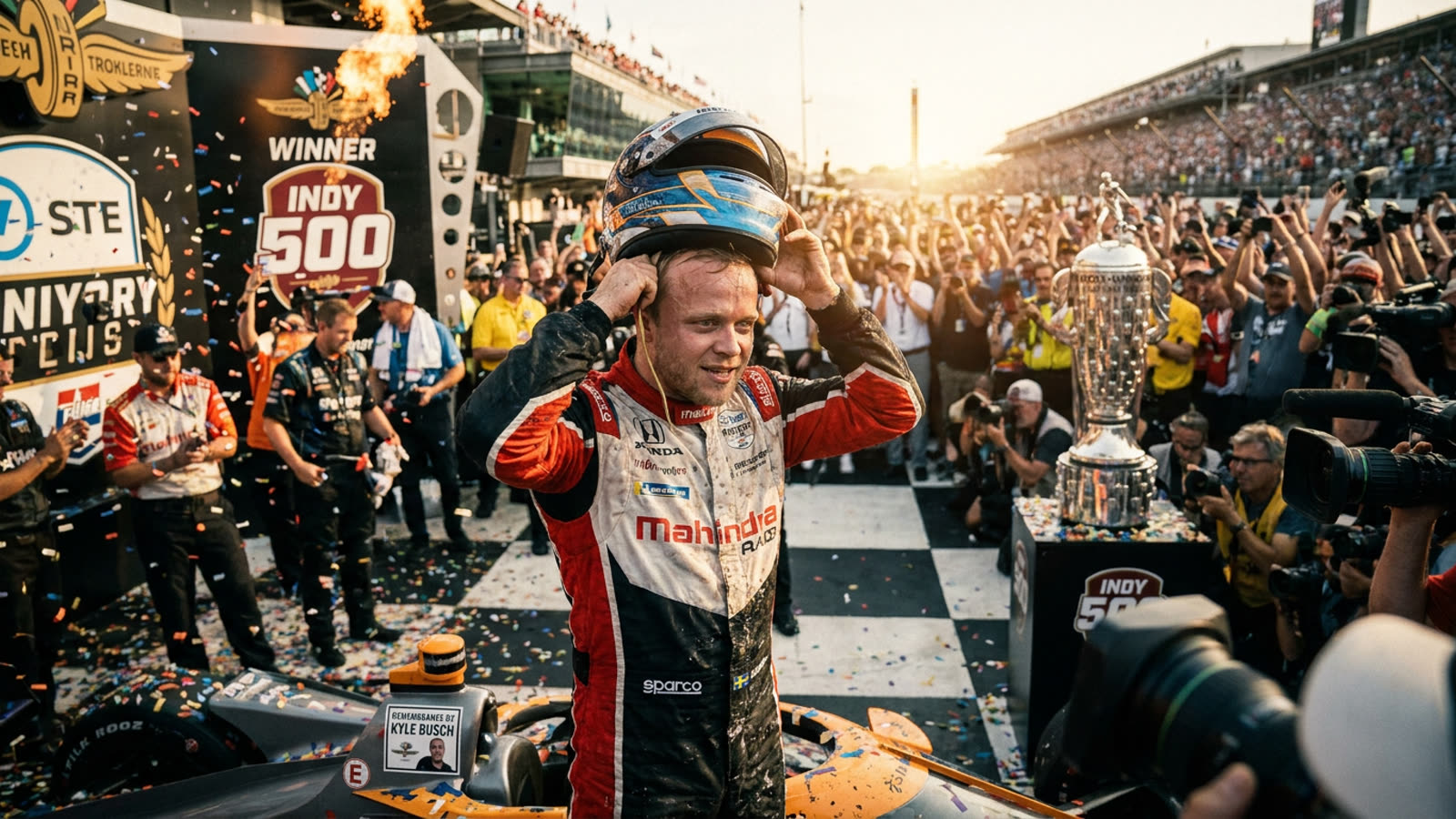
The Indianapolis 500 has always been a race measured in fractions — of fuel, of tire grip, of nerve. On Sunday, it became a race measured in the smallest fraction ever recorded: two hundredths of a second, the blink within a blink, the difference between immortality and the answer to a trivia question.
Felix Rosenqvist crossed the yard of bricks first, but just barely. The 34-year-old Swede, driving for Arrow McLaren, edged out his pursuer in a finish so close that the timing system needed a moment to confirm what 300,000 spectators at Indianapolis Motor Speedway weren't entirely sure they'd witnessed. The previous record for the closest Indy 500 finish — Al Unser Jr.'s 0.043-second victory over Scott Goodyear in 1992 — had stood for over three decades. Rosenqvist halved it.
A career defined by near-misses
Rosenqvist's path to this moment has been anything but direct. A Formula E champion and respected IndyCar competitor, he has spent years as the driver who was always fast but rarely lucky. Mechanical failures, pit-stop miscues, and the cruel arithmetic of oval racing had conspired to keep him from the top step. His move to McLaren's IndyCar program was supposed to change that narrative, but results had been inconsistent.
Sunday changed everything. Rosenqvist ran a tactically perfect race, conserving fuel when others pushed, finding clean air when the pack bunched, and — crucially — positioning himself for the final restart with three laps remaining. The closing sequence was a masterclass in controlled aggression: he drafted past two cars on the back straight of lap 199, then defended the inside line through turn one on the final circuit as his rival pulled alongside.
The technology of certainty
At 0.02 seconds, the margin of victory is almost philosophical. At racing speeds exceeding 220 mph, it translates to roughly six inches — less than the length of a driver's forearm. The IndyCar Series uses transponder-based timing accurate to the thousandth of a second, but even that precision felt inadequate for what the crowd had just seen. Television replays showed two cars crossing the line as one, their nose cones seemingly occupying the same space.
The official call took eleven seconds — an eternity in a sport where results are usually instantaneous. When Rosenqvist's name appeared on the scoring pylon, the grandstands erupted, though a significant portion of the crowd had been cheering for the other car.
Our take
The Indy 500 sells itself on history and spectacle, but what it really trades in is narrative compression — an entire season's worth of drama packed into three hours and 500 miles. Rosenqvist's victory delivered that and more. The Swedish driver, who has spent a decade proving he belongs in elite motorsport, finally has the result that matches his talent. That it came on a day when the racing community was already emotionally raw from honoring Kyle Busch only adds to the weight of the moment. Records exist to be broken, but some margins are so fine they feel less like victories and more like fate.