The footage has been viewed hundreds of millions of times, and it still doesn't make sense. Ronaldinho receives the ball near the touchline against England in the 2002 World Cup quarterfinal, glances up, and launches a free kick that appears to be a cross before bending impossibly over David Seaman's desperate backpedal. Was it intentional? The question has never been definitively answered, which is precisely the point. With Ronaldinho, you were never entirely sure where audacity ended and accident began — and neither, perhaps, was he.
The Brazilian who won everything worth winning between 2002 and 2006 — World Cup, Champions League, Ballon d'Or, FIFA World Player of the Year twice — remains the most joyful footballer ever to reach the absolute summit of the game. Others have been more prolific, more consistent, more decorated. None have made the sport look quite so much like play.
The smile that changed atmospheres
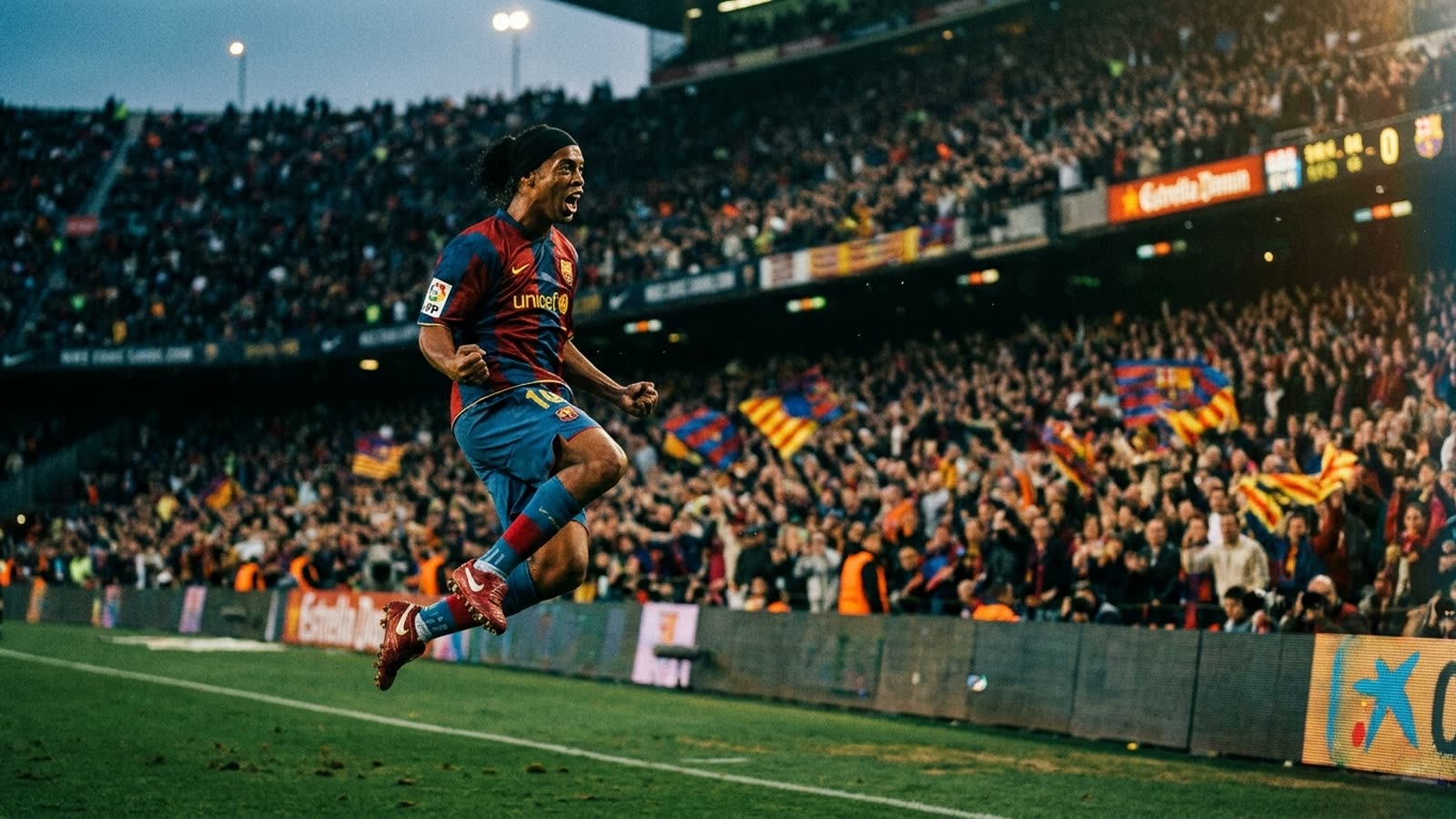
Ronaldinho's most remarkable quality wasn't his elastico or his no-look passes, though both were supernatural. It was his capacity to alter the emotional temperature of a stadium. When he received the ball, crowds leaned forward not in anxiety but in anticipation of delight. The standing ovation he received at the Santiago Bernabéu after destroying Real Madrid in 2005 — from the home supporters — remains one of football's most extraordinary tributes. They were applauding not just excellence but the sheer pleasure of watching someone who appeared to be having more fun than anyone in the building.
This was not naivety. Ronaldinho emerged from the same Porto Alegre streets that produced countless Brazilian talents, learned his craft in the same pressure-cooker youth systems, and competed at the highest level against defenders who would have happily broken his legs to stop him. The joy was a choice, maintained through tactical fouling and hostile atmospheres and the grinding repetition of elite football.
Why it couldn't last
The career arc is well-documented: the explosive peak at Barcelona from 2003 to 2006, the gradual decline as nightlife and a relaxed approach to training caught up with him, the journeyman years through Milan, Flamengo, and beyond. By thirty, he was a nostalgia act. By comparison, his successors Messi and Cristiano Ronaldo maintained peak performance into their late thirties through monastic discipline and scientific optimization.
But this framing misses something essential. Ronaldinho's approach to football was inseparable from his approach to life. The same personality that produced those moments of impossible improvisation also produced the late nights and the weight gains. You could not have extracted the genius and left behind the indiscipline; they were expressions of the same fundamental orientation toward experience. He played football the way he lived — fully, immediately, without excessive concern for tomorrow.
Our take
Modern football has become extraordinarily sophisticated, with GPS trackers monitoring every sprint, nutritionists calibrating every meal, and analysts dissecting every decision. The results are obvious in the athleticism and tactical intelligence of contemporary players. But something has been lost too — a certain spontaneity, a willingness to attempt the absurd simply because it might be beautiful. Ronaldinho's legacy isn't just the trophies or the highlight reels. It's the reminder that sport, at its best, is supposed to be fun. Not just for spectators, but for the people playing it. The smile wasn't a marketing strategy. It was a competitive philosophy, and for a few blazing years, it was the best in the world.