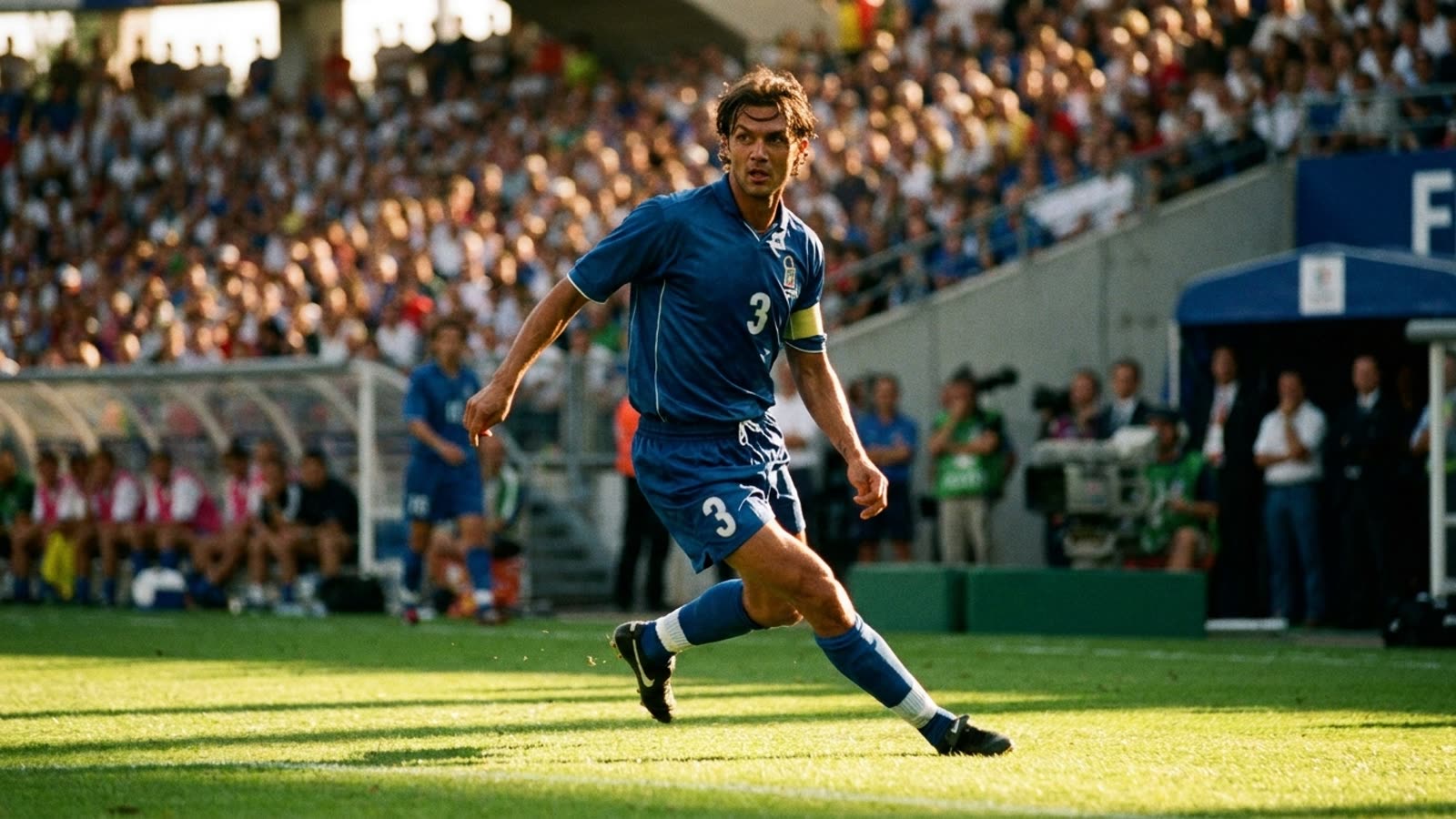
There is a quote attributed to Paolo Maldini that has become something of a koan in football circles: "If I have to make a tackle, then I have already made a mistake." Whether he said it precisely this way is disputed, but the sentiment captures something essential about the man who spent a quarter-century at the highest level of the game while treating physical confrontation as a last resort rather than a first principle.
Maldini retired from professional football in 2009, having played more than 900 matches for AC Milan and over 120 for Italy. He won the Champions League twice, Serie A seven times, and captained both club and country with the kind of quiet authority that made histrionics unnecessary. But statistics, however impressive, fail to convey what made him singular. Maldini was a defender who seemed to exist slightly ahead of time, arriving at the point of danger before danger fully materialized.
The geometry of anticipation
Watch footage of Maldini at work and you notice something peculiar: the absence of drama. Where other defenders threw themselves into sliding challenges or engaged in muscular duels, Maldini simply appeared in the right position, intercepting passes with the casual precision of someone collecting mail. His defensive work resembled spatial problem-solving more than combat.
This was not natural gift alone. Maldini studied attackers obsessively, learning their tendencies, their preferred feet, the angles they favored. He positioned his body to eliminate options rather than to win collisions. The result was a style that looked almost passive but was in fact deeply aggressive — he was denying space before opponents could occupy it.
His longevity reflected this approach. Defenders who rely on pace and power tend to decline sharply after thirty. Maldini remained elite into his forties because his game depended on intelligence and positioning, qualities that age erodes slowly if at all.
The left-back who was actually a center-back
Maldini spent much of his early career at left-back despite being naturally right-footed, a testament to his technical completeness. He could defend on either side, overlap when required, and deliver crosses that suggested a winger's education. But his true position, the one that revealed his deepest qualities, was center-back, where he migrated in his thirties.
At center-back, Maldini became the organizing intelligence of Milan's defense, the player who set the line, communicated with the goalkeeper, and ensured that his partners understood their responsibilities. He was not vocal in the manner of some defensive leaders — no theatrical screaming, no finger-pointing. His authority came from competence so obvious it required no advertisement.
Our take
Modern football has embraced defenders who can play like midfielders, who spray diagonal passes and carry the ball into the attacking third. This is progress, mostly. But something has been lost in the valorization of the ball-playing center-back: an appreciation for defensive art in its purest form. Maldini was technically excellent, certainly, but his genius lay in the negative space — the attacks that never happened, the strikers who spent ninety minutes running into dead ends. He made defending look like the most intelligent thing a footballer could do, which it often is. The tackle is a correction. Positioning is the point.