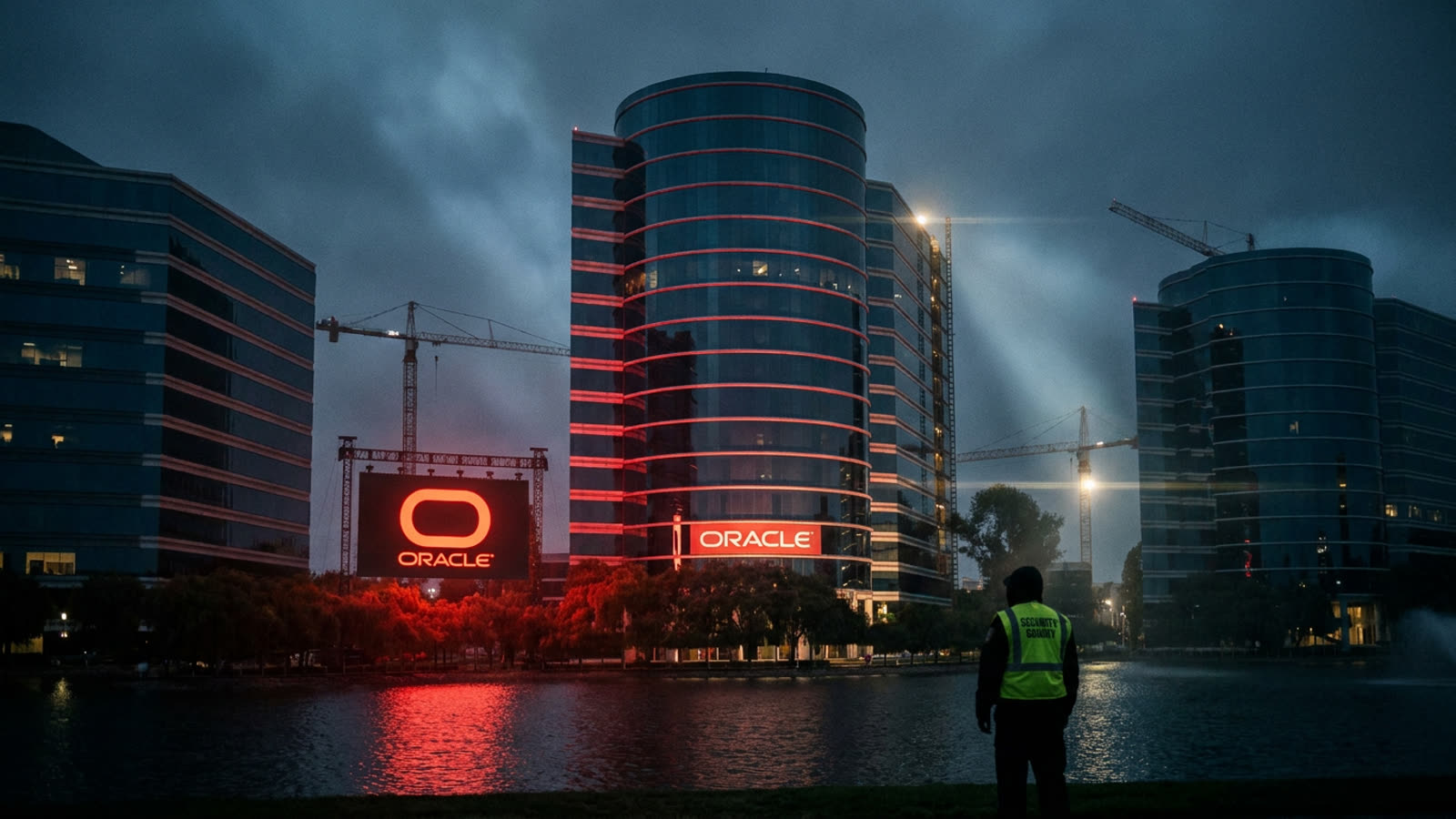
Oracle has spent four decades selling the unsexy plumbing of enterprise computing—databases, middleware, back-office software that nobody brags about at dinner parties. Now Larry Ellison wants his company to matter in the age of artificial intelligence, and the price of admission is brutal: 21,000 employees out the door, billions in new debt, and a strategic pivot that amounts to betting the company's future on infrastructure it has historically rented from others.
The layoffs, representing roughly a quarter of Oracle's global workforce, are not the desperate cuts of a company in distress. Oracle remains profitable, its cloud revenue growing, its stock near all-time highs. This is something more calculated: a reallocation of capital from humans to machines at a scale that reveals just how expensive competing in AI infrastructure has become.
The arithmetic of desperation
Oracle's problem is positional, not existential. In the cloud wars, it remains a distant fourth behind Amazon Web Services, Microsoft Azure, and Google Cloud—a gap that seemed permanent until generative AI created a new scramble for data center capacity. Suddenly, every enterprise wants GPU clusters, and the hyperscalers cannot build them fast enough. Oracle spotted an opening.
But building AI infrastructure requires capital that Oracle does not have in sufficient quantities. Hence the debt. The company has reportedly been raising billions through bond offerings, adding leverage to a balance sheet that was already carrying substantial obligations. The workforce reduction is the other half of the equation: cutting operating expenses to service the new debt while freeing cash for capital expenditure.
The math is elegant in its brutality. Employees cost money every month; data centers cost money once and generate revenue for years. If Oracle can convert headcount into hardware at the right ratio, it might finally close the gap with its larger rivals.
The Ellison doctrine
Larry Ellison has never been shy about dramatic pivots. He declared cloud computing a fad before making it Oracle's entire strategy. He dismissed Amazon as a competitor before spending a decade trying to catch up. Now 80 years old, Ellison is making what may be his final large-scale bet, and he is doing it with other people's money—both bondholders' and, in a sense, the employees who will not be around to see whether it works.
The strategy has a certain logic. Oracle's existing customer base—banks, governments, healthcare systems—tends to be conservative, slow to migrate, and deeply entangled with Oracle's database products. These are exactly the customers who might prefer an AI infrastructure provider they already know over a hyperscaler they find intimidating. If Oracle can offer competitive GPU capacity at competitive prices, the switching costs that have always been its moat could become its growth engine.
Our take
Oracle is making a leveraged bet that the AI infrastructure shortage will last long enough for it to matter, and that its enterprise relationships will translate into cloud wins. It is a reasonable gamble, but it is still a gamble. The 21,000 people losing their jobs are not being sacrificed to save a failing company; they are being sacrificed to fund an ambition that may or may not pan out. That is a colder calculation than most corporate layoff announcements admit, and Oracle deserves credit for at least being honest about the trade-off. Whether the bet pays off depends on variables Ellison cannot control: how quickly Nvidia can ramp supply, how aggressively the hyperscalers defend their turf, and whether Oracle's enterprise customers actually want what it is selling. The company is all-in. The cards have not yet been dealt.