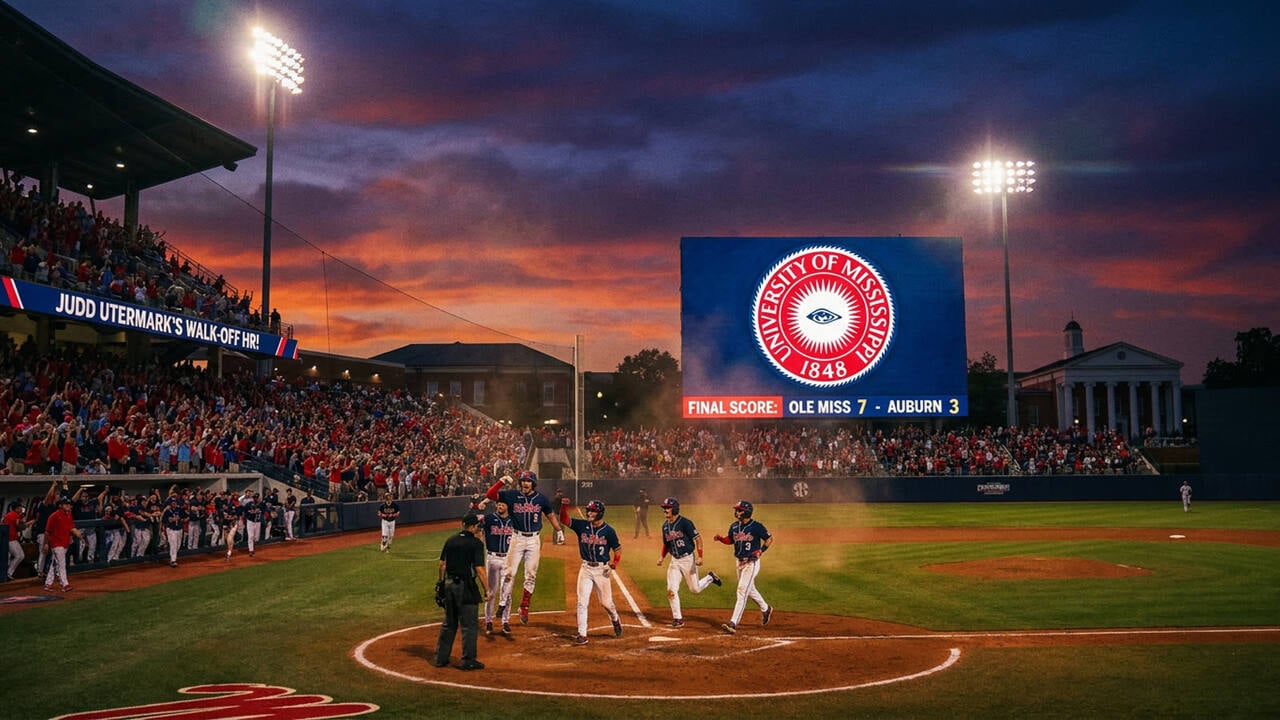
Ole Miss does not do gentle exits. The Rebels, still carrying the psychic residue of last June's national championship loss, demolished Auburn in an NCAA Tournament regional matchup that felt less like a baseball game and less like a statement of intent carved into the outfield grass.
Judd Utermark's home run—a no-doubt shot that cleared the fence with the authority of a program that has learned to treat every postseason at-bat as existential—was the punctuation mark on a performance that should worry every remaining team in the bracket. Ole Miss has become college baseball's version of a wounded predator: more dangerous precisely because it knows what losing tastes like.
The Auburn problem
Auburn entered this tournament with legitimate credentials and a fan base that has grown accustomed to June baseball. The Tigers have recruited well, developed pitchers adequately, and built the kind of program that regularly survives regional play. None of that mattered against a Rebels lineup that treated Auburn's pitching staff like batting practice.
The loss exposes a familiar Auburn vulnerability: the Tigers can compete with anyone for seven innings, but they lack the offensive depth to survive a shootout against elite competition. When Ole Miss applied pressure, Auburn's response was to hope rather than execute. Hope is not a strategy that survives elimination games.
Why Ole Miss is different this year
Mike Bianco's program has always had talent. What it has now is something harder to quantify: the specific hunger that comes from having touched a championship trophy and watched it slip away. The 2025 Rebels were good enough to reach the final. The 2026 Rebels play like a team that has decided being good enough is insufficient.
Utermark's emergence as a power threat adds a dimension the Rebels lacked last season. When your lineup can hurt opponents from multiple spots in the order, pitchers have no refuge. Auburn's staff learned this the hard way, watching carefully constructed game plans dissolve with each Ole Miss swing.
The road ahead
The College World Series bracket remains crowded with capable programs, but Ole Miss has separated itself from the pack in a meaningful way. The Rebels are not just winning games; they are winning them with the controlled aggression of a team that has visualized this moment for twelve months.
College baseball's postseason rewards teams that peak at the right moment. Ole Miss appears to be doing exactly that, and the rest of the field should be concerned.
Our take
Ole Miss is the team nobody wants to face in Omaha, and Auburn just learned why. The Rebels have transformed last year's championship loss from a wound into a weapon, and Utermark's performance suggests they have found another offensive gear at precisely the right moment. Bianco has built something that looks increasingly inevitable.