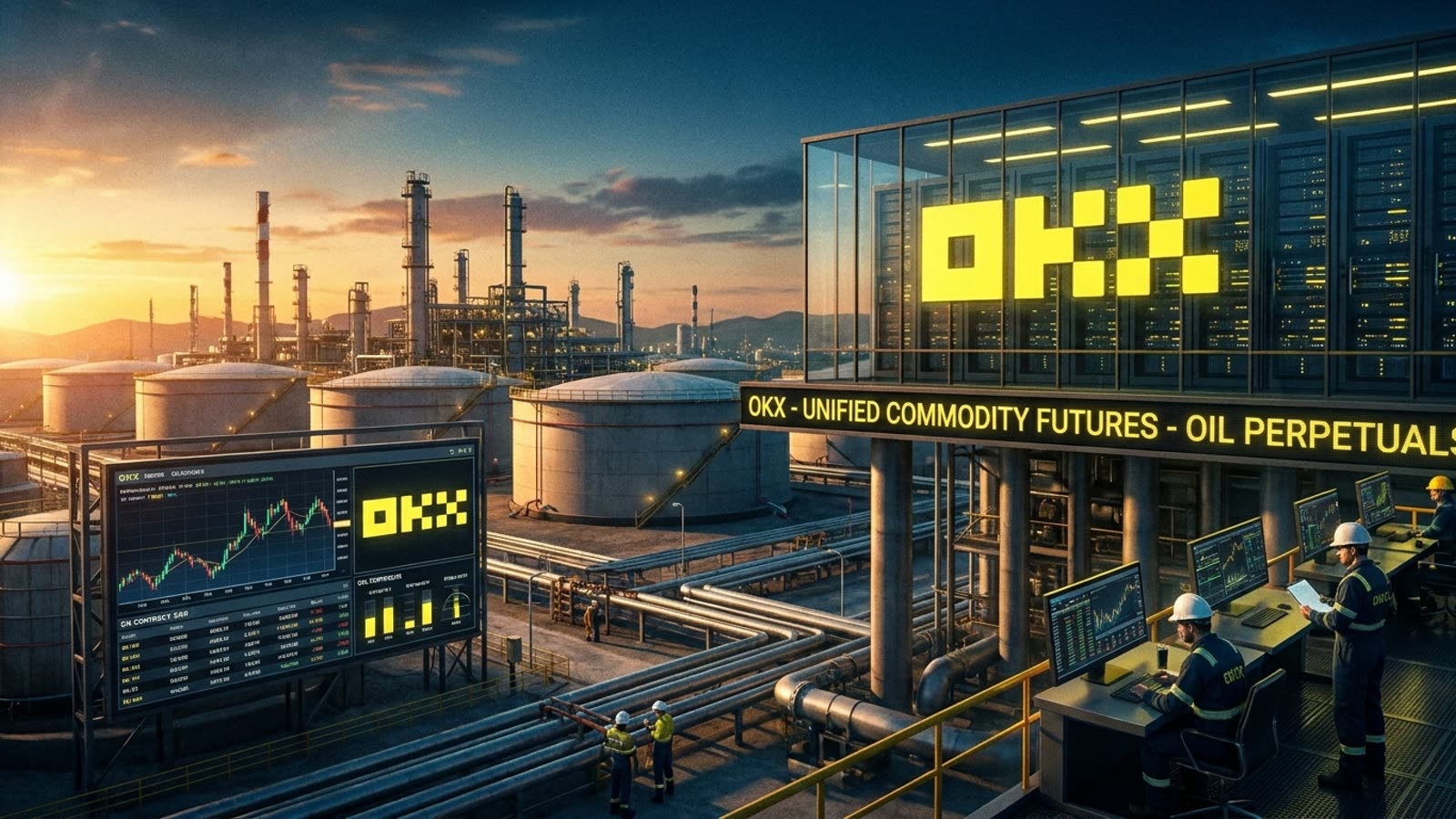
The line between crypto casino and commodity exchange just got considerably blurrier. OKX, one of the world's largest cryptocurrency platforms, has announced a partnership with Intercontinental Exchange — the owner of the New York Stock Exchange — to bring perpetual futures contracts on crude oil to its 120 million users. If you understand why this matters, you're either a derivatives trader or about to become very confused.
Perpetual futures are crypto's signature financial innovation, or abomination, depending on whom you ask. Unlike traditional futures that expire on a set date — forcing traders to either settle or roll their positions — perpetuals never expire. They track an underlying asset's price indefinitely through a mechanism called funding rates, where traders on the winning side of a bet periodically pay those on the losing side. It's elegant, liquid, and responsible for much of crypto's notorious leverage-fueled volatility.
Why ICE is playing along
Intercontinental Exchange is not a company known for reckless experimentation. It operates eleven exchanges globally, clears trillions in derivatives annually, and owns the Brent crude benchmark that prices two-thirds of the world's traded oil. So why partner with a crypto exchange to offer a product that regulators have repeatedly flagged as potentially problematic?
The answer is volume. Crypto perpetual futures generate staggering trading activity — often exceeding spot markets by a factor of ten or more. Bitcoin perpetuals alone see hundreds of billions in daily notional volume. ICE presumably sees an opportunity to capture some of that speculative energy and redirect it toward commodities, earning fees along the way. For OKX, the deal provides regulatory legitimacy and access to institutional-grade price feeds.
The retail trader arrives at the oil pit
The more interesting question is what happens when crypto's predominantly retail user base gains frictionless access to oil markets. Traditional commodity futures require specialized accounts, substantial margin, and a tolerance for expiration mechanics that confuse even sophisticated investors. Perpetuals eliminate these barriers. A twenty-three-year-old in Manila can now take leveraged positions on West Texas Intermediate with the same ease as betting on Bitcoin.
This democratization cuts both ways. Commodity markets have historically been dominated by commercial hedgers — airlines locking in fuel costs, refiners managing inventory risk — and professional speculators who provide liquidity. An influx of retail flow could improve liquidity further, or it could introduce the kind of momentum-driven volatility that crypto markets know intimately. When Dogecoin pumps, the consequences are contained. When oil whipsaws, airlines adjust ticket prices.
Our take
This partnership is less a crypto story than a commodities story with crypto characteristics. ICE is acknowledging that perpetual futures, whatever their regulatory baggage, have proven their appeal. The product structure works. The question is whether traditional markets can absorb crypto's culture of 24/7 trading, high leverage, and retail-driven momentum without destabilizing price discovery for assets that actually matter to the physical economy. The experiment begins now, and the oil market didn't exactly volunteer for it.