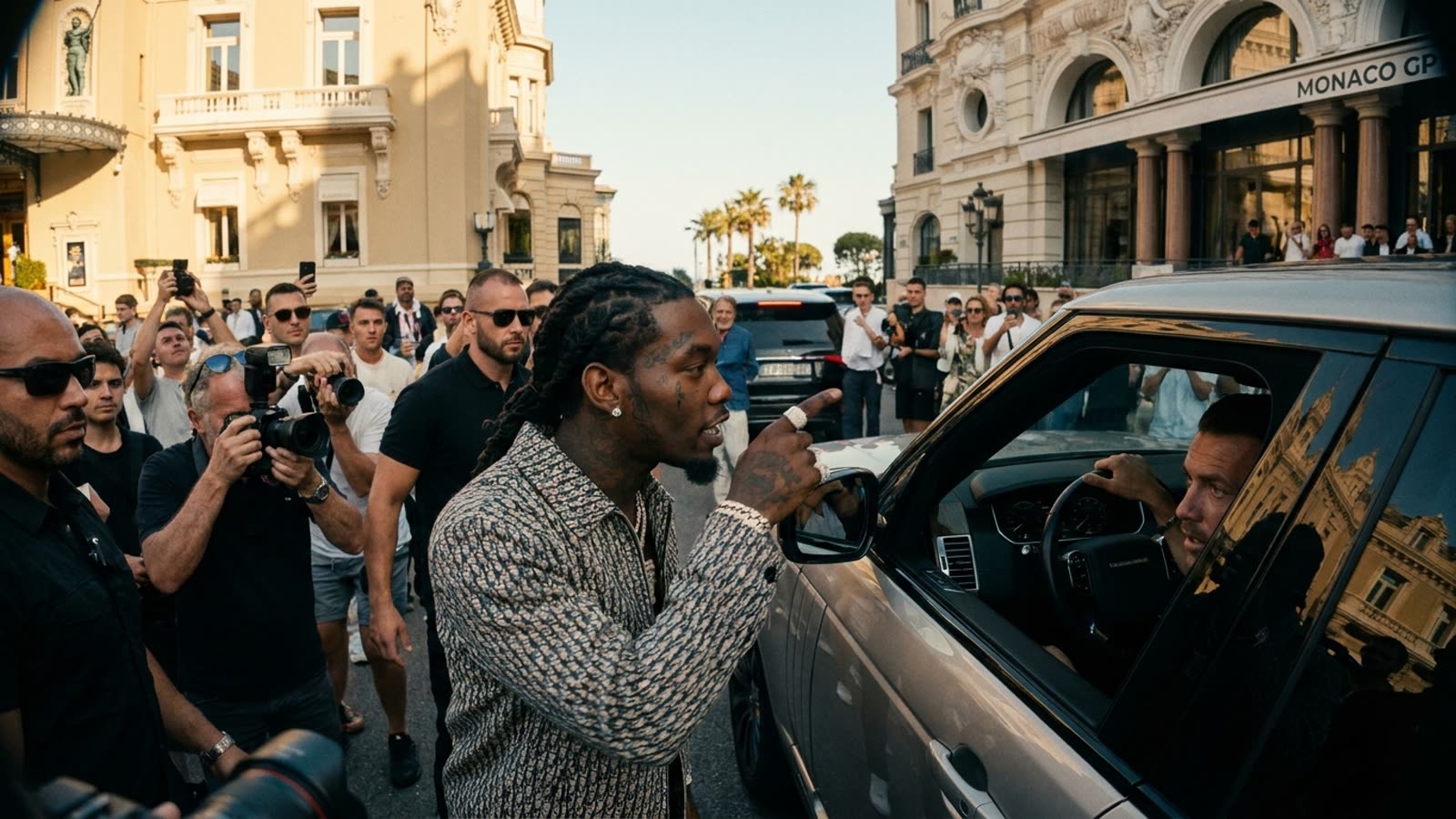
When Offset stepped out of his Monaco evening to confront a driver he accused of manhandling women, the cameras were already rolling. They always are now. The resulting footage—tense, theatrical, resolved without apparent injury—offers a case study in how celebrity transforms ordinary conflict into content, and how fame creates its own peculiar moral framework.
The rapper, one-third of Migos and perpetually adjacent to Cardi B's gravitational pull, was captured in a heated exchange on Monaco's gilded streets, allegedly after witnessing or hearing about rough treatment of women by a driver. The confrontation escalated, deescalated, and was uploaded before most of Europe had finished breakfast.
The vigilante instinct
There's something almost quaint about a celebrity physically intervening in what they perceive as injustice. In an era when most stars outsource confrontation to lawyers, publicists, and carefully worded Instagram stories, Offset's street-level approach feels anachronistic—a throwback to an older model of masculine honor culture that fame was supposed to have polished away.
The instinct isn't entirely ignoble. If women were indeed being mistreated, intervention has moral weight. But the execution—public, filmed, immediately viral—transforms advocacy into performance. The question isn't whether Offset believed he was doing right; it's whether the presence of cameras and the knowledge of one's own celebrity status changes the calculus of when and how to act.
Monaco as stage
The setting matters. Monaco exists as a kind of theme park for the ultra-wealthy, a place where Ferraris are traffic and discretion is theoretically prized but practically impossible. For hip-hop royalty, the principality offers both legitimacy and risk—a chance to be seen among old money while remaining perpetually foreign to its codes.
A confrontation that might pass unremarked in Atlanta or Miami becomes international news in Monte Carlo. The geography amplifies everything: the stakes, the witnesses, the footage quality. Offset wasn't just defending women; he was defending them in one of the most surveilled luxury environments on Earth.
Our take
Celebrity vigilantism is a genre unto itself now, distinct from both genuine heroism and cynical publicity. Offset may have genuinely believed he was protecting vulnerable people, and perhaps he was. But the instant documentation, the global distribution, the discourse—all of it feeds a machine that rewards dramatic intervention over quiet resolution. The women allegedly mistreated become supporting characters in someone else's narrative. Monaco's streets become a soundstage. And we, reliably, watch.