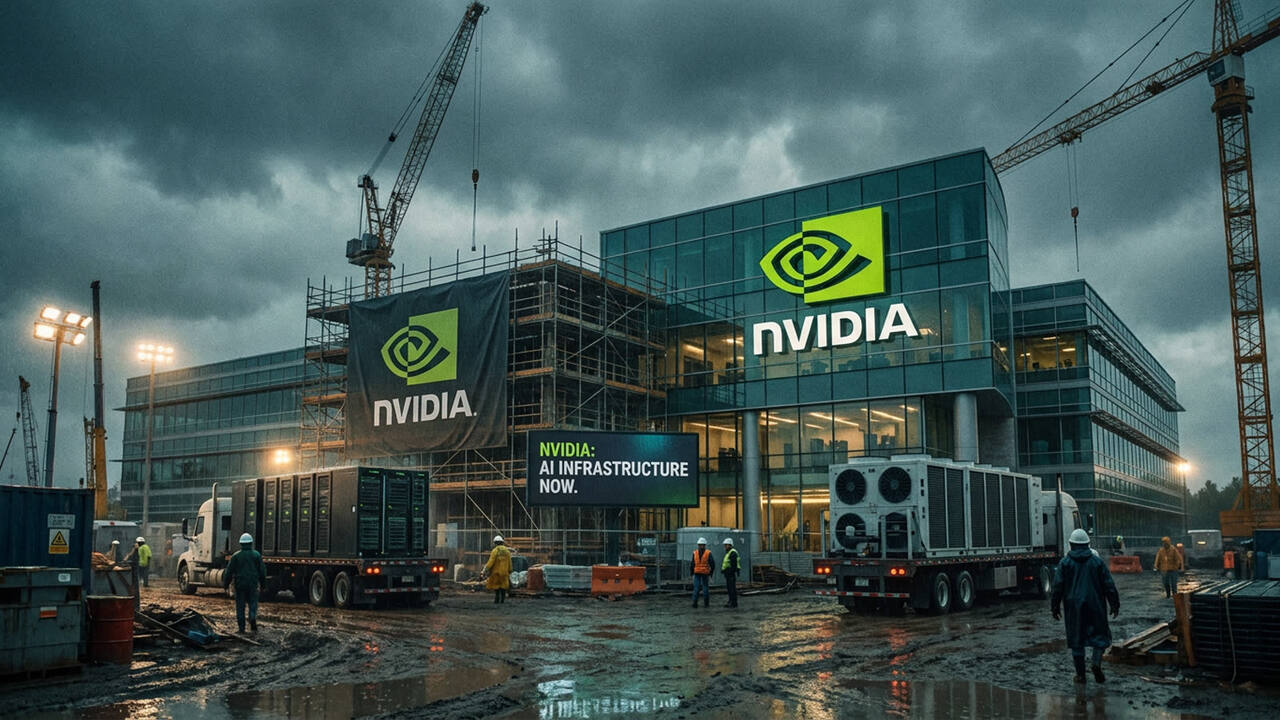
When a company generates more than $60 billion in annual revenue and commands profit margins that make pharmaceutical executives weep with envy, it typically does not need to ask Wall Street for money. Nvidia's decision to seek over $25 billion in its first bond deal since 2021 tells us something important about the AI infrastructure buildout: even the winners are running faster than their cash flows can carry them.
The timing is instructive. Nvidia's stock has been volatile amid a broader tech selloff this week, with chip stocks taking particular punishment as investors reassess AI valuations. Rather than wait for calmer waters, the company is moving now—suggesting either confidence in its credit standing or urgency about capital deployment that cannot wait for sentiment to improve.
The math behind the move
Nvidia is not in financial distress. Far from it. The company's data center business has been growing at triple-digit percentages, and its GPUs remain the essential hardware for training large language models. But the scale of investment required to maintain dominance is staggering. Customers like Microsoft, Google, and Amazon are spending tens of billions annually on AI infrastructure, and they expect Nvidia to match their ambitions with production capacity, research, and next-generation chip development.
Debt financing makes sense here for purely mechanical reasons. Interest payments are tax-deductible; equity dilution is not. With Nvidia's credit rating and the current rate environment, borrowing $25 billion costs far less than the return the company expects to generate by deploying it. This is corporate finance operating as intended.
What it reveals about the AI economy
The more interesting question is what Nvidia's capital hunger says about the broader AI buildout. We are now in a phase where the infrastructure layer—chips, data centers, power generation—requires investment measured in hundreds of billions of dollars globally. Even companies printing money cannot self-fund at this pace.
This creates a fascinating dependency. The AI boom is real, the demand is genuine, but its continuation requires continuous access to capital markets. If credit conditions tighten or investor appetite for AI exposure sours, the buildout slows—regardless of underlying technological progress. Nvidia's bond deal is a reminder that the AI revolution, like all industrial transformations, runs on financing as much as on innovation.
Our take
Nvidia borrowing $25 billion is not a sign of weakness; it is a sign of ambition colliding with physics. The company sees opportunities that exceed even its considerable cash generation, and it is rational to use cheap debt to capture them. But the deal also illuminates a vulnerability in the AI narrative: this is not a self-sustaining flywheel yet. It is a capital-intensive industrial expansion that depends on continued investor faith. That faith has been rewarded handsomely so far. Whether it continues to be depends on whether AI applications eventually generate returns commensurate with the infrastructure investment. Nvidia is betting they will. The bond market, apparently, agrees.