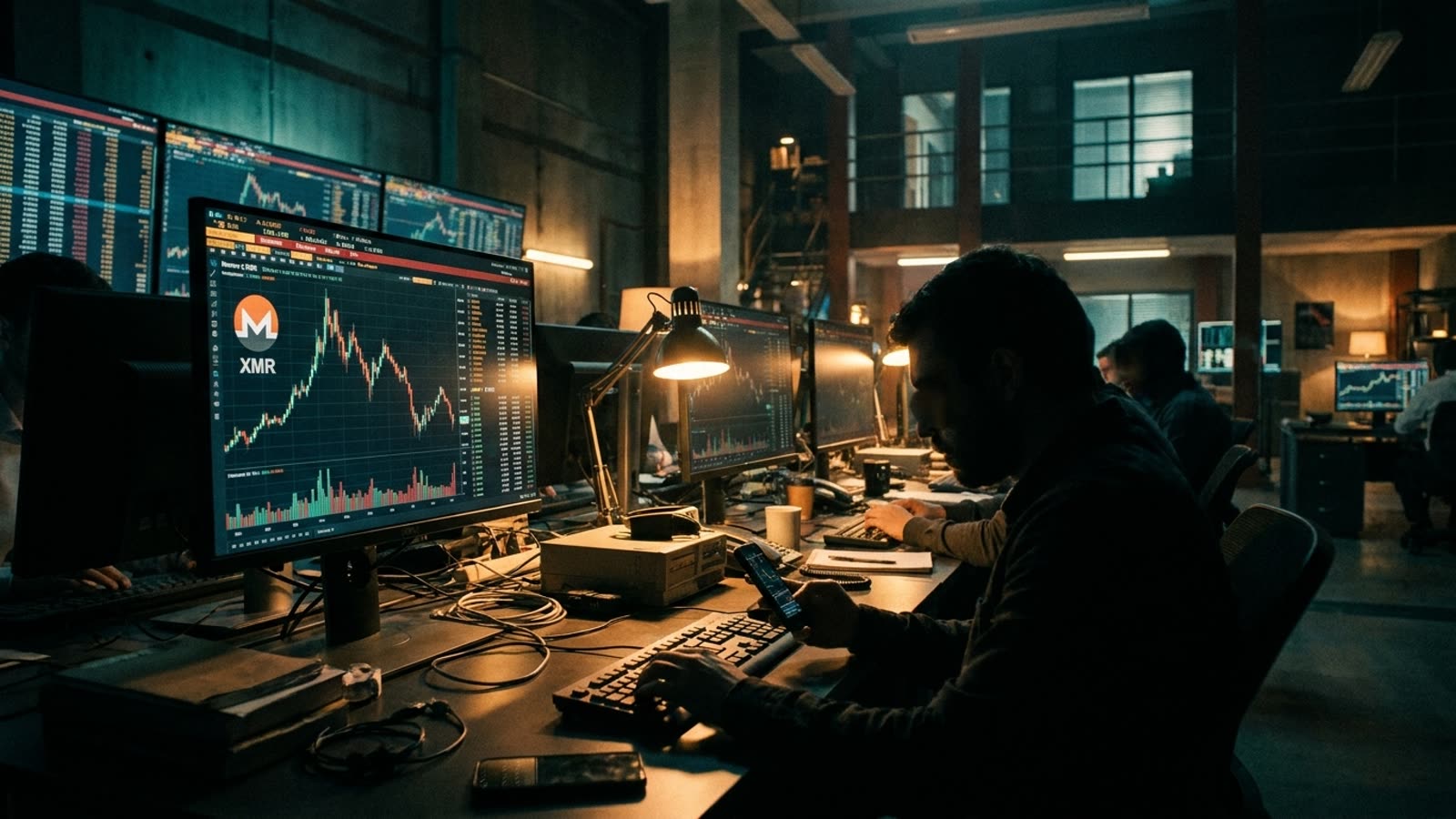
Monero is trading flat today at roughly $558, which would be unremarkable for most assets but constitutes a minor miracle for a coin that has spent the better part of three years being systematically expelled from mainstream finance. The privacy-focused cryptocurrency has gained 85% over the past twelve months while major exchanges continue to delist it, regulators treat it as contraband, and its community operates with the siege mentality of partisans behind enemy lines.
The paradox is instructive. In a market increasingly dominated by institutional capital chasing regulatory clarity, Monero has become the anti-ETF — a token that cannot be custodied by BlackRock, cannot be offered on Coinbase, and cannot be traced by the blockchain analytics firms that governments now consider essential infrastructure. And yet it persists, with a market cap comfortably in the top fifteen.
The deplatforming premium
Monero's survival owes much to the same forces that were supposed to kill it. Each delisting — Binance dropped XMR in 2024, following Kraken and others — removed casual speculators and left behind a core of ideological holders who view privacy as a feature, not a bug. The resulting supply squeeze has supported prices even as trading venues contracted.
The coin's technology has also matured. Ring signatures and stealth addresses make Monero transactions functionally untraceable, a claim that has largely held up against forensic scrutiny. For users in jurisdictions with capital controls, surveillance states, or simply a philosophical commitment to financial privacy, XMR offers something Bitcoin cannot.
Regulatory reality
The counterargument is straightforward: privacy coins facilitate illicit finance. The Financial Action Task Force has pushed member nations toward stricter rules, and exchanges have complied preemptively rather than risk their licenses. Japan and South Korea effectively banned privacy coins years ago; the EU's Markets in Crypto-Assets framework creates similar pressures.
Yet enforcement has been uneven. Monero remains available on decentralized exchanges, peer-to-peer platforms, and in jurisdictions with lighter regulatory touch. The coin's atomic swap capability with Bitcoin allows users to move between transparent and private rails without intermediaries. Regulation has raised the friction cost, not eliminated the product.
Our take
Monero's flat trading session is a reminder that crypto's libertarian roots have not been fully domesticated by the ETF era. The coin is unlikely to achieve mainstream adoption — that ship sailed when Coinbase said no — but it has found a durable niche as the asset of last resort for those who believe financial privacy is a right, not a loophole. Whether that belief is naive or prescient depends on your view of the surveillance trajectory. Either way, XMR's 85% annual gain suggests the market has not entirely abandoned the cypherpunk thesis. The cockroach keeps crawling.