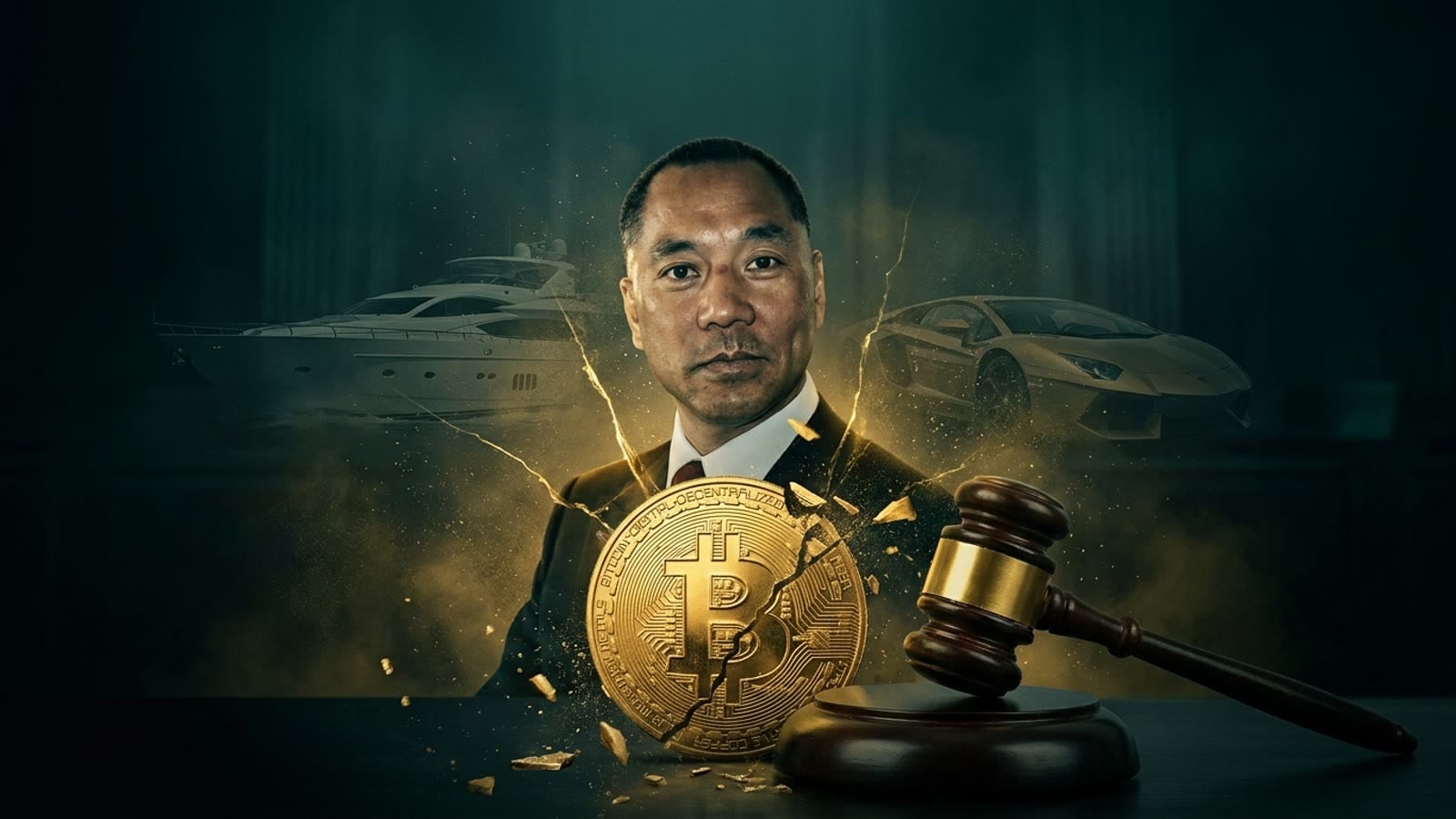
Ho Wan Kwok, the exiled Chinese businessman better known as Miles Guo (or Guo Wengui), has been sentenced to 30 years in federal prison after a jury convicted him of orchestrating a fraud that took more than $1 billion from over a thousand victims around the world. U.S. District Judge Analisa Torres also ordered the forfeiture of $889 million and roughly $900 million in restitution, concluding a saga that ran from 2018 to 2023 and ended a long, strange second act for one of China's most flamboyant fugitives.
The money, prosecutors said, bought the life of a man who never claimed to be modest: a roughly 50,000-square-foot mansion, a $37 million superyacht named the Lady May, a $1 million Lamborghini, a Ferrari for his son, and a wardrobe of designer goods. At sentencing, the judge noted that Guo expressed no remorse and took no responsibility.
The con was built on belief, not technology
What made Guo dangerous was not a clever algorithm. It was a story. After fleeing China in 2017 amid accusations of corruption, bribery, kidnapping and rape, all of which he denied, Guo reinvented himself in the United States as a prominent critic of the Chinese Communist Party. He cultivated a devoted online following of Chinese expatriates and pro-democracy supporters, joined Mar-a-Lago, and partnered with Steve Bannon to launch GTV Media Group and proclaim a 'New Federal State of China.'
That political halo was the engine of the fraud. Victims who bought into his ventures believed they were funding a movement. This is the textbook definition of affinity fraud: exploiting shared identity and trust to sell investments that, in reality, fed the promoter's lifestyle.
A 'crypto' empire with almost no crypto
Guo's pitch leaned heavily on the allure of digital assets. He promoted Himalaya Coin (H-Coin, or HCN) and a related purported stablecoin, the Himalaya Dollar, alongside earlier crypto-flavored offerings called G-Coins and G-Dollars and a private stock placement in GTV. He told investors that 20 percent of H-Coin's value was backed by gold and that he would personally cover any losses they suffered.
Both claims were false. And here is the detail that should make any crypto investor pause: according to trial testimony, H-Coin was barely a cryptocurrency at all. The former CEO of the Himalaya Exchange, Jesse Brown, testified that H-Coin 'was never a crypto product,' that customers could not truly buy it, and that it was not on any blockchain network. On paper it was described as an Ethereum-based token; in practice it lived only inside Guo's own walled garden.
That walled garden was the Himalaya Exchange, a platform Guo controlled. H-Coin and the Himalaya Dollar traded nowhere else. A BitGo executive testified that the exchange operated as a 'closed-loop system': users could buy the tokens with fiat currency only on the exchange itself, and could not withdraw them or trade them anywhere else. Money flowed in. It did not flow out. The price and the value were whatever Guo's ecosystem said they were.
Why it matters
Strip away the politics and the yachts, and Guo's scheme is a clean case study in how crypto branding can be used to manufacture legitimacy. There was no external exchange listing to provide a real market price, no public blockchain to verify supply, no independent custody, and no audited gold reserve, only a closed system and a charismatic founder promising he would make everyone whole.
The red flags were not exotic. A token that trades on exactly one exchange, owned by the same person who issued it, that you cannot withdraw, backed by assets nobody can independently verify, is not an investment. It is a trap with a logo. Guo's victims learned that the expensive way. The 30-year sentence is the law catching up to a lesson the market keeps having to relearn.
Guo, who maintains his innocence and says the funds financed political activism, intends to appeal.