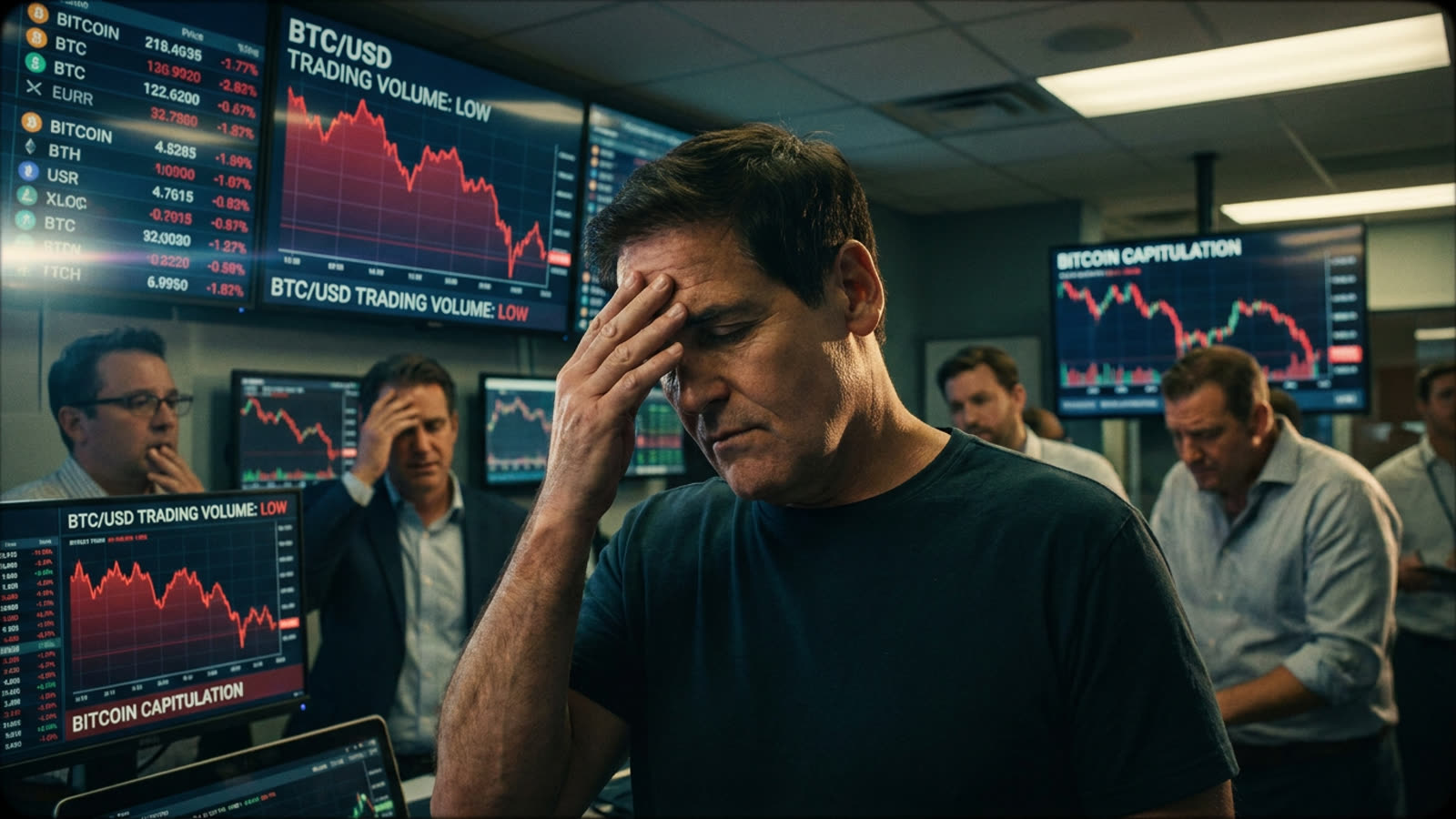
Mark Cuban, the outspoken billionaire who once championed Bitcoin as a legitimate store of value, has quietly exited most of his position. His reason is disarmingly simple: the asset failed to do what he bought it to do.
Cuban's disappointment centers on Bitcoin's correlation problem—the cryptocurrency's stubborn tendency to move in lockstep with risk assets precisely when investors need it to zig while stocks zag. The hedge narrative, which promised Bitcoin would behave like digital gold during market stress, has repeatedly collapsed under scrutiny. During the 2022 drawdown, Bitcoin fell alongside equities. During the 2024 regional banking scare, it rallied with tech stocks. And during the recent Strait of Hormuz tensions, it has traded like a leveraged Nasdaq proxy rather than a flight-to-safety asset.
The correlation trap
For institutional allocators and sophisticated individual investors like Cuban, correlation is everything. A portfolio hedge that correlates 0.8 with your existing holdings isn't a hedge—it's leverage wearing a costume. Bitcoin's rolling 90-day correlation with the S&P 500 has spent most of the past three years above 0.5, occasionally spiking above 0.7 during volatility events. Gold, by contrast, has maintained its traditional negative-to-zero correlation with equities.
Cuban's exit is notable precisely because he wasn't a crypto skeptic. He accepted Bitcoin payments for Dallas Mavericks merchandise, invested in blockchain startups, and defended the technology against regulatory overreach. His departure isn't ideological—it's actuarial. The asset simply didn't perform its assigned role in his portfolio construction.
What this signals for the class
Cuban joins a growing cohort of early institutional believers who have quietly reduced exposure. The narrative has shifted from "Bitcoin is uncorrelated" to "Bitcoin is a high-beta tech play" to, increasingly, "Bitcoin is whatever the marginal buyer needs it to be." That's not necessarily bearish for price—momentum traders and retail speculators don't require decorrelation. But it does narrow the addressable market for Bitcoin as a serious portfolio allocation.
The irony is that Bitcoin's correlation problem may be self-inflicted. As institutional adoption increased, the asset became more tethered to the same liquidity cycles, risk-on/risk-off dynamics, and macro sensitivities that govern traditional markets. The very success Bitcoin sought—mainstream acceptance—may have destroyed its most compelling use case.
Our take
Cuban's sale is a data point, not a death knell. But it crystallizes something the crypto industry has struggled to acknowledge: the hedge narrative was always more marketing than mathematics. Bitcoin may yet find its footing as a speculative growth asset, a remittance rail, or a censorship-resistant store of value for specific use cases. But the dream of slotting it into a traditional 60/40 portfolio as the new gold? That dream died somewhere between the 2022 crash and Cuban's sell order. The honest conversation about what Bitcoin actually is—rather than what its advocates wish it were—is overdue.