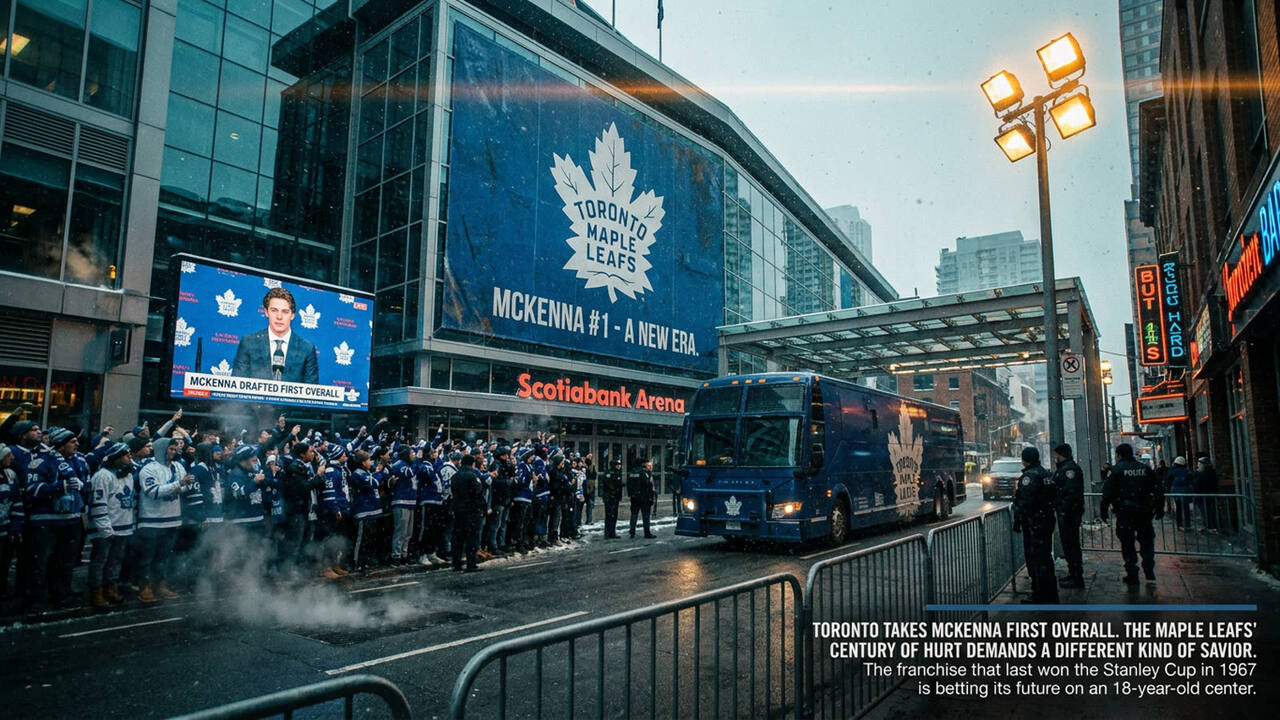
The Toronto Maple Leafs have not won the Stanley Cup since Lyndon Johnson was in the White House, the Summer of Love was still a year away, and the NHL had only six teams. Fifty-nine years of playoff heartbreak, front-office churn, and fan base therapy sessions have produced one of professional sports' most exquisitely painful droughts. On Thursday night, the franchise took the first step of its latest reinvention by selecting center Porter McKenna with the first overall pick in the 2026 NHL Entry Draft—a choice that was as predictable as it was symbolically loaded.
McKenna, who dominated the OHL this season with a rare combination of skating speed, playmaking vision, and two-way discipline, represents exactly the kind of franchise cornerstone Toronto has been chasing since Mats Sundin's prime. The Leafs' brass did not overthink this one. When you hold the top pick and a consensus generational talent is available, you take him.
The weight of the sweater
No NHL franchise carries more historical baggage than Toronto. The Leafs have the league's largest and most emotionally invested fan base, a media market that treats every playoff exit like a national tragedy, and an organizational culture that has, at various points, been described as dysfunctional, cursed, and simply snake-bitten. McKenna inherits all of this the moment he pulls on the blue and white.
The comparisons to Auston Matthews are inevitable and unfair. Matthews was supposed to be the one who ended the drought when Toronto took him first overall in 2016. He became one of the best goal scorers in the world, won a Hart Trophy, and still could not drag the Leafs past the first round in his early years. The lesson: individual brilliance alone does not cure organizational pathology.
What McKenna actually offers
Scouts describe McKenna as a more complete player than Matthews was at the same age—a center who can dominate both ends of the ice, kill penalties, and elevate linemates rather than simply outshining them. His hockey IQ has drawn comparisons to Sidney Crosby, though such talk is premature and sets expectations at an unreasonable altitude. What is clear is that McKenna plays the game with a maturity unusual for a teenager, rarely making the kind of flashy-but-risky decisions that plague young stars.
Toronto's rebuild, if this is indeed a full rebuild rather than a retool, will require more than one player. The Leafs have cap flexibility, additional draft capital, and a front office that appears willing to be patient for the first time in recent memory. McKenna is the foundation, not the finished house.
Our take
The Maple Leafs selecting McKenna first overall was the safest, smartest, and least interesting decision they could have made—which is precisely why it was the right one. Toronto's curse is not about talent acquisition; it is about organizational steadiness, playoff composure, and the ability to tune out a market that demands immediate salvation. McKenna cannot fix any of that by himself. But he can be the kind of player around whom a real contender is built, provided the franchise resists its historical urge to panic at the first sign of adversity. The 1967 drought will not end because of one draft pick. It will end, if it ever does, because Toronto finally learns to be boring.